
Views: 213 Author: Mega Services Publish Time: 2026-10-22 Origin: Site


Content Menu
● What Are AC Coils, and How Do They Work?
>> Evaporator Coil: Absorbing Indoor Heat
>> Condenser Coil: Releasing Heat Outdoors
● Why Dirty AC Coils Affect Comfort and Efficiency
● Signs Your AC Coils Need Professional Attention
>> Why a Frozen Evaporator Coil Needs Attention
>> A Refrigerant Recharge Is Not a Complete Diagnosis
● What to Do If Your AC Coil Freezes
● AC Coil Cleaning: What Homeowners Can Safely Do
>> Avoid Aggressive Cleaning Methods
>> How Often Should AC Coils Be Cleaned?
● What a Thorough AC Coil Inspection Should Include
>> Questions to Ask Before Approving Work
● AC Coil Repair or Replacement: How to Decide
>> What Determines AC Coil Replacement Cost?
● Refrigerant Compatibility: An Important Replacement Check
>> Does an R-410A System Need Immediate Replacement?
● Protect Your Home's Comfort With Informed Coil Care
● Frequently Asked Questions About AC Coils
>> 1. Can Dirty AC Coils Make My Air Conditioner Stop Cooling?
>> 2. Can I Clean an Evaporator Coil Myself?
>> 3. Does a Frozen Coil Always Mean Low Refrigerant?
>> 4. How Long Do AC Coils Last?
>> 5. Should Both AC Coils Be Replaced Together?
>> 6. Will Coil Cleaning Reduce My Energy Bill?
AC coils help your air conditioner remove heat, control humidity, and keep your home comfortable. When these components become dirty, frozen, or damaged, you may notice weak cooling, longer running times, or water around your indoor equipment. Understanding evaporator and condenser coils helps you recognize problems early and make better maintenance and repair decisions.
At Mega Services Heating & Cooling, our focus is helping families create safe, comfortable, and energy-efficient homes through heating and cooling installation, repair, and maintenance. This guide explains what AC coils do, what homeowners can safely check, and which questions to ask before approving a repair.
Most residential central air conditioners have two main coils: an indoor evaporator coil and an outdoor condenser coil.
Both are heat exchangers. Refrigerant travels through their tubing, while thin metal fins increase the surface area available for heat transfer.
Your air conditioner does not simply produce cold air. It moves heat from inside your home to the outdoors.
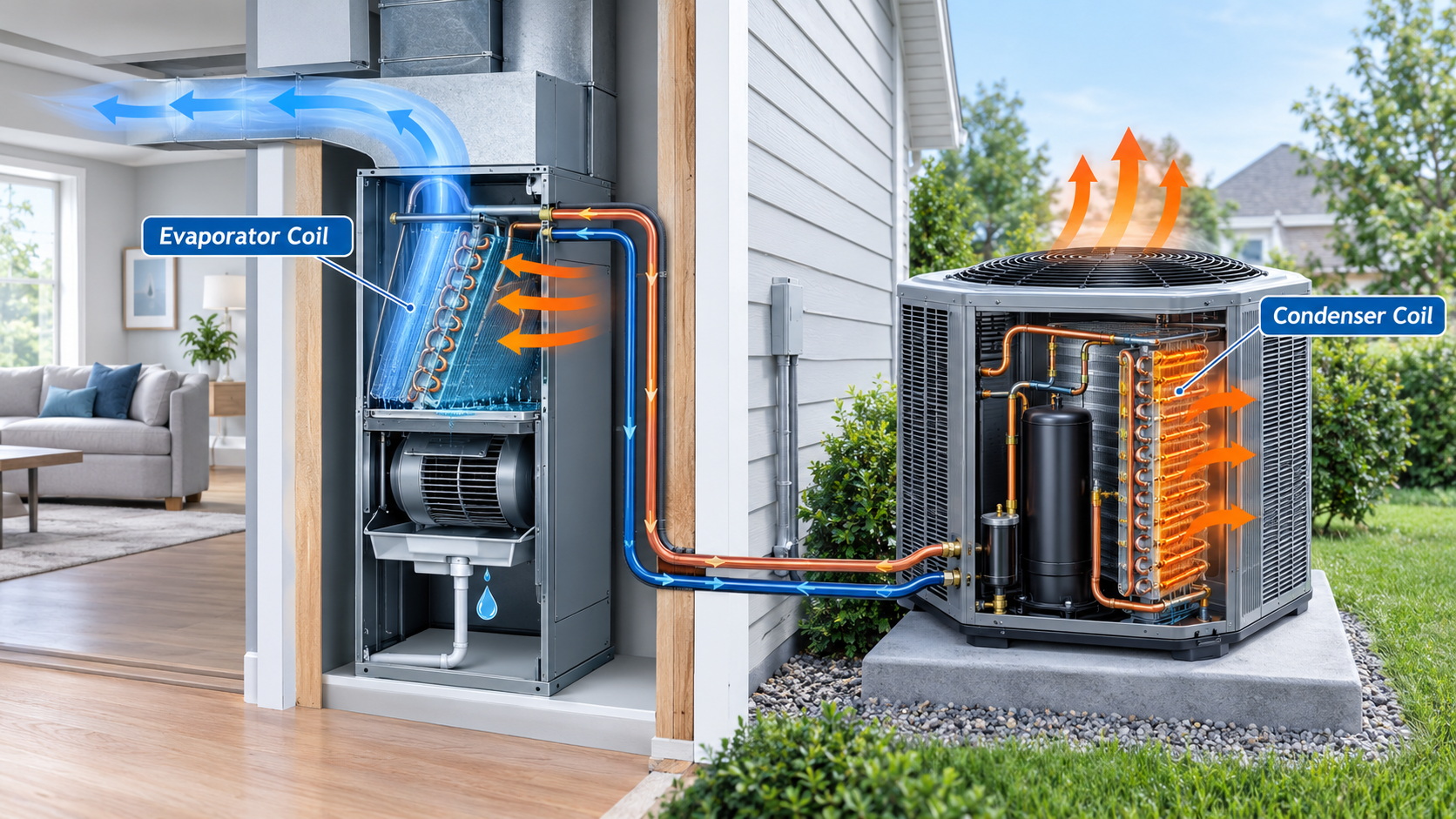
The evaporator coil usually sits inside an air handler or in a cabinet connected to your furnace.
As the blower moves warm indoor air across the coil, refrigerant inside absorbs heat and evaporates. The cooled air then travels through your ductwork.
The coil also removes moisture. When its surface is below the air's dew point, water vapor condenses into liquid, collects in a drain pan, and exits through a condensate drain.
That distinction matters: moisture leaves through the drainage system, not through the outdoor condenser.
The condenser coil sits in the outdoor unit.
After the compressor raises the refrigerant's pressure and temperature, the hot refrigerant flows through this coil. The outdoor fan moves air across it, allowing heat to escape. The refrigerant then condenses back into liquid.
Restricted outdoor airflow makes this heat-release process more difficult.
| Component | Typical Location | Main Function | Common Concerns |
|---|---|---|---|
| Evaporator coil | Indoor air handler or furnace cabinet | Absorbs indoor heat and supports dehumidification | Dirt, icing, corrosion, refrigerant leaks |
| Condenser coil | Outdoor unit | Releases heat into outdoor air | Debris, bent fins, corrosion, physical damage |
| Condensate drain | Connected to the indoor drain pan | Carries collected moisture away | Blockages, overflow, water damage |
In a heat pump, the coils exchange heating and cooling roles when the system reverses operation.
Dirt can interfere with both airflow and heat transfer.
On the indoor coil, accumulated dust can reduce airflow and insulate the heat-transfer surface. Outdoors, leaves, grass clippings, and other debris can restrict the air moving through the condenser.
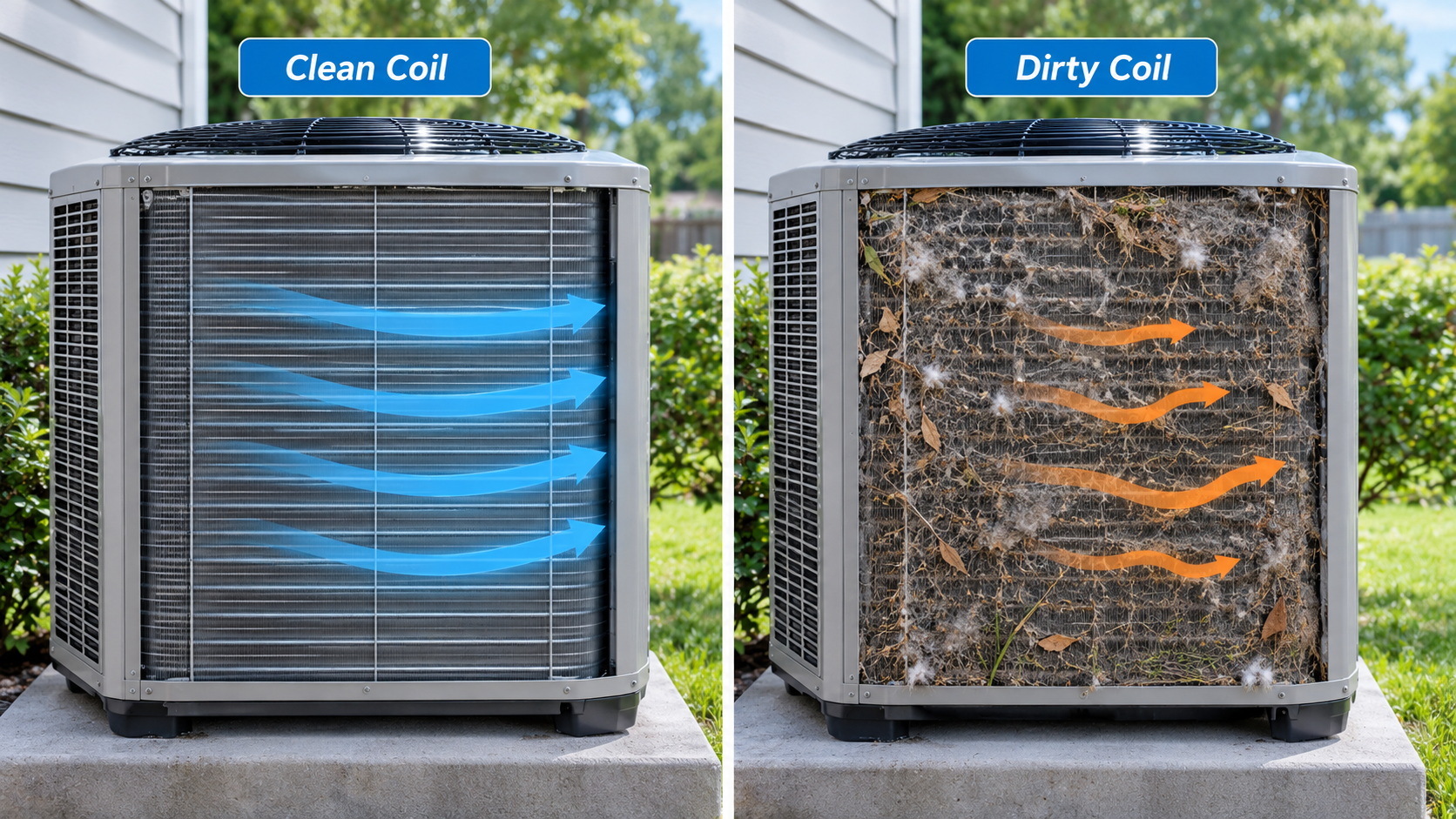
Possible consequences include:
- Longer cooling cycles.
- Difficulty reaching the thermostat setting.
- Higher electricity use.
- Reduced moisture removal.
- Additional strain on system components.
However, a higher utility bill alone does not prove that your coils need cleaning. Outdoor temperatures, thermostat changes, duct leakage, and equipment problems can produce similar results.
The useful question is not simply, "Are the coils dirty?" It is, "What is preventing this system from delivering normal cooling?"
Many coil-related symptoms overlap with other problems. Treat them as reasons to investigate, not as a diagnosis.
| Symptom | Possible Explanations | Recommended Response |
|---|---|---|
| Weak airflow | Dirty filter, restricted coil, blower issue, duct problem | Check the filter and unobstructed vents |
| Ice on indoor equipment or refrigerant tubing | Low airflow, refrigerant problem, operating fault | Stop cooling and arrange service |
| Warm air from vents | Refrigerant loss, compressor fault, airflow or control issue | Request a system diagnosis |
| Water near the indoor unit | Blocked drain, damaged pan, melting ice | Stop operation if leakage threatens property |
| Longer running times | Dirty coils, extreme weather, duct losses, other faults | Compare conditions and schedule an inspection |
Ice is not evidence that your air conditioner is cooling especially well. It indicates an abnormal operating condition.
Insufficient airflow can cause the evaporator temperature to fall too low. Refrigerant problems can also cause freezing. As ice builds, airflow becomes more restricted, making the problem worse.
Do not chip ice from the coil or apply direct heat. Thin fins and refrigerant tubing are easily damaged.
An air conditioner circulates refrigerant in a sealed circuit. Refrigerant is not a fuel that normally gets used up.
A low charge may indicate leakage or an earlier charging error. Ask what caused the shortage and how the technician intends to address it.
Repeatedly adding refrigerant without investigating the cause can leave you paying for temporary relief rather than a lasting solution.
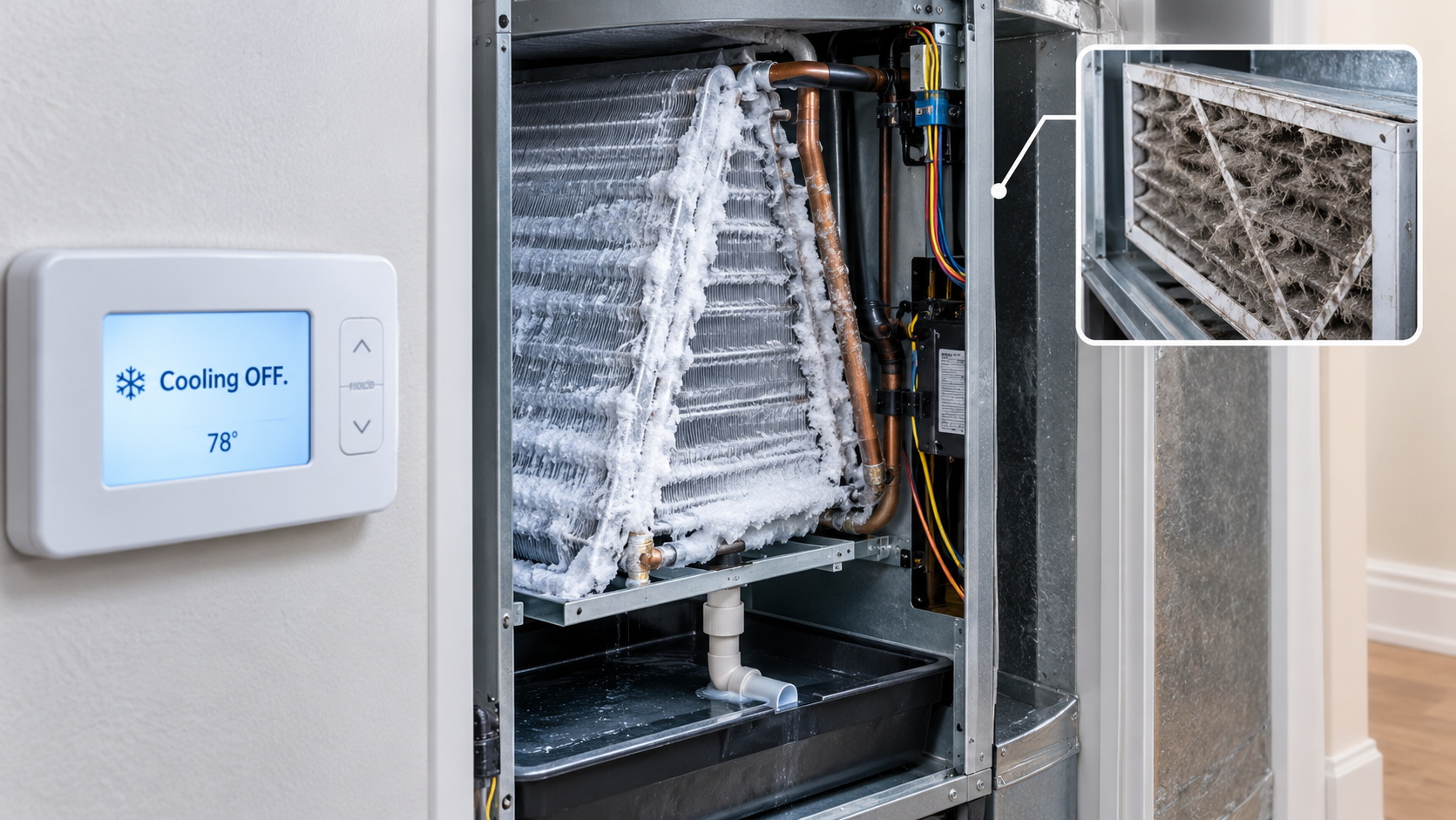
Follow these steps while arranging professional help:
1. Turn cooling off at the thermostat. Continued operation will not correct the underlying problem.
2. Check the air filter. Replace a visibly dirty disposable filter with the correct size and specified type.
3. Check supply and return openings. Move furniture or other objects blocking airflow.
4. Let the ice melt naturally. Do not scrape, bend fins, or use a hair dryer.
5. Watch for water. Thawing ice can overwhelm a damaged or restricted drainage system.
6. Arrange service before resuming normal cooling.
Fan-only operation may help thaw some systems, but follow your equipment instructions or a technician's advice. If water is approaching electrical components, do not continue operating the equipment.
Record when the icing started, whether airflow changed, and whether the problem has happened before. These details help narrow the investigation.
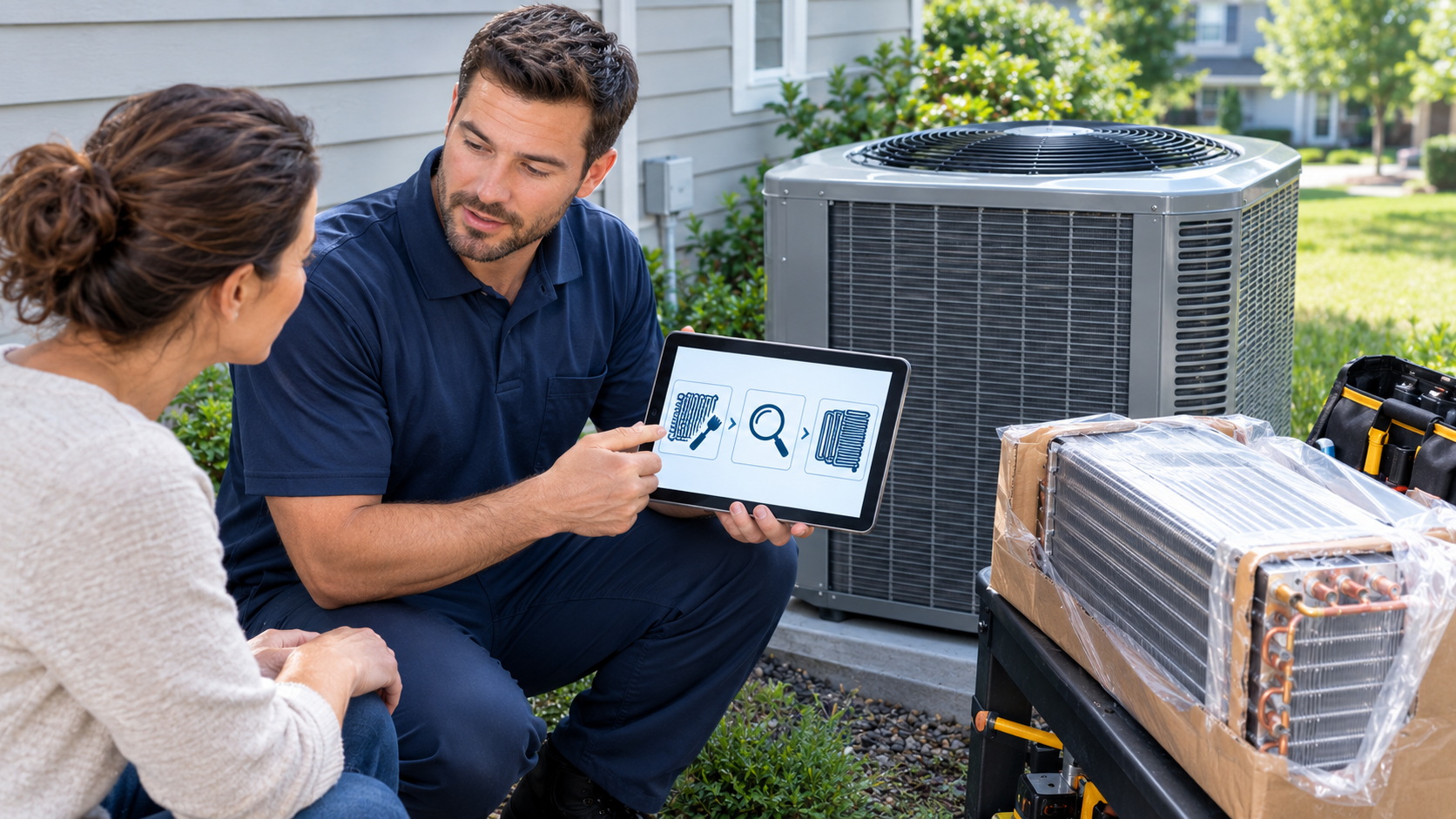
Good maintenance starts with preventing dirt buildup.
Homeowners can generally:
- Inspect and replace accessible filters according to equipment guidance.
- Keep indoor return-air grilles unobstructed.
- Remove loose leaves and vegetation around the outdoor unit.
- Keep grass clippings directed away from the condenser.
- Observe visible icing, drainage problems, or unusual operating patterns.
Maintain the outdoor clearance specified by the manufacturer. Avoid storing furniture, tools, or garden supplies against the unit.
Do not assume every coil tolerates the same cleaner or cleaning technique.
Pressure washers can bend fins. Strong chemicals may damage metals or protective coatings. Spraying electrical components introduces additional hazards.
Before any permitted outdoor maintenance, follow the manufacturer's instructions for disconnecting power. Do not remove electrical covers or reach inside the equipment.
Indoor evaporator coil cleaning is usually best left to a professional because access may involve delicate components, wiring, insulation, and the refrigerant circuit.
Arrange an annual cooling-system inspection, ideally before heavy seasonal use.
Inspection does not mean every coil requires chemical cleaning every year. Cleaning frequency depends on actual condition, airflow, filtration, operating hours, and environmental exposure.
Homes near construction, heavy landscaping activity, or dusty surroundings may need closer attention.
The practical approach is to inspect regularly and clean when needed, using a method approved for the equipment.
A useful service visit should evaluate the system around the coil, not just the coil surface.
Depending on the symptoms, a technician may check:
- Filter condition and suitability.
- Indoor and outdoor coil cleanliness.
- Blower and outdoor fan operation.
- Airflow restrictions.
- Condensate drainage and pan condition.
- Refrigerant operating conditions.
- Evidence of corrosion, physical damage, or leakage.
For suspected refrigerant leaks, ask how the leak will be located and confirmed.
For airflow problems, ask whether the filter, blower, ducts, and coil have all been considered.
Request a clear explanation:
1. What specific fault did you find?
2. What observations or measurements support that diagnosis?
3. Will cleaning address the cause or only one symptom?
4. Is the replacement part approved for my equipment?
5. What testing will confirm successful operation afterward?
A clear diagnosis makes competing proposals easier to compare and reduces the risk of replacing a coil unnecessarily.
There is no universal age or price threshold that makes replacement automatically correct.
Consider the equipment's overall condition, warranty coverage, repair history, part availability, and the scope of the proposed work.
| Option | When It May Make Sense | Important Limitation |
|---|---|---|
| Coil cleaning | Dirt is restricting performance and the coil remains sound | Cleaning cannot repair a refrigerant leak |
| Targeted repair | A confirmed defect is accessible and repairable | Corrosion may make repairs less durable |
| Coil replacement | A compatible replacement is available and the remaining system is serviceable | Matching and installation quality matter |
| Matched equipment replacement | Major faults coexist or repairs offer poor long-term value | Higher upfront cost requires careful comparison |
A coil-only price does not represent the full installed cost.
A written estimate should identify:
- Replacement coil model and compatibility.
- Labor and equipment access.
- Refrigerant recovery and charging.
- Required metering-device or cabinet changes.
- Leak testing and evacuation.
- Startup verification.
- Parts and labor warranty terms.
A parts warranty may not cover labor, refrigerant, or related modifications. Confirm coverage before comparing totals.
Avoid choosing solely by the lowest quoted price. An incomplete scope can make an apparently inexpensive repair difficult to compare with a properly specified proposal.
A replacement coil must be approved for the equipment combination and refrigerant. Physical fit alone is not enough.
Capacity, metering requirements, airflow, pressure ratings, and manufacturer instructions all matter.
No. A functioning R-410A system does not automatically require replacement because newer equipment uses different refrigerants. Existing systems can continue to be serviced, subject to applicable requirements and compatible component availability.
However, R-32 and R-454B are not drop-in substitutes for R-410A. Equipment must be designed and approved for its specified refrigerant.
Before approving a major replacement, request the proposed model numbers and refrigerant type. Ask the contractor to explain compatibility rather than relying on statements such as "the coil fits."
AC coils work as part of a larger system. Clean surfaces, correct airflow, proper refrigerant charge, and reliable drainage all contribute to dependable cooling.
When something changes, start with observable symptoms rather than assumptions. A frozen coil needs diagnosis. A leaking coil needs more than cleaning. A replacement coil needs verified compatibility.
Contact Mega Services Heating & Cooling to schedule an AC inspection, discuss coil cleaning or repair, or review replacement options. Share your equipment model, symptoms, and repair history so the conversation starts with the information that matters.
Yes. Severe dirt buildup can restrict airflow or heat transfer enough to impair cooling. However, electrical faults, refrigerant problems, and compressor issues can cause similar symptoms. An inspection should establish the actual cause.
Homeowner maintenance is best limited to accessible tasks permitted by the manufacturer. Indoor coil access and cleaning often require professional attention. Avoid improvised chemicals, aggressive brushing, or opening equipment compartments without appropriate training.
No. A dirty filter, restricted airflow, or blower problem can also cause freezing. Stop cooling and have the cause checked rather than assuming the system only needs refrigerant.
There is no guaranteed lifespan. Installation quality, maintenance, corrosion, environmental exposure, and operating conditions affect durability. Evaluate the coil's condition and the remaining system rather than using age alone.
Not necessarily. A compatible individual coil may be suitable when the remaining equipment is in good condition. In other situations, replacing matched equipment may offer better value. Ask for the technical and financial reasoning behind each option.
It may help when dirt is impairing performance. The improvement depends on the starting condition and other system issues. Cleaning cannot guarantee a specific savings percentage or correct unrelated duct, airflow, or mechanical problems.
1.Original article reviewed for topic coverage and reconstruction. Used as background for coil functions, maintenance concerns, warning signs, and common homeowner questions. Its pricing and lifespan estimates are not presented here as universal benchmarks.
2.Supports annual preseason professional checkups, evaporator and condenser coil cleaning, refrigerant-charge checks, blower maintenance, and condensate-drain inspection.
3.Provides homeowner cooling-maintenance guidance, including checking the evaporator coil annually and cleaning it as necessary.
4.Supports the explanation of evaporator-coil function, equipment compatibility, and the need for professional coil replacement. Specific replacement selections should follow manufacturer-approved combinations and installation requirements.
5.Supports the relationships among coil cleanliness, airflow, refrigerant charge, condensate drainage, equipment reliability, and energy use.
6.Supports the distinction between changes affecting newer equipment and the continued operation, maintenance, and repair of existing R-410A systems.
7.Supplementary technical context on refrigerant compatibility and why R-32 and R-454B should not be treated as drop-in replacements for existing R-410A equipment.


