
Views: 222 Author: Mega Services Publish Time: 2026-07-06 Origin: Site


Content Menu
● Understanding the "400 CFM Per Ton" Rule
● Case Study: A 2.5‑Ton System at Different Airflows
● Climate, Humidity, and the Right Airflow
● Why Rules of Thumb Are Not Enough
● How Pros Really Set Correct Airflow
● Practical Homeowner Checklist: Signs Your Airflow Might Be Wrong
● How Mega Services Heating & Cooling Optimizes Airflow
● When 400 CFM Per Ton Still Makes Sense
● Call to Action: Get Your Airflow Checked the Right Way
● Frequently Asked Questions (FAQ)
>> Q1. Is 400 CFM per ton of cooling always correct for my home?
>> Q2. What happens if my HVAC airflow is too low?
>> Q3. When would higher airflow, like 450 CFM per ton, be a good idea?
>> Q4. How can I tell if my system's airflow was set using a rule of thumb instead of proper design?
>> Q5. What should I ask my HVAC contractor about airflow during a new installation or major repair?
For decades, many HVAC pros have repeated the rule of thumb: 1 ton of cooling ≈ 400 CFM of airflow. [lorisweb]
This guideline grew out of typical comfort-cooling assumptions—moderate indoor temperatures, average humidity, and standard residential duct systems. [mepacademy]
But real homes rarely match "average" conditions. Factors like relative humidity, indoor dry-bulb and wet-bulb temperatures, air density, mass flow rate, and elevation all change how much airflow a system actually needs to deliver safe, comfortable, and energy-efficient performance. [hvac-blog.acca]
If airflow is wrong, capacity shifts between sensible cooling (temperature change) and latent cooling (moisture removal), and the result can be hot rooms, sticky air, noisy ducts, or even frozen coils. [housecallpro]
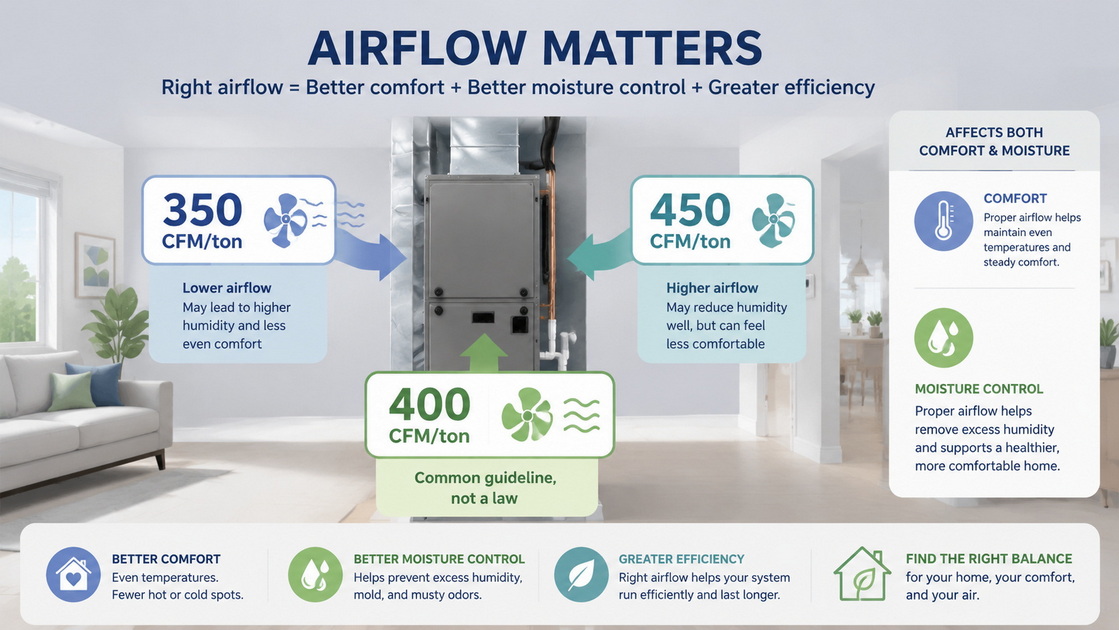
When your system's airflow is correct, several things happen at once:
- The air conditioner delivers close to its rated BTU capacity, so you get what you paid for. [fsec.ucf]
- Temperature and humidity stay in a comfortable range, typically around 75°F and 40–60% relative humidity for most homes. [linkedin]
- The equipment operates within the manufacturer's design envelope, which supports efficiency, reliability, and longer service life. [hvac-blog.acca]
When airflow is too low, the coil can run too cold, efficiency drops, and the system may pull moisture aggressively but struggle with temperature—sometimes even icing up. [linkedin]
When airflow is too high, the opposite happens: temperature may look fine on the thermostat, but the system removes less moisture, and comfort suffers in humid climates. [linkedin]
For a residential customer, this is why "close enough" airflow is not good enough. Correct airflow is foundational to comfort, indoor air quality, and energy bills.
The ACCA article uses a 2.5‑ton air conditioner to show how changing airflow changes performance, even when the equipment, indoor temperature, and outdoor conditions stay the same. [fsec.ucf]
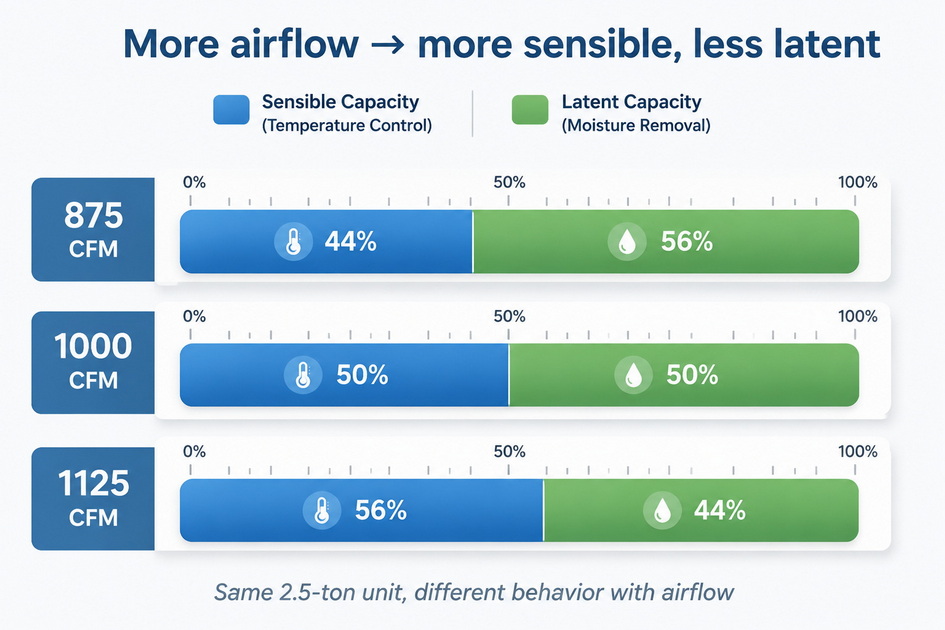
With indoor dry-bulb at 75°F and entering indoor wet-bulb at 63°F, three airflow settings were evaluated: [fsec.ucf]
- 875 CFM (≈350 CFM/ton)
- 1,000 CFM (≈400 CFM/ton)
- 1,125 CFM (≈450 CFM/ton)
Here is a simplified view of the performance data presented in the original article: [fsec.ucf]
| Airflow setting | Approx. CFM/ton | Total capacity (BTU/h) | Sensible ratio (S/T) | Sensible capacity (BTU/h) | Latent capacity (BTU/h) |
|---|---|---|---|---|---|
| 875 CFM | ~350 | 29,500 | 52% | 15,340 | 14,160 |
| 1,000 CFM | ~400 | 29,800 | 58% | 17,284 | 12,516 |
| 1,125 CFM | ~450 | 30,300 | 61% | 18,483 | 11,817 |
[fsec.ucf]
Several key insights emerge:
- At lower airflow (~350 CFM/ton), the system delivers similar total capacity but significantly more latent capacity—better at pulling moisture from the air. [fsec.ucf]
- Around 400 CFM/ton, the total capacity rises slightly and sensible capacity increases, shifting the balance toward temperature control. [fsec.ucf]
- At higher airflow (~450 CFM/ton), total capacity increases again and sensible capacity dominates; this can be ideal in warmer but drier climates where humidity is less of a concern. [linkedin]
For a homeowner, these numbers translate directly into how the house *feels*:
- Humid climate, sticky indoors → lower CFM per ton may be more comfortable. [hvac-blog.acca]
- Dry climate, "never quite cool enough" → higher CFM per ton can improve temperature performance. [linkedin]
The "right" airflow per ton is heavily influenced by climate zone and latent load. [energyvanguard]
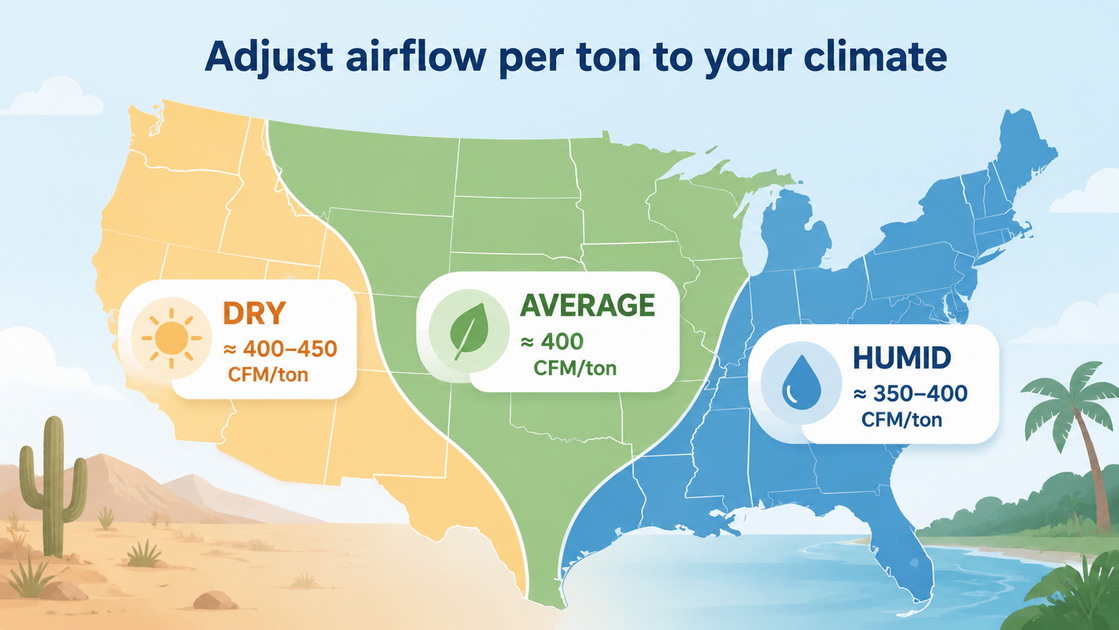
- In hot, humid climates, lower airflow such as 350 CFM per ton helps the system spend more capacity on moisture removal, improving indoor comfort. [linkedin]
- In warmer, drier climates, airflow closer to 450 CFM per ton supports greater sensible capacity and more effective temperature control. [linkedin]
- In "average" conditions and a typical house with a sensible heat ratio in the 0.80–0.85 range, airflow around 400 CFM per ton often strikes a practical balance. [hvac-blog.acca]
Industry experts emphasize that these values should be treated as guided starting points, not fixed laws. Manual S® and OEM performance tables provide detailed expanded data that shows how airflow affects total, sensible, and latent capacity under actual design conditions. [hvac-blog.acca]
From our perspective at Mega Services Heating & Cooling, this is why we do not simply "dial in 400 CFM per ton" and walk away. Instead, we look at:
- Your home's location and climate
- Indoor humidity patterns over the year
- Building tightness and infiltration (how "leaky" the house is)
- Occupant comfort feedback and problem rooms
Then we set airflow to match real-world needs, not just textbook numbers.
Contractors have used quick rules like "400 CFM per ton" or "1 CFM per square foot" for decades because they are fast and easy. [scribd]
However, these shortcuts can backfire when:
- The house has unusual latent loads (lots of indoor moisture sources or infiltration). [energyvanguard]
- The duct system was never properly sized or has multiple restrictions. [housecallpro]
- The equipment's actual performance at your design conditions does not match the assumed rule of thumb. [hvac-blog.acca]
The ACCA guidance is clear: ditch rules of thumb and employ science. [fsec.ucf]
That means measuring, testing, and using manufacturer data instead of guessing. For homeowners, this translates into fewer callbacks, fewer frustrations, and systems that deliver what the nameplate promises. [housecallpro]
Modern best practice for airflow is more like a checklist than a single number. Leading experts recommend these steps: [energyvanguard]
1. Start with load calculations.
Use Manual J® to determine sensible and latent loads, then apply Manual S® to select equipment that fits those loads. [energyvanguard]
2. Use OEM performance tables.
Look up the specific unit's expanded performance data at the expected indoor dry-bulb, wet-bulb, and outdoor conditions. [hvac-blog.acca]
3. Find the airflow that meets both sensible and latent requirements.
Choose the airflow column where total capacity meets or slightly exceeds the design load, while the sensible ratio remains appropriate for the space. [energyvanguard]
4. Verify duct and blower settings.
Adjust tap settings, ECM profiles, and duct sizing to deliver the target CFM at the installed static pressure. [housecallpro]
5. Test and benchmark in the field.
Use airflow measurement tools and psychrometric readings to confirm that the installed system behaves like the table data. Benchmark results for future maintenance. [housecallpro]
At Mega Services Heating & Cooling, this is the process we follow when setting up and tuning systems in our customers' homes. Instead of "set it and forget it," we measure, adjust, and validate performance under real operating conditions.
If you are not an HVAC engineer, airflow can sound abstract—yet its symptoms are very familiar. Based on field experience and industry guidance, here are practical signs that airflow per ton may be off in your home: [linkedin]
- Rooms feel clammy or sticky even when the thermostat says the temperature is fine.
- Large temperature differences between rooms or between floors.
- Frequent short cycling or system running constantly on extreme days.
- Unusual noise at vents (whistling, roaring, or "whooshing" sounds).
- Dust buildup or poor filtration performance despite regular filter changes.
- Frozen indoor coil or water leaking around the air handler.
If you recognize one or more of these issues, airflow—along with duct design, system sizing, or refrigerant charge—may be part of the root cause. A proper diagnostic visit focuses on measurements instead of assumptions.
From a contractor's vantage point, every home tells a different story. At Mega Services Heating & Cooling, we approach airflow per ton as a custom design variable, not a fixed number. Building on the principles outlined by ACCA and other industry experts, our typical process looks like this: [hvac-blog.acca]

- Detailed comfort interview. We listen to where you feel hot, cold, or sticky, and when the issues show up during the year.
- Load and duct review. We examine existing equipment, duct layout, and key measurements such as static pressure and filter configuration.
- Performance data alignment. We cross-reference your system with OEM tables to find the airflow range that fits your climate and design conditions. [fsec.ucf]
- Fine-tuning airflow. We adjust blower settings and, when necessary, recommend duct modifications to hit the target CFM per ton safely. [housecallpro]
- Benchmarking and follow-up. We document baseline performance using psychrometric readings and revisit comfort feedback as seasons change. [fsec.ucf]
This blend of science, experience, and customer feedback allows us to move beyond generic rules and deliver genuinely better comfort.
Despite its limitations, the 400 CFM per ton guideline remains a useful reference point when used correctly. [lorisweb]
400 CFM per ton tends to be reasonable when:
- The home's sensible heat ratio is in the typical comfort-cooling range. [energyvanguard]
- Humidity is present but not extreme, and ventilation loads are moderate. [linkedin]
- Ductwork is reasonably well sized, and static pressure is within equipment tolerances. [housecallpro]
In such conditions, 400 CFM per ton is often used as the "middle column" in OEM tables to ballpark airflow before fine-tuning up or down for specific climate or comfort requirements. [hvac-blog.acca]
Used this way, 400 CFM per ton becomes a starting point, not the final answer.
If your home feels uncomfortable—too humid, too dry, unevenly cooled, or just "never quite right"—your system may not be operating at the airflow it truly needs. Instead of relying on generic rules, Mega Services Heating & Cooling uses manufacturer data, industry standards, and detailed measurements to set airflow precisely for your home and climate. [hvac-blog.acca]
Contact Mega Services Heating & Cooling today to schedule a performance-focused HVAC evaluation. We will test, diagnose, and fine-tune your system so it delivers safe, comfortable, and energy-efficient operation—without guessing at 400 CFM per ton.
No. 400 CFM per ton is a guideline, not a universal law. The right airflow depends on your climate, moisture loads, duct design, and your equipment's performance tables. [linkedin]
If airflow is too low, the coil can get too cold, efficiency drops, humidity control may become aggressive but uneven, and you may even see frozen coils or water leaks. [linkedin]
Higher airflow is often beneficial in warmer, drier climates where latent loads are low and enhanced sensible capacity improves temperature control and comfort. [energyvanguard]
If your contractor cannot show you equipment performance tables, calculated loads, or measured airflow data—and relies only on "that's how we always do it"—your system may have been set by rule of thumb. [hvac-blog.acca]
Ask how they determined the target CFM per ton, whether they used Manual J® and Manual S®, and how they verified airflow against OEM expanded performance data and field measurements. [energyvanguard]
- ACCA HVAC Blog – "400 CFM Per Ton, Or Is It?" (Matt Akins), Air Conditioning Contractors of America. [https://hvac-blog.acca.org/400-cfm-per-ton-or-is-it/] [fsec.ucf]
- Hey Ed – "What Is the Correct Airflow for an AC?" ACCA HVAC Blog. [https://hvac-blog.acca.org/hey-ed-what-is-the-correct-airflow-for-an-ac/] [hvac-blog.acca]
- Sandi Garrido – "The 400 CFM Myth: A Guideline, Not a Law." LinkedIn article. [https://www.linkedin.com/posts/sandigarrido_does-400-cfm-always-equal-1-ton-of-cooling-activity-7379582543219810306-B5pO] [linkedin]
- Jim Bergmann et al. – Discussion of 300–450 CFM per ton for different climate zones and comfort ranges. LinkedIn post. [https://www.linkedin.com/posts/jim-bergmann-2968178_is-it-300-400-or-450-cfm-per-ton-of-cooling-activity-7217589810155118592-fFb] [linkedin]
- Housecall Pro – "How to Calculate CFM for HVAC: CFM Formula + Calculator." [https://www.housecallpro.com/resources/how-to-calculate-cfm-for-hvac/] [housecallpro]
- MEP Academy – "How Many CFM Per Ton." [https://mepacademy.com/how-many-cfm-per-ton/] [mepacademy]
- Energy Vanguard – "What's the Correct Air Flow for an Air Conditioner?" [https://www.energyvanguard.com/blog/whats-the-correct-air-flow-for-an-air-conditioner/] [energyvanguard]


