
Views: 213 Author: Mega Services Publish Time: 2026-11-13 Origin: Site


Content Menu
● What Is a Central Air Conditioning System?
● Central Air Conditioner Components and Their Roles
>> Indoor and Outdoor Air Usually Stay Separate
● How Central Air Conditioning Works: The Cooling Cycle
>> 1. The Thermostat Requests Cooling
>> 2. Return Ducts Bring Indoor Air Back
>> 3. The Evaporator Coil Absorbs Heat
>> 4. The Compressor Raises Refrigerant Pressure
>> 5. The Condenser Releases Heat Outdoors
>> 6. The Expansion Device Prepares Another Cycle
● Why Your Home Can Feel Cool but Still Humid
>> Bigger Equipment Is Not Always Better
>> A Practical Humidity Example
● Why Ductwork Can Matter as Much as the Air Conditioner
>> Signs Your Ducts Need Attention
● What Makes a Central Air Conditioner Energy Efficient?
>> Look Beyond the Advertised Rating
● Central Air Conditioner Maintenance: What Homeowners Can Do
>> Keep Registers and Outdoor Airflow Clear
>> Arrange Professional Maintenance
● Common Central AC Problems and Safe First Steps
● What a Quality Central AC Installation Should Include
● Conclusion: Turn Better Understanding Into Better Comfort
>> 1. Does Central Air Conditioning Bring Fresh Air Indoors?
>> 2. Does Central Air Conditioning Also Heat the House?
>> 3. Why Does My Air Conditioner Run Longer on Hot Days?
>> 4. Will a Larger Central AC Cool My Home Better?
>> 5. Can Central Air Conditioning Improve Indoor Air Quality?
>> 6. Why Is One Room Warmer Than the Rest?
How does central air conditioning work? Your system removes heat and moisture from indoor air, releases that heat outdoors, and circulates cooled air through ducts. Understanding this process helps you recognize problems, make better maintenance decisions, and choose equipment that fits your home.
At Mega Services Heating & Cooling, our focus is helping families create safe, comfortable, energy-efficient living environments through heating and air conditioning installation, repair, and maintenance.
This guide explains the cooling cycle, the components behind it, and the practical details that matter when your home feels too warm, too humid, or unevenly cooled.
A central air conditioning system cools multiple rooms through a shared network of supply and return ducts.
Most residential split systems have an outdoor unit and an indoor evaporator coil. The indoor coil works with an air handler or a furnace blower to move air throughout the house.
Packaged systems place the main cooling components in one outdoor cabinet, but the basic heat-transfer process remains similar.
The essential principle is heat transfer: an air conditioner moves heat rather than creating cold. Refrigerant carries absorbed indoor heat outside, while the blower distributes cooled air indoors.
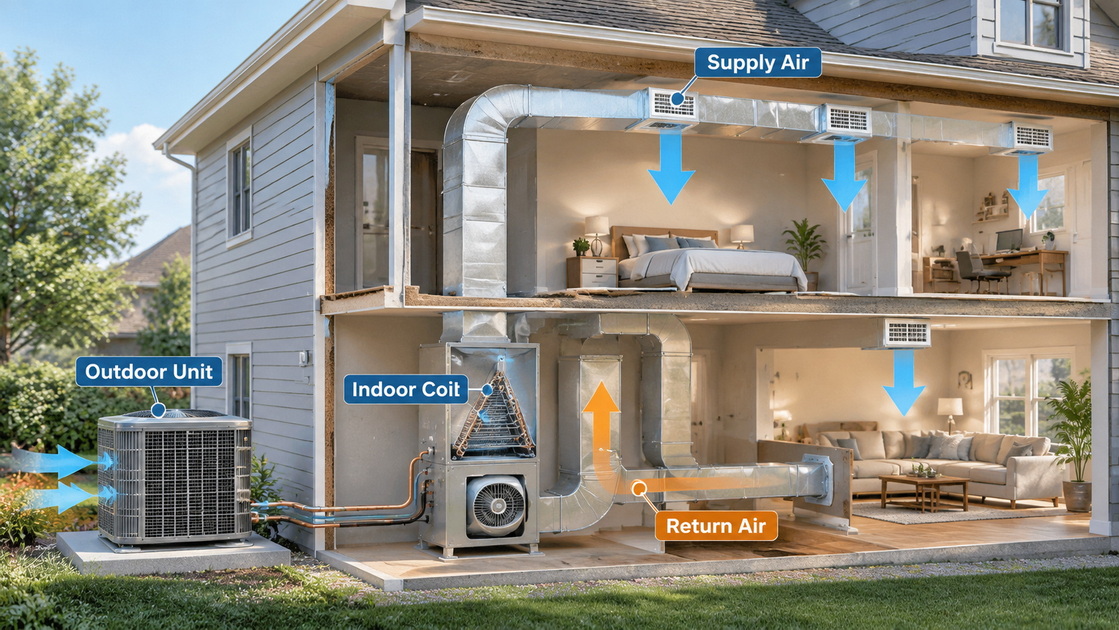
Understanding the main components makes service recommendations easier to follow.
| Component | Main function | Why it matters |
|---|---|---|
| Thermostat | Signals when cooling is needed | Controls operation around your temperature setting |
| Evaporator coil | Absorbs indoor heat | Cools air and removes moisture |
| Compressor | Raises refrigerant pressure and temperature | Drives refrigerant circulation |
| Condenser coil | Releases heat outdoors | Allows refrigerant vapor to condense |
| Outdoor fan | Moves air across the condenser | Supports outdoor heat rejection |
| Expansion device | Meters refrigerant and lowers its pressure | Prepares refrigerant to absorb indoor heat |
| Blower and ducts | Circulate household air | Deliver cooling to individual rooms |
| Condensate drain | Carries away collected water | Helps prevent water damage |
The outdoor unit does not normally send outdoor air into your rooms. Its fan moves outdoor air across the condenser coil.
Meanwhile, your indoor blower recirculates household air through the indoor coil and ductwork. Fresh-air ventilation, when provided, uses a separate or integrated ventilation arrangement.
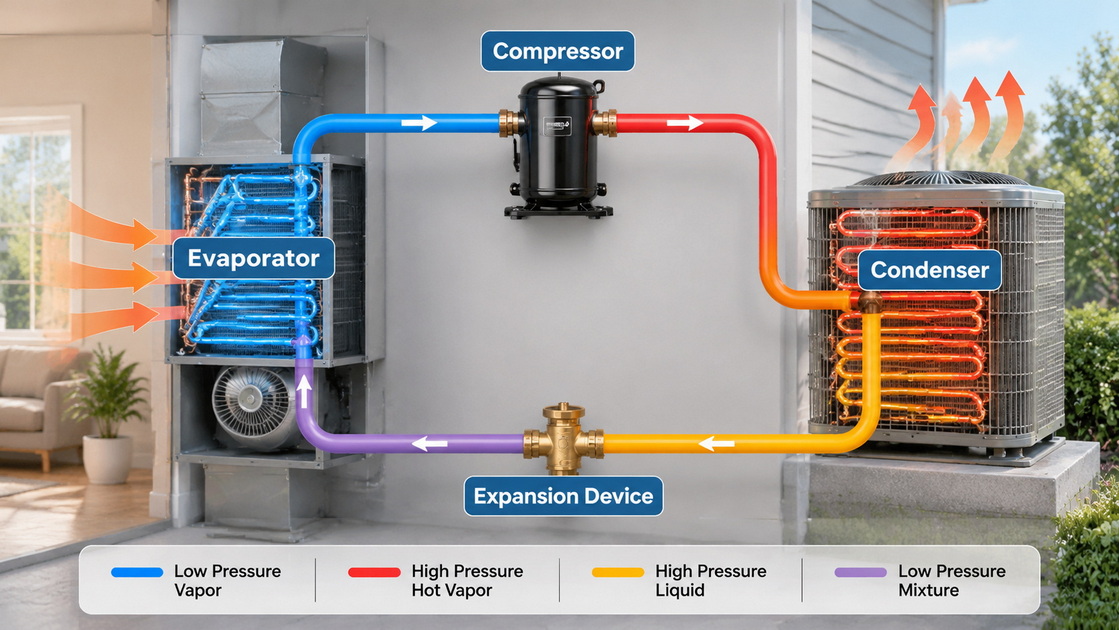
The process repeats whenever the thermostat calls for cooling.
When indoor temperature rises above the selected setting, the controls activate the cooling equipment.
Depending on the system, operation may use a single stage, multiple stages, or variable output.
The blower draws warm household air through return grilles and return ducts. A filter captures particles before air reaches sensitive equipment, depending on the system's configuration.
Return ducts bring air back; supply ducts deliver conditioned air to rooms.
Air passes across the cold evaporator coil. Refrigerant inside the coil absorbs heat and evaporates.
Moisture also condenses on the coil when its surface temperature is below the air's dew point. That water collects in a drain pan and leaves through the condensate drain.
Refrigerant vapor travels to the compressor. Compression raises its pressure and temperature, allowing it to release heat to outdoor air—even when the weather outside is hot.
Hot refrigerant passes through the outdoor condenser coil. The outdoor fan moves air across the coil, carrying away heat.
As refrigerant releases heat, it condenses into a liquid.
The expansion device meters refrigerant entering the evaporator and reduces its pressure. This creates the conditions needed for refrigerant to absorb indoor heat again.
The blower continues distributing cooled air as the cycle repeats.
Temperature alone does not determine comfort. A room can reach the thermostat setting and still feel clammy.
Air conditioners handle two cooling loads:
- Sensible load: heat removal that lowers air temperature.
- Latent load: moisture removal through condensation.
A system that satisfies temperature demand too quickly may not operate long enough to remove adequate moisture.
An oversized air conditioner can cool quickly and shut off frequently. This short cycling may reduce humidity removal and produce temperature swings.
Before replacing equipment, request a Manual J load calculation. It evaluates factors such as insulation, windows, orientation, local design conditions, and air leakage.
Equipment selection should then account for both temperature and moisture loads, rather than relying only on square footage or the existing unit's size.
Consider a home that reaches its temperature setting quickly but remains uncomfortable. This is an illustrative scenario, not a reported customer case.
Lowering the thermostat may make rooms colder without addressing the underlying issue. A professional assessment should examine equipment sizing, airflow, controls, outdoor moisture entry, and whether supplemental dehumidification is appropriate.
An efficient outdoor unit cannot compensate for a poorly performing air-distribution system.
Federal homeowner guidance estimates that approximately 20%–30% of air moving through a typical home's duct system can be lost through leaks, holes, and poorly connected ducts. That figure describes air loss—not a guaranteed percentage reduction in your utility bill.
Supply leaks can send cooled air into an attic or crawlspace. Return leaks can draw unwanted air into the system.
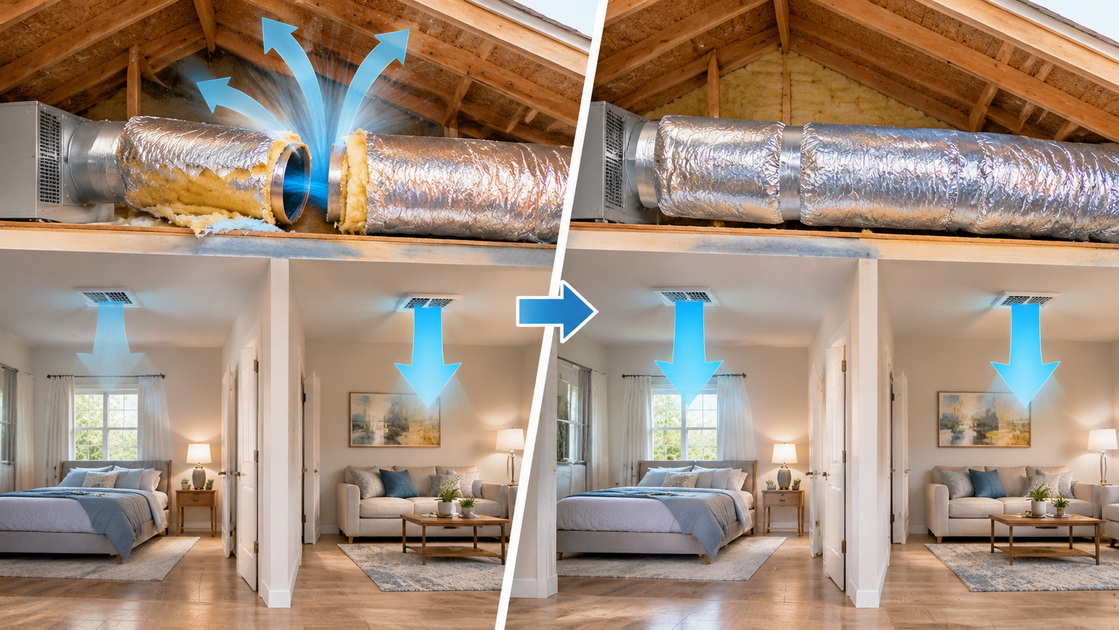
Watch for:
- Rooms that remain warmer than others.
- Weak airflow from particular registers.
- Noisy airflow or whistling grilles.
- Visible disconnected or damaged ducts.
- Persistent comfort problems after equipment repairs.
Missing duct insulation can also allow cooled air to gain heat while traveling through hot spaces.
Ask for airflow and duct evaluations before assuming that a larger air conditioner will solve uneven cooling.
Efficiency depends on the entire installation, not just the equipment label.
Seasonal ratings help compare equipment under standardized conditions. Actual electricity use also depends on weather, thermostat settings, insulation, duct performance, installation quality, and maintenance.
Central air conditioning is not automatically more economical than cooling a single occupied room with a smaller unit. The useful comparison is whether the system efficiently meets your household's actual cooling needs.
When comparing proposals, ask:
1. What load calculation supports the recommended capacity?
2. Are the indoor and outdoor components a matched combination?
3. Can the existing ducts deliver the required airflow?
4. How will refrigerant charge and airflow be verified?
5. What maintenance does the manufacturer require?
Variable-capacity equipment may improve comfort by adjusting output to changing demand. However, appropriate sizing, compatible controls, and correct setup remain essential.
A practical maintenance routine protects airflow and helps identify problems early.
Inspect the filter monthly during heavy use, then clean or replace it according to its condition and manufacturer instructions.
Replacement frequency varies with filter type, pets, dust, and operating hours.
Use the specified size and an appropriate filtration level. A more restrictive filter is not automatically better if the system cannot accommodate its airflow resistance.
Avoid blocking supply registers or return grilles with furniture, rugs, or curtains.
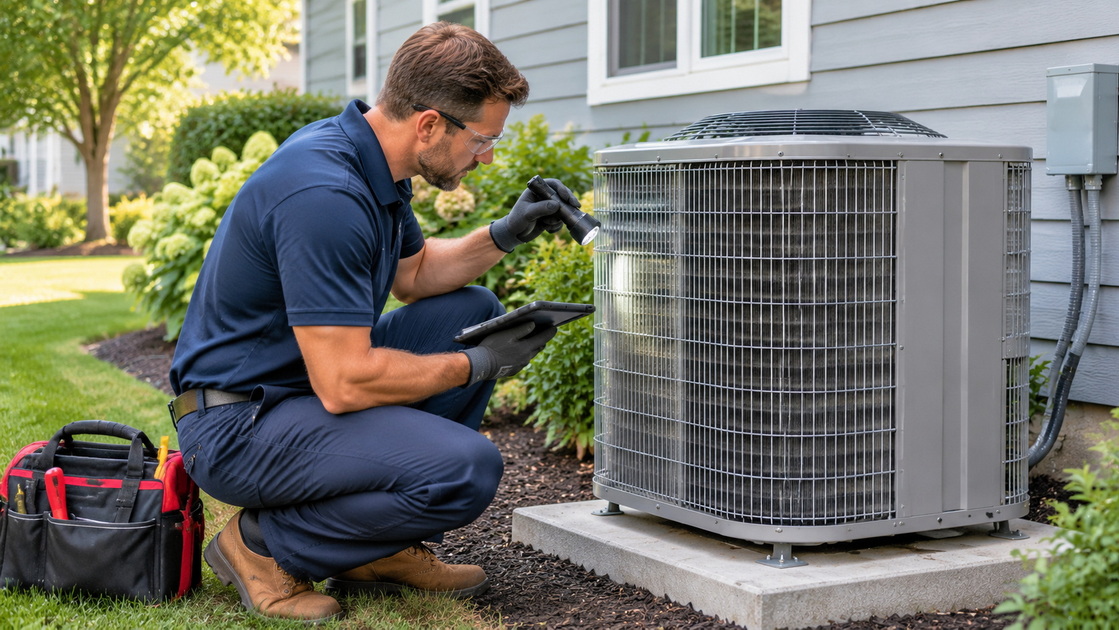
Outside, keep loose leaves and vegetation from obstructing the unit. Follow manufacturer clearance requirements rather than applying one universal spacing rule.
Do not open electrical panels, reach through fan guards, or use aggressive cleaning methods that could damage coil fins.
A professional inspection should address more than surface cleaning. Relevant checks include:
- Coil condition and blower operation.
- Condensate drainage.
- Electrical connections and controls.
- Airflow and duct restrictions.
- Refrigerant performance using appropriate diagnostic procedures.
The system does not normally consume refrigerant. If the charge is low, the cause should be investigated rather than treating repeated refills as routine maintenance.
Symptoms help describe a problem, but they do not prove which component has failed.
| Symptom | Possible causes | Safe homeowner response |
|---|---|---|
| Warm air from vents | Incorrect settings, airflow problems, equipment faults | Check cooling mode, filter, and open registers |
| Weak airflow | Dirty filter, duct restriction, blower issue | Inspect the accessible filter and remove grille obstructions |
| Ice on refrigerant lines | Restricted airflow or refrigerant problems | Stop cooling and arrange service |
| Water near the indoor unit | Drain blockage, drainage defect, thawing ice | Stop operation if leakage threatens damage |
| Frequent starts and stops | Sizing, control, airflow, or equipment problems | Record the pattern for your technician |
| Breaker trips repeatedly | Electrical or equipment fault | Stop resetting it and request professional diagnosis |
A burning smell, smoke, sparking, or water contacting electrical equipment requires prompt attention. Stop using the system when safe; contact emergency services if there is an active fire or immediate danger.
Never chip ice from a coil or attempt refrigerant repairs yourself.
Installation determines whether equipment can deliver its intended performance.
A replacement proposal should explain the cooling load, equipment selection, duct suitability, controls, drainage, and installation requirements.
Before considering the job complete, ask how the contractor verified:
- Equipment matching and thermostat compatibility.
- Blower airflow and duct-system pressure.
- Refrigerant charge under suitable testing conditions.
- Condensate drainage and applicable overflow protection.
- Normal operation and homeowner instructions.
Ask for the findings in writing. Documented startup checks provide a useful baseline for future maintenance and troubleshooting.
For homeowners, this changes the conversation from "Which unit is cheapest?" to "What will make the complete system perform reliably?"
Central air conditioning works through coordinated heat transfer, moisture removal, and air distribution. A problem in any one area can affect the comfort of the entire home.
When cooling becomes unreliable, focus on diagnosis before choosing a repair or replacement. Equipment, ducts, controls, and the building itself all deserve consideration.
Contact Mega Services Heating & Cooling to schedule air conditioning maintenance, request a cooling-system diagnosis, or discuss a properly sized replacement. Share which rooms feel uncomfortable, when symptoms occur, and any recent changes in system performance so the assessment can begin with useful information.
Usually, a conventional residential split system recirculates indoor air. Fresh air requires a dedicated ventilation system, an outdoor-air connection, or another designed ventilation method.
A cooling-only air conditioner does not provide heating. It may share a blower and ducts with a furnace. A heat pump can provide both heating and cooling.
Hotter weather increases the home's cooling load. Longer operation can be normal, especially for variable-capacity equipment. Failure to maintain temperature, ice, or unusual noises deserves investigation.
Not necessarily. Oversizing can cause short cycling and poor moisture removal. Capacity should follow a load calculation and appropriate equipment selection, not a simple preference for more power.
Compatible filtration can reduce airborne particles, and cooling can remove moisture. However, ordinary filtration does not remove every pollutant or replace ventilation and source control.
Possible causes include solar exposure, insulation differences, restricted airflow, duct leakage, or inadequate return-air pathways. A room-by-room assessment is more useful than immediately lowering the thermostat.
1. Logan Services A/C, Heat & Plumbing. Original article reviewed for topic coverage, technical explanations, and opportunities for clarification.
2. U.S. Department of Energy. Homeowner guidance on central cooling, maintenance, filters, refrigerant problems, and common operating symptoms.
3. U.S. Department of Energy, Building America. Technical basis for load calculations, equipment selection, sensible and latent loads, and blower capacity.
4. U.S. Department of Energy. Source for the estimate that approximately 20%–30% of air moving through a typical home's ducts is lost through leaks, holes, and poor connections.
5. U.S. Department of Energy, Building Science Education. Guidance on equipment matching, refrigerant charge, airflow, sizing, and duct sealing.
6. U.S. Department of Energy. Explanation of temperature–humidity comfort differences and the importance of appropriate system controls.
7. U.S. Department of Energy. Background on supply leakage, return leakage, and ducts located outside conditioned spaces.


