
Views: 221 Author: Mega Services Publish Time: 2026-11-23 Origin: Site


Content Menu
● Why Knowing Your Furnace Age Matters
● How to Find Your Furnace Age by Serial Number
>> Step-by-Step: Locate the Rating Plate
● What If You Cannot Find the Serial Number?
● Does Furnace Age Affect Energy Efficiency?
● New Federal Standards Homeowners Should Know
● Safety Warning Signs in an Aging Furnace
● Repair or Replace? A Practical Checklist
● How to Extend Your Furnace's Life
>> 1. How can I tell how old my furnace is without the serial number?
>> 2. What do the first four digits of a furnace serial number mean?
>> 3. How long should a gas furnace last?
>> 4. Is a 20-year-old furnace dangerous?
>> 5. Should I replace my furnace at 15 years?
>> 6. Will a new furnace lower my heating bill?
Wondering how old your furnace is? Check the serial number on the rating plate, decode the date, and compare it to a typical lifespan of 15–20 years. Once you know the age, you can decide whether to repair, monitor, or replace the unit.
At Mega Services Heating & Cooling, we inspect furnaces in homes every heating season. The first question we ask is simple: how old is the unit? The answer shapes every recommendation we make about safety, comfort, and energy bills.
This guide shows you how to determine furnace age by serial number, what to do when the label is missing, and when age signals it is time to act.
Furnace age affects four things homeowners care about:
- Energy efficiency: Older units waste more fuel.
- Safety: Aging parts, especially the heat exchanger, raise risk.
- Repair decisions: A $600 repair makes sense on a 7-year-old unit. It rarely does on a 20-year-old one.
- Home value: Buyers and inspectors look closely at heating equipment age.
Moving into a new home with a mystery furnace is the most common reason people ask. Others ask because the system is noisy, uneven, or driving up bills.
Most manufacturers encode the build date in the serial number. The date is often in the first four digits. For example, a serial number starting with 0188 was most likely built in January 1988.
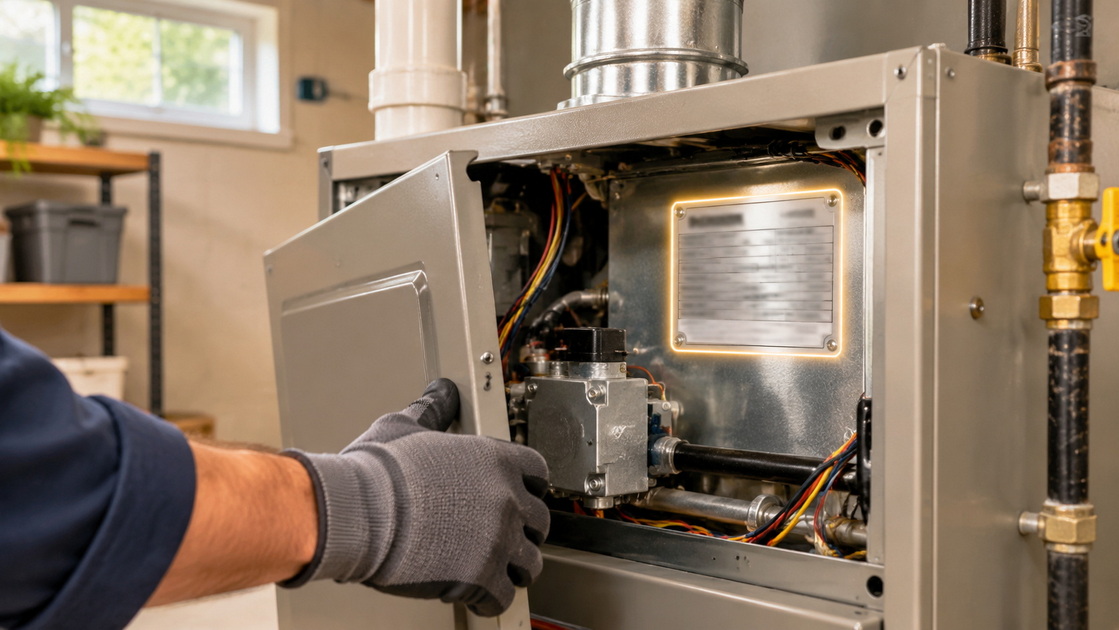
Follow these steps:
1. Turn off power to the furnace at the switch or breaker.
2. Remove the front access panel. The label is often on the inside of the door or on the cabinet wall.
3. Look for a silver or white sticker listing the model number, serial number, and sometimes the build date.
4. Check the blower compartment. Some older units have a date stamped on the fan housing or blades.
5. Take a clear photo of the whole label. You will need it for lookups.
Newer furnaces often show the manufacture date right on the label. Older ones take more digging.
Date formats vary by brand. These are common patterns:
| Format | Example | Likely Meaning |
|---|---|---|
| Month + year (MMYY) | 0188 | January 1988 |
| Letter + year + week | A 12 34 | Year 2012, week 34 (the letter often codes the month or plant) |
| Year + week (YYWW) | 0734 | Week 34 of 2007 |
| Letter-coded month | D 2015 | Fourth month (April) in some systems |
Treat these as clues, not guarantees. Brands change formats over time. Always confirm with the manufacturer's lookup.
Labels fade, peel, or get painted over. You still have options.
The model number often sits beside the serial number. Some brands embed date information in it. In many cases the first character is a letter. The next digits may show the year and week of manufacture.
Most major brands offer an online furnace serial number lookup. You enter the model or serial number, and the tool returns the build date. Some will also identify the unit from photos if you contact them.
When the label is gone, look for:
- Permit records from your city or county for the install date.
- Installer stickers or service tags near the unit.
- Home inspection reports from your purchase.
- Utility rebate records if a past owner claimed one.
- Technology clues: A standing pilot light usually points to an older unit.
If nothing works, a licensed technician can often estimate age from the design, parts, and wear.
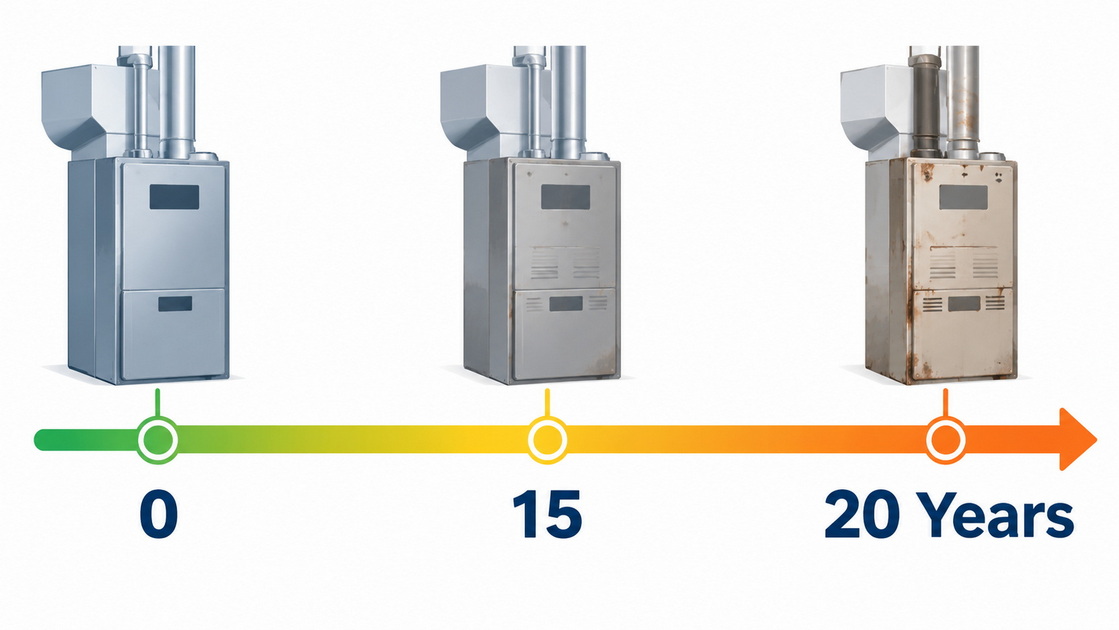
Lifespan data varies by source. The U.S. Department of Energy's 2023 furnace rule estimates an average lifetime of 21.5 years for non-weatherized gas furnaces. It puts the figure at 22.5 years in the North and 20.2 years in the rest of the country. The rule also notes significant variation between individual units.
Industry sources give a more conservative range. A typical gas furnace lasts 15–20 years.
| System Type | Typical Lifespan |
|---|---|
| Gas furnace | 15–20 years |
| Electric furnace | 20–30 years |
| Oil furnace | 15–25 years |
| Boiler | 20–25 years |
| Air-source heat pump | 10–15 years |
ENERGY STAR advises considering replacement once a furnace passes 15 years. That is the point to start planning, not necessarily the day to replace.
What stretches or shortens life:
- Installation quality and correct sizing.
- Annual maintenance and regular filter changes.
- Climate and run time.
- Airflow restrictions that overheat the unit.
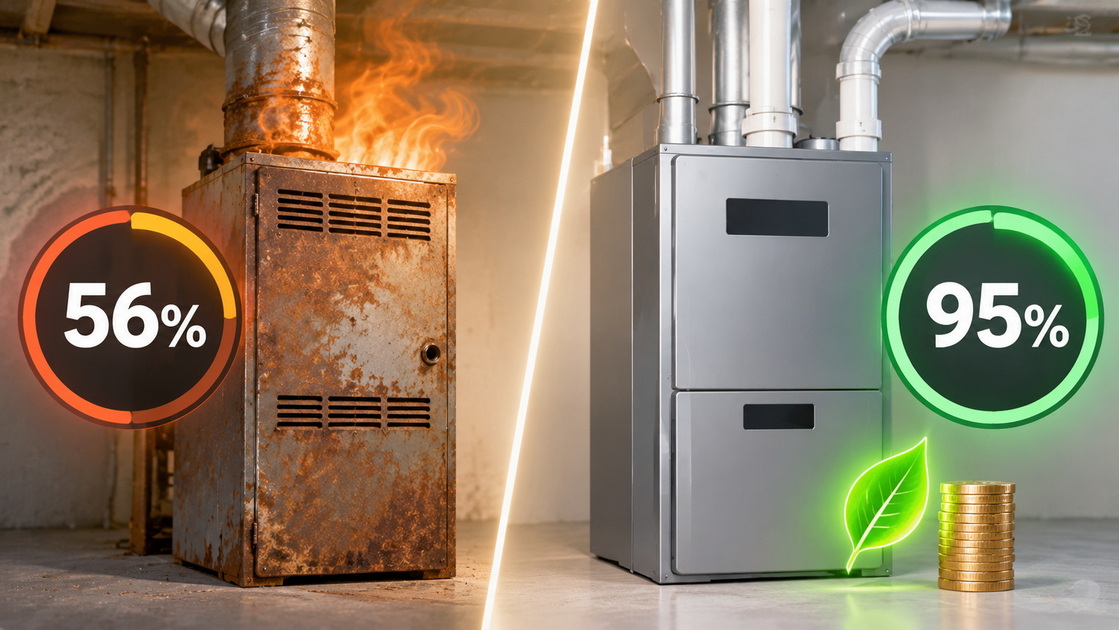
Yes. Efficiency is measured by AFUE (Annual Fuel Utilization Efficiency). It shows how much of the fuel becomes heat for your home.
Older furnaces can run at roughly 56–70% AFUE. That means 30–44 cents of every fuel dollar goes up the flue. Modern condensing furnaces reach 95% or higher.
The Department of Energy's purchasing guidance shows how this adds up. It compares a 21-year energy cost for a 70,000 Btu/h furnace at three efficiency levels:
| Efficiency Level | AFUE | 21-Year Energy Cost |
|---|---|---|
| Best available | 99% | $6,885 |
| ENERGY STAR | 95% | $7,174 |
| Less efficient | 80% | $8,520 |
The gap between 95% and 80% is about $1,350 over the period. A 60% unit would cost far more.
Heat pumps move heat instead of burning fuel. They can deliver around 300% efficiency. That does not always mean lower heating bills. Natural gas is often cheaper than electricity per unit of heat.
A heat pump does offer other benefits:
- Summer savings: It also serves as a high-SEER air conditioner.
- No combustion: It removes a source of carbon monoxide in the home.
- Lower emissions: It cuts your household carbon footprint.
Homes heated with propane or oil often see savings right away.
Rules are changing. Current standards for non-weatherized gas furnaces require a minimum of 80% AFUE. The Department of Energy finalized a new standard in 2023. Starting in late 2028, new non-weatherized gas furnaces must reach 95% AFUE.
This effectively requires condensing technology. These furnaces capture heat from exhaust gases that would otherwise be wasted.
What this means for you:
- Replacing in the next few years still gives you a wide choice of models.
- Condensing furnaces need proper venting and a drain for condensate. Plan for installation changes.
- Planning ahead lets you compare quotes calmly, instead of rushing during a January breakdown.
Age alone is not a danger. But older furnaces have more wear, and the heat exchanger is a key part to watch. It expands and contracts with every cycle. Over many years it can crack. A crack can allow carbon monoxide (CO) into your home.
CO has no color, smell, or taste. The CDC lists headache, dizziness, weakness, nausea, chest pain, and confusion as common symptoms. They are often mistaken for the flu.
Call a licensed technician if you notice:
- A yellow or flickering burner flame instead of steady blue.
- Soot, rust, or scorch marks near the furnace or flue.
- Heavy window condensation or stale, stuffy air.
- Flu-like symptoms that ease when you leave the house.
- A CO alarm that sounds, even once.
The Consumer Product Safety Commission recommends CO alarms on every level of the home and outside sleeping areas. Test them monthly.
If a CO alarm sounds: get everyone outside, call 911, and do not re-enter until it is cleared.
Use this checklist once you know your furnace age.
1. Is the unit over 15 years old? Start planning for replacement.
2. Is the repair estimate large? If the repair cost is a big share of a new unit's price, replacement usually wins.
3. Have repairs become frequent? Repeated breakdowns signal declining reliability.
4. Are bills rising? An efficiency drop shows up on your statements.
5. Is the heat uneven? Hot and cold spots can point to worn components.
6. Has a technician flagged the heat exchanger? This is a safety issue, not a comfort issue.
7. What is your timing? If the unit still works, you may wait until spring or summer to compare options.
A useful rule of thumb: multiply the unit's age by the repair cost. If the number is above about $5,000, consider replacing. It is a rough guide, not a law. A technician should confirm.
Picture a 19-year-old, 80% AFUE gas furnace. It needs a $900 blower motor. The heat is uneven and bills have crept up. The unit is well past ENERGY STAR's 15-year prompt. The money would go into a system near the end of its typical life. Replacing it with a 95% AFUE model reduces fuel waste and avoids another repair soon. In that case, replacement is usually the sounder investment.
Whatever its age, a few habits help:
- Replace filters every 1–3 months.
- Schedule annual maintenance before winter.
- Keep vents and returns clear of furniture and dust.
- Seal and insulate ducts to reduce strain.
- Install a programmable or smart thermostat to avoid needless run time.
- Address odd noises early. Small problems become big ones.

Can't find the label, or unsure what the numbers mean? Mega Services Heating & Cooling can identify your furnace age, test its safety, and give you an honest repair-or-replace recommendation.
Call us or book an inspection today. We'll help you decide with clear numbers, not pressure.
Check the model number, permit records, installer stickers, and inspection reports. You can also contact the manufacturer with photos. A technician can estimate age from the design and wear.
They often show the build date. For example, 0188 usually means January 1988. Formats differ by brand, so confirm with the manufacturer's lookup.
Most last 15–20 years. The Department of Energy's 2023 rule uses an average of 21.5 years for gas furnaces. Maintenance and installation quality shift this.
Not automatically. But wear on the heat exchanger and venting raises risk. Have it inspected yearly, and keep working CO alarms in your home.
ENERGY STAR advises considering replacement after 15 years. Start comparing options then, and replace when repairs, bills, or safety findings make it sensible.
Often yes. Moving from roughly 56–70% AFUE to 95% or higher means much less wasted fuel. Savings depend on your fuel prices and home.
- [One Hour Heating & Air Conditioning – How Old Is My Furnace?](https://www.onehourheatandair.com/expert-tips/furnaces/how-old-is-my-furnace/) [onehourheatandair](https://www.onehourheatandair.com/expert-tips/furnaces/how-old-is-my-furnace/)
- [U.S. Department of Energy – DOE Finalizes Energy Efficiency Standards for Residential Furnaces](https://www.energy.gov/articles/doe-finalizes-energy-efficiency-standards-residential-furnaces-save-americans-15-billion) [energy](https://www.energy.gov/articles/doe-finalizes-energy-efficiency-standards-residential-furnaces-save-americans-15-billion)
- [U.S. Department of Energy – Purchasing Energy-Efficient Residential Furnaces](https://www.energy.gov/cmei/femp/purchasing-energy-efficient-residential-furnaces) [energy](https://www.energy.gov/cmei/femp/purchasing-energy-efficient-residential-furnaces)
- [U.S. Department of Energy – Energy Conservation Standards for Consumer Furnaces (Final Rule)](https://www.energy.gov/sites/default/files/2023-09/consumer-furnace-fr.pdf) [energy](https://www.energy.gov/sites/default/files/2023-09/consumer-furnace-fr.pdf)
- [ENERGY STAR – Furnaces Key Product Criteria](https://www.energystar.gov/products/furnaces/key_product_criteria) [energystar](https://www.energystar.gov/products/furnaces/key_product_criteria)
- [Appliance Standards Awareness Project – Furnaces](https://appliance-standards.org/product/furnaces) [appliance-standards](https://appliance-standards.org/product/furnaces)
- [Lennox – How Long Does a Furnace Last](https://www.lennox.com/residential/lennox-life/consumer/how-long-does-a-furnace-last) [lennox](https://www.lennox.com/residential/lennox-life/consumer/how-long-does-a-furnace-last)
- [Carrier – How Long Does a Furnace Last?](https://www.carrier.com/us/en/residential/hvac-resources/furnaces/how-long-does-a-furnace-last/) [carrier](https://www.carrier.com/us/en/residential/hvac-resources/furnaces/how-long-does-a-furnace-last/)
- [Boulder HVAC Pros – How Long Does a Furnace Last? What the Federal Data Says](https://boulderhvacpros.com/how-long-does-a-furnace-last-what-the-federal-data-says-and-the-signs-that-matter-more-than-age/) [boulderhvacpros](https://boulderhvacpros.com/how-long-does-a-furnace-last-what-the-federal-data-says-and-the-signs-that-matter-more-than-age/)
- [Nordic Home Inspection – Furnace Life Expectancy](https://www.nordichomeinspection.com/furnace-life-expectancy/) [nordichomeinspection](https://www.nordichomeinspection.com/furnace-life-expectancy/)
- [Bumble Breeze – Can Your Furnace Leak Carbon Monoxide?](https://www.bumblebreeze.com/blog/can-your-furnace-leak-carbon-monoxide-and-7-warning-signs-las-vegas-homeowners-should-know/) [bumblebreeze](https://www.bumblebreeze.com/blog/can-your-furnace-leak-carbon-monoxide-and-7-warning-signs-las-vegas-homeowners-should-know/)
- [U.S. CPSC – Plan for High Efficiency Furnaces](https://www.cpsc.gov/zhT-CN/Recalls/1988/plan-for-high-efficiency-furnaces) [cpsc](https://www.cpsc.gov/zhT-CN/Recalls/1988/plan-for-high-efficiency-furnaces)


