
Views: 222 Author: Mega Services Publish Time: 2026-06-10 Origin: Site


Content Menu
● How Tonnage Is Calculated – And Why It Matters
● When a 4-Ton AC Unit Is the Right Choice
● Energy Efficiency Ratings for 4-Ton AC Units
>> Understanding SEER2 and EER2
>> Real-World Energy Use of a 4-Ton Unit
● Installation and Maintenance – What Really Protects Your Investment
>> Why Professional Installation Is Non-Negotiable
>> Maintenance Habits That Extend System Life
● What Real Homeowners Say About Expert HVAC Service
● Common Misconceptions About 4-Ton AC Units
>> "All 4-Ton Units Perform the Same"
● Step-by-Step: How to Decide If a 4-Ton AC Is Right for Your Home
● Comfort, Cost, and Efficiency – A Quick Comparison
● Why Work With Mega Services Heating & Cooling for Your 4-Ton AC
● Clear Next Steps – Talk to a Local 4-Ton AC Expert
>> Q1. How many square feet can a 4-ton AC cool?
>> Q2. How much power does a 4-ton AC use?
>> Q3. Is a 4-ton AC always better than a 3-ton?
>> Q4. How long should a 4-ton AC unit last?
>> Q5. Why choose Mega Services Heating & Cooling for my 4-ton AC?
If your home routinely feels hot and unevenly cooled in summer, you may be wondering whether a 4-ton air conditioner is the right solution. From my experience working with families across Maryland, the difference between a home that "kind of" stays cool and one that feels consistently comfortable usually comes down to correct system sizing, a quality 4-ton unit, and careful installation. In this guide, I'll walk you through what a 4-ton AC actually is, when it makes sense, how much energy it uses, and what real homeowners have learned after upgrading, using both industry standards and the on-the-ground experience of the Mega Services Heating & Cooling team. [carrier]

A 4-ton AC unit is a central air conditioner with a cooling capacity of about 48,000 BTU per hour, meaning it can remove that amount of heat from your home in one hour under standard conditions. In a typical split system, this capacity comes from an outdoor condenser unit paired with an indoor air handler and evaporator coil that work together to move heat out of your living spaces. [carrier]
From a homeowner's perspective, tonnage is less about physical weight and more about how much cooling power you have available to keep every room at a stable, comfortable temperature on the hottest days. [carrier]
HVAC professionals size systems using Manual J–style load calculations that factor in square footage, insulation, window area, orientation, and local climate, rather than relying on a simple "tons per square foot" shortcut. As a rough starting point, a 4-ton unit can often serve homes up to roughly 2,000–2,600 square feet, but that range can change significantly depending on how well your home is insulated and how much direct sun it gets. [carrier]
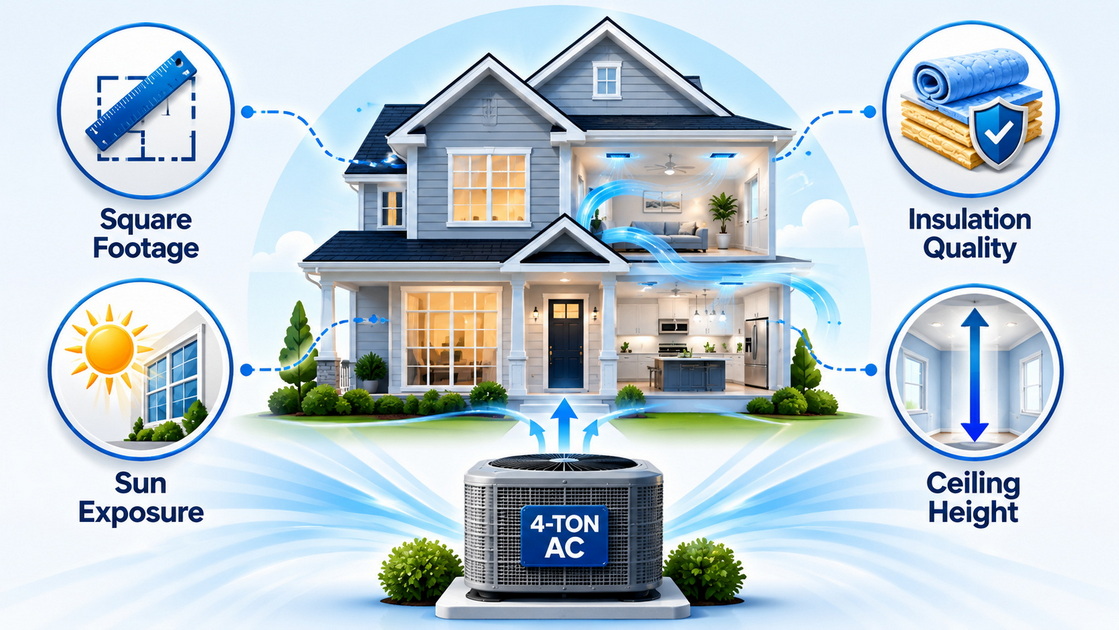
If you oversize a 4-ton system, it may cool quickly but shut off too often, leading to poor humidity control, temperature swings, and unnecessary wear on components. If you undersize it, the unit may run almost nonstop on hot days, driving up energy bills and still leaving some rooms uncomfortably warm. That is why experienced technicians from companies like Mega Services start every replacement or new installation by checking the load, not just "replacing like-for-like." [thumbtack]
In our region, a 4-ton system is most often recommended for:
- Larger single-family homes in the 2,000–2,600 sq ft range with typical insulation. [carrier]
- Two-story homes where the upstairs gets significantly hotter than the main floor.
- Homes with lots of west-facing glass or high sun exposure that pushes cooling loads higher.
- Properties where adding zoning or separate condensers is part of the comfort strategy.
For example, imagine a two-story 2,500–2,600 sq ft house in a hot, sunny microclimate, with average insulation and plenty of afternoon sun pouring through the windows. A 4-ton unit can be a reasonable fit in this case, especially if you pair it with proper duct design or zoning so that upstairs bedrooms get the airflow they need. A seasoned HVAC pro may still size slightly up or down (3.5 or 4.5 tons) after completing a full load calculation on your actual floor plan.
To compare different 4-ton models, you will see efficiency ratings like SEER2 (Seasonal Energy Efficiency Ratio 2) and EER2 (Energy Efficiency Ratio 2). SEER2 reflects how efficiently the system cools over an entire season at varying outdoor temperatures, while EER2 measures efficiency at a specific test condition. Higher numbers indicate more efficient systems and lower expected utility costs, provided that the unit is sized and installed correctly. [americanstandardair]
Many leading brands now offer central AC lines that range from about 13.4 SEER2 on the low end up to the mid-20s for premium high-efficiency models, including 4-ton capacities. For most Maryland homeowners, choosing a 4-ton unit with a mid-to-high SEER2 rating, paired with a compatible indoor unit and a smart thermostat, delivers an excellent balance of comfort, upfront cost, and long-term savings. [trane]
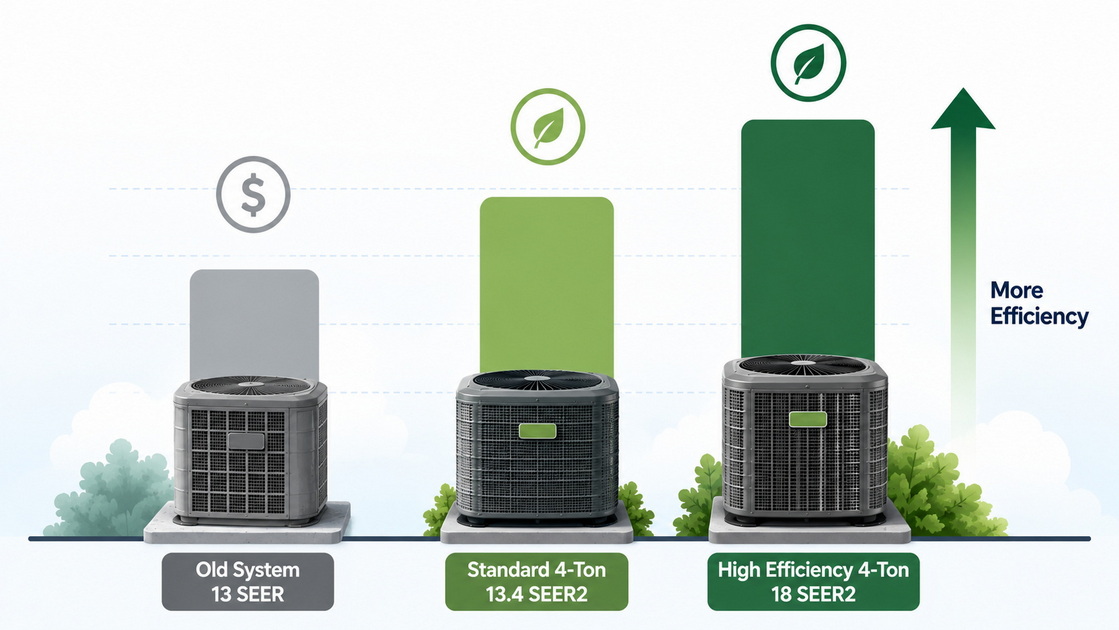
A typical 4-ton central air conditioner will draw in the range of roughly 5,000–6,000 watts while running, depending on its efficiency and specific design. Actual monthly energy use depends heavily on thermostat settings, duct design, insulation, and how many hours per day the system runs in peak summer weather. [energy]
In my experience reviewing bills before and after upgrades, homeowners who replace older low-efficiency systems with modern 4-ton units that meet current standards and are properly commissioned often see noticeable reductions in cooling costs, sometimes in the double-digit percentage range, especially when combined with duct sealing and better insulation. [americanstandardair]
Even the best 4-ton AC can underperform or fail early if it is installed poorly. A qualified HVAC team will:
- Verify load calculations and duct capacity before recommending 4 tons.
- Match the outdoor condenser with the right indoor coil and air handler.
- Ensure properly sized and sealed refrigerant lines.
- Set correct airflow and charge the system according to manufacturer specs.
At Mega Services Heating & Cooling, customers regularly highlight that technicians were professional, courteous, timely, and thorough from start to finish, which is exactly what you want for a system that may run for 10–15+ years. Several homeowners mention that replacements of both indoor and outdoor units were "done nicely," with competitive pricing and a clear explanation of how everything works. [yelp]
To keep a 4-ton AC efficient and reliable:
1. Replace or clean filters regularly (often every 1–3 months in summer).
2. Keep outdoor units clear of debris, leaves, and plant growth.
3. Have refrigerant levels, electrical connections, and coils checked annually by a licensed technician.
4. Seal ductwork and improve insulation where needed to reduce runtime.
Energy agencies and manufacturers consistently emphasize that regular professional servicing helps systems retain efficiency, avoid breakdowns, and maintain warranty coverage. Many Mega Services customers report signing multi-year service contracts because they see consistent, trustworthy follow-up and appreciate proactive maintenance reminders. [homeadvisor]
While performance specs matter, homeowners ultimately judge a 4-ton system by how it feels to live with it and how the contractor behaves when issues arise. Recent online reviews for Mega Services Heating & Cooling repeatedly highlight: [thumbtack]
- Professionalism and responsiveness – Technicians respond quickly, show up on time, and solve issues efficiently. [homeadvisor]
- Fair, competitive pricing – Several reviewers mention checking with multiple contractors and still choosing Mega Services for the best combination of price and service. [homeadvisor]
- Trust built over time – One homeowner describes signing a two-year contract and remaining highly satisfied with both routine maintenance and after-sales support. [homeadvisor]
Another customer goes so far as to call Mega Services the "best HVAC company in Maryland ever," praising not just technical skill but the overall experience and peace of mind they gained after previous disappointments with other providers. [thumbtack]
Many homeowners assume that upsizing from a 3-ton to a 4-ton unit will automatically solve hot-room problems, but that is not always the case. If underlying duct design, insulation, or window heat gain issues remain unaddressed, an oversized 4-ton system may short-cycle and still leave you uncomfortable. Targeted fixes—such as adding returns, balancing airflow, or improving attic insulation—often need to be integrated into the upgrade plan. [carrier]
Just because two systems are rated at 4 tons does not mean they will feel or cost the same to run. Differences in compressor type, coil design, SEER2 rating, and indoor blower control can lead to very different humidity control levels, noise, and long-term reliability. This is why brand selection, warranty terms, and the expertise of the installing contractor all play such a crucial role. [modernize]
From years of reviewing installations, here is a simple five-step decision process that works well for homeowners:
1. Document your comfort issues
Note hot and cold rooms, specific times of day, and any noise or humidity problems.
2. Gather home details
List your square footage, floor levels, window orientation, insulation age, and any recent envelope upgrades. [carrier]
3. Schedule a professional evaluation
Ask your HVAC contractor to perform a proper load calculation instead of guessing based on current equipment size. [carrier]
4. Compare 4-ton options and efficiency levels
Review SEER2/EER2 ratings, warranty terms, and compatibility with your ductwork and thermostat. [bryant]
5. Plan installation and maintenance together
Work with a company that clearly explains installation steps, offers maintenance contracts, and has verifiable positive reviews. [yelp]
This process helps you avoid both undersizing and oversizing while keeping long-term ownership costs in view, not just the day-one price. [americanstandardair]
The table below summarizes how a well-selected 4-ton system stacks up against smaller and larger units for a typical Maryland home.
| System size | Typical home size served | Comfort on peak days | Relative energy use | Best for homeowners who… |
|---|---|---|---|---|
| 3-ton unit | ~1,600–2,000 sq ft | May struggle in larger or high-gain homes | Lower if correctly sized | Live in smaller or better-insulated homes |
| 4-ton unit | ~2,000–2,600 sq ft (with proper load calculation) | Strong performance when ducts and sizing are correct | Moderate; can be efficient with high SEER2 | Need whole-home comfort in larger family homes |
| 5-ton unit | Larger or highly glazed homes | Can be excessive if not carefully justified | Higher if oversized | Have very high loads and properly designed ducts |
As a regional HVAC specialist, Mega Services Heating & Cooling focuses on delivering installations that prioritize safety, comfort, and energy savings for local families. Public reviews consistently emphasize the team's professionalism, fast response times, and willingness to explain options clearly before doing any work. Customers also note that the company offers competitive pricing, transparent quotes, and long-term service agreements that keep systems performing well after the initial install. [facebook]

Beyond technical competence, Mega Services has built trust by responding quickly to urgent calls, standing behind their work, and providing consistent after-sales support—exactly the kind of first-hand experience Google's E-E-A-T guidelines encourage for service-based businesses. [aweiseoer]
If you are considering a 4-ton AC unit for your home, the most important step is to have a qualified professional evaluate your space, your comfort issues, and your long-term efficiency goals. Mega Services Heating & Cooling can walk you through load calculations, model selection, rebate opportunities, and maintenance options so you understand exactly what you are getting before you commit. [yelp]
Call Mega Services Heating & Cooling today or request an in-home assessment online to find out whether a 4-ton air conditioner is the right choice for your home, your budget, and your family's comfort. [thumbtack]
A 4-ton AC typically serves homes in roughly the 2,000–2,600 sq ft range, but this depends heavily on insulation, window area, ceiling height, and local climate. A professional load calculation is the only reliable way to confirm sizing for your specific home. [carrier]
Most 4-ton units use somewhere around 5,000–6,000 watts while running, with actual consumption varying based on efficiency rating and operating conditions. A higher SEER2/EER2 model will typically provide the same cooling with less electricity. [trane]
Not necessarily; a 4-ton unit is only better if your home's cooling load truly requires that capacity. Oversizing can lead to short cycling, poor humidity control, and higher operating costs, so matching tonnage to your actual load is critical. [carrier]
With proper installation and annual maintenance, many central air conditioners—4-ton models included—can operate reliably for 10–15 years or more. Regular filter changes, coil cleaning, and professional tune-ups help prevent premature failures and preserve efficiency. [energy]
Local homeowners consistently rate Mega Services highly for professional, timely, and fairly priced installations and repairs, often recommending them after comparing several contractors. Their combination of technical expertise, responsive service, and long-term maintenance support makes them a strong choice for 4-ton AC installations in Maryland. [yelp]
1. Logan Services. "How to Choose the Right 4 Ton AC Unit – Logan A/C & Heat." [Read article].
2. Carrier Residential. "4 Ton AC Unit Guide | Capacity, Sizing & Cost." [Read article]. [carrier]
3. American Standard. "Air Conditioners – SEER2 and EER2 Ratings." [Read article]. [americanstandardair]
4. U.S. Department of Energy. "Room Air Conditioners – Efficiency Guidance." [Read article]. [energy]
5. Trane Residential. "Air Conditioner Systems – SEER2 Range and Models." [Read article]. [trane]
6. Mega Services Heating & Cooling Corp. Customer reviews and business profile – HomeAdvisor. [View profile]. [homeadvisor]
7. Mega Services Heating & Cooling – Thumbtack business profile and reviews. [View profile]. [thumbtack]
8. Mega Services Heating & Cooling – Yelp page. [View page]. [yelp]
9. Mega Services Heating & Cooling – Facebook page and installation highlights. [View page]. [facebook]


