
Views: 211 Author: Mega Services Publish Time: 2026-09-24 Origin: Site


Content Menu
● Quick Answer: How Many Air Purifiers Do You Need?
● Begin With Room Size and Layout
● Understand CADR Before Choosing an Air Purifier
>> Do Not Rely Only on "Maximum Coverage" Claims
● Where to Put an Air Purifier
>> Place It in the Room You Use Most
>> Keep It Near the Problem Area
>> Leave Open Space Around the Unit
>> Choose a Safe Height and Surface
>> Keep It Away From Heat and Moisture
● Where Not to Put an Air Purifier
● Can One Air Purifier Clean Multiple Rooms?
>> When One Unit May Be Enough
>> Why Moving a Purifier Between Rooms Is Less Effective
● Portable Air Purifiers and Whole-Home Solutions
● A Practical Indoor Air Quality Checklist
>> Replace HVAC Filters Regularly
>> Keep Return Vents and Supply Vents Clear
>> Use Kitchen Exhaust During Cooking
● Example: A Two-Story Home Air Purifier Plan
● Summary
>> 1. How many air purifiers should I have in my home?
>> 2. Where should I put an air purifier in a bedroom?
>> 3. Should an air purifier go on the floor or a table?
>> 4. Can one air purifier clean an entire house?
>> 5. Can an air purifier help with pet dander?
>> 6. Can an air purifier remove cooking smells?
>> 7. Can an air purifier fix mold or humidity problems?
>> 8. Is a whole-home air cleaner better than a portable air purifier?
Choosing the right air purifier is only part of improving the air inside your home. Where you place it and how many units you use can have a major effect on how well it performs.
At Mega Services Heating & Cooling, we help homeowners create safer, more comfortable, and more energy-efficient living spaces through heating, cooling, maintenance, filtration, and indoor air quality solutions. A portable air purifier can help reduce airborne particles in the rooms where your family spends the most time. However, the best results come from using the right size unit, placing it correctly, maintaining your HVAC system, and addressing the sources of indoor pollutants.
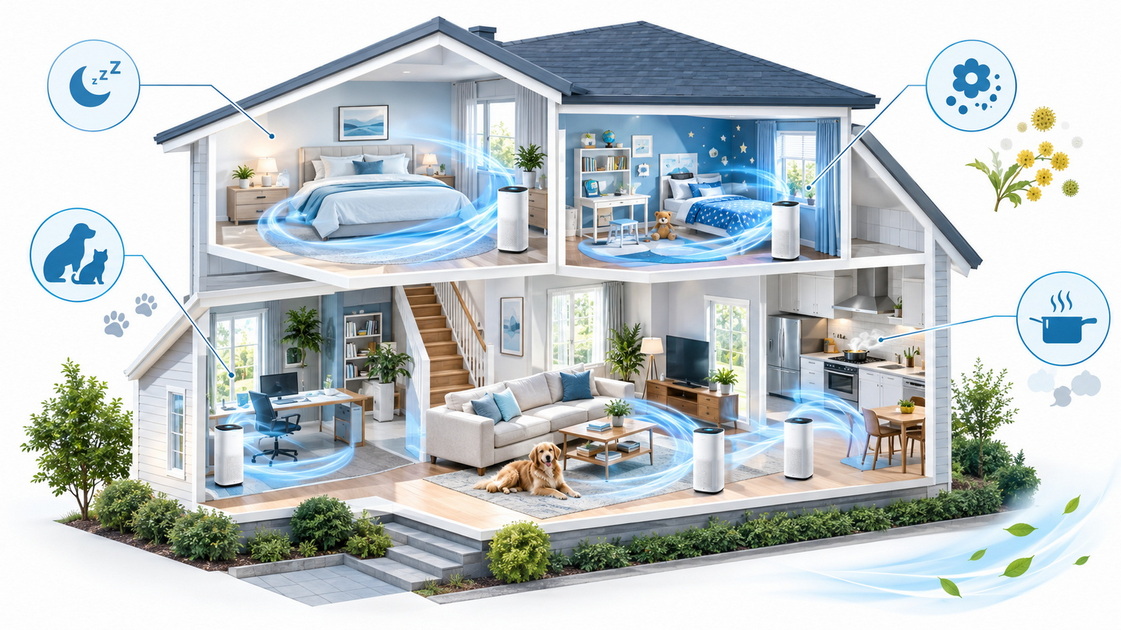
For most homes, one well-sized air purifier in each priority room is more effective than one small device trying to clean the entire house. Bedrooms, living rooms, home offices, nurseries, and pet areas are often the best places to begin.
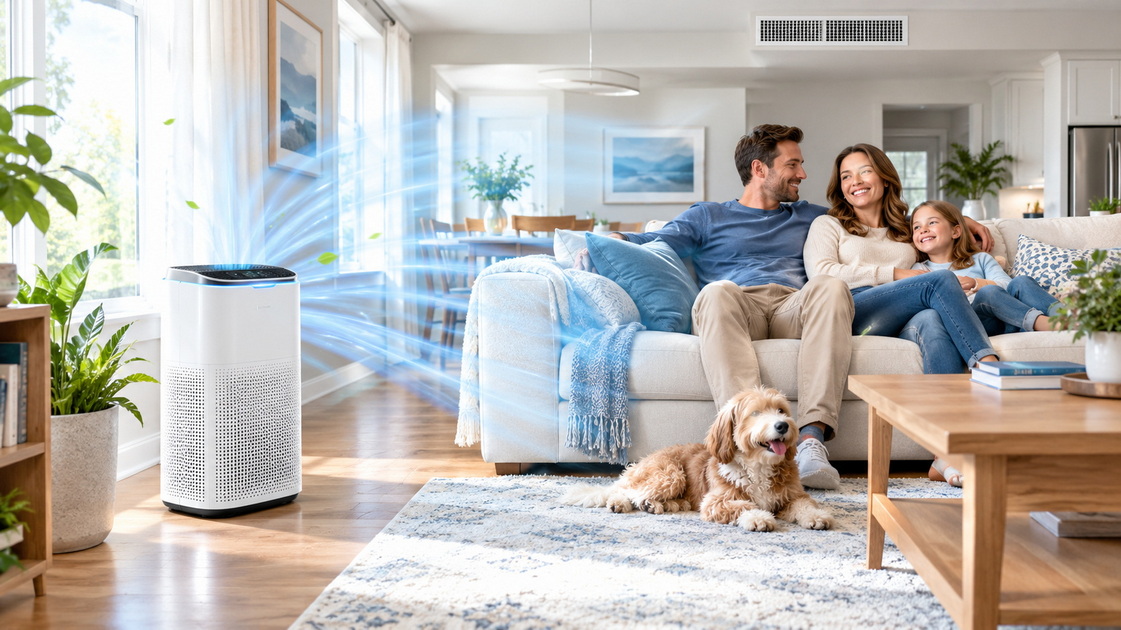
The number of air purifiers your home needs depends on more than square footage. Room layout, ceiling height, doors, pets, cooking habits, allergies, outdoor air conditions, and household occupancy all matter.
As a practical guideline:
- Use one properly sized portable air purifier per enclosed priority room
- Start with bedrooms, especially for people with allergies, asthma, pet sensitivities, or seasonal pollen concerns
- Add a larger unit to the main living room or family room if that is where your household spends the most time
- Consider more than one purifier for large open rooms, high ceilings, or areas with higher levels of dust, pet dander, smoke, or cooking particles
- Consider a whole-home filtration or air-cleaning solution if you want support throughout your home rather than only in individual rooms
A small purifier placed in a central hallway is unlikely to provide meaningful cleaning for bedrooms behind closed doors. Likewise, a unit designed for a small bedroom may not have enough airflow capacity for a large living room with tall ceilings and an open kitchen.
> A portable air purifier is most effective when it is matched to the room where it will run consistently. In many homes, targeted placement is more important than simply owning a purifier.
Before choosing a purifier, measure the room you want to improve.
For a rectangular or square room, use this formula:
Room Area=Length×Width
For example, a living room that measures 15 feet long and 20 feet wide is:
15×20=300 square feet
That gives you a starting point for selecting a properly sized unit. However, square footage alone does not tell the full story.
A room with 12-foot ceilings holds more air than the same room with 8-foot ceilings. Large rooms, vaulted ceilings, lofts, open staircases, and connected spaces may require a higher-capacity purifier than a basic square-footage recommendation suggests.
Most purifier sizing recommendations assume an 8-foot ceiling. If your ceiling is higher, the purifier must move and filter a larger volume of air.
For example:
- A 300-square-foot room with an 8-foot ceiling contains about 2,400 cubic feet of air
- A 300-square-foot room with a 12-foot ceiling contains about 3,600 cubic feet of air
The second room contains 50% more air. In that situation, choose a larger purifier or consider using more than one unit.
Open floor plans can feel like one large room, but the air does not always circulate evenly. A purifier in a living room may not clean the air in a connected kitchen, dining area, hallway, or loft at the same rate.
Furniture placement, staircases, doors, HVAC returns, supply vents, cooking activity, and temperature differences can all change the way air moves through your home.
If your main living area includes several connected zones, calculate the total square footage of the open space. Then choose a purifier with enough capacity for the entire area, not just one section of it.
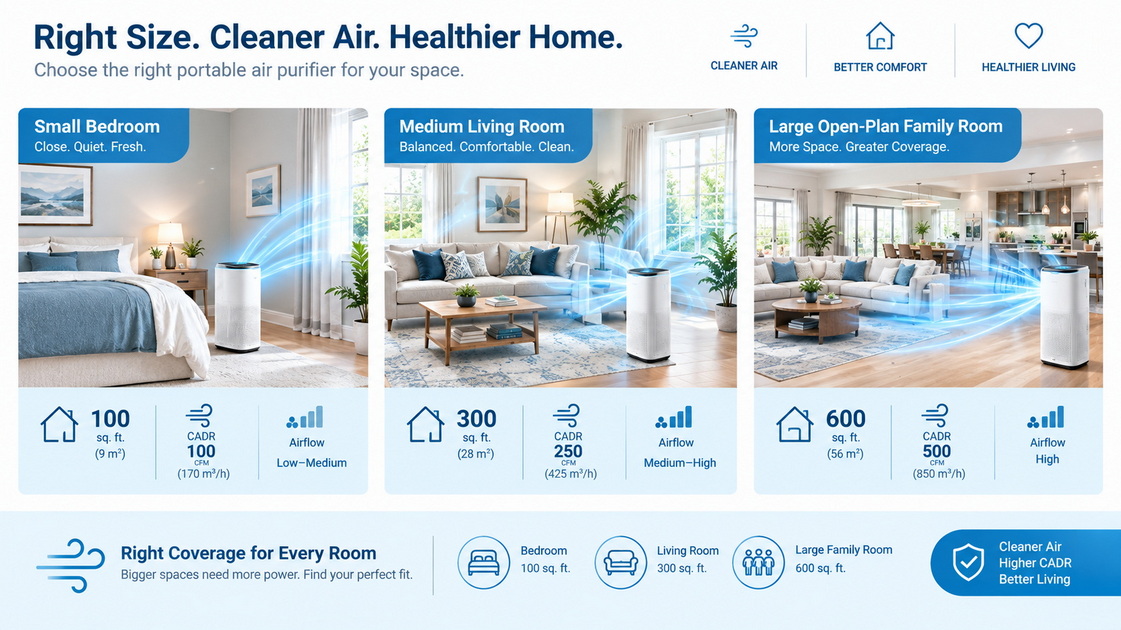
CADR means Clean Air Delivery Rate. It is one of the most helpful numbers to review when comparing portable air purifiers.
CADR measures the volume of filtered air a purifier can deliver. In simple terms, a higher CADR usually means the unit can clean more air in less time.
You may see separate CADR ratings for:
- Smoke
- Dust
- Pollen
The smoke CADR is often the most useful rating because smoke particles are small and can be difficult to filter. A purifier with a strong smoke CADR can generally provide reliable performance for many common airborne particles.
A helpful starting point is to choose a smoke CADR that is at least two-thirds of your room's square footage.
Target CADR=Room Square Footage×0.67
For a 300-square-foot room:
300×0.67=201
In this example, look for a purifier with a smoke CADR of approximately 200 or higher.
For homes affected by wildfire smoke, frequent pet dander, heavy dust, high ceilings, or allergy concerns, selecting a purifier with extra capacity can be beneficial.
| Room Size | Target Minimum Smoke CADR | Typical Use |
|---|---|---|
| 100 square feet | 65 CFM | Small office, nursery, compact bedroom |
| 200 square feet | 130 CFM | Standard bedroom or home office |
| 300 square feet | 200 CFM | Large bedroom or medium living room |
| 400 square feet | 260 CFM | Family room or larger shared room |
| 500 square feet | 325 CFM | Large living area |
| 600 square feet | 390 CFM | Large open room with standard ceilings |
Many air purifier boxes list a large maximum room size. That number may be based on low fan speed, one air change per hour, ideal conditions, or a space with standard ceiling height.
A purifier may technically operate in a large room, but that does not always mean it will clean the air quickly enough for your needs.
When comparing models, review:
- Smoke CADR
- Recommended room size
- Noise level at higher speeds
- Replacement filter availability
- Filter replacement cost
- Energy use
- Airflow direction
- Manufacturer maintenance instructions
A purifier that is slightly oversized for a room can often be more comfortable to use because it may achieve good results without constantly running at its loudest setting.
The best location allows the purifier to draw in room air, filter it, and return cleaner air without obstruction. Proper placement helps the unit work more efficiently and supports more even circulation.
Start with the room where you or your family spend the most time.
For many households, the first priority is one of the following:
- Primary bedroom
- Child's bedroom
- Nursery
- Living room
- Family room
- Home office
- Room where pets spend most of their time
Bedrooms are often an excellent first choice because people spend several continuous hours there each night. Running a properly sized purifier overnight can support a more comfortable sleeping environment, especially during pollen season or when outdoor smoke affects local air conditions.
Place the purifier in the same room where dust, pet dander, pollen, odors, or airborne particles are most noticeable.
Examples include:
- A bedroom where a pet sleeps
- A living room with rugs, upholstered furniture, and high household activity
- A home office near an open window during allergy season
- A room where outdoor smoke or dust enters more easily
- A hobby room where light particles are created
- A space where family members regularly gather
Keep the purifier reasonably close to the problem area, but do not place it directly against a pollution source. For example, do not position it directly beside a stove, fireplace, or humidifier where it may be exposed to excessive heat, grease, steam, or moisture.
Air purifiers need space around their intake and outlet vents. A unit that is hidden behind furniture, placed inside a cabinet, or pressed into a corner cannot circulate air effectively.
Follow the unit's manufacturer instructions. As a general placement practice:
- Keep the intake and outlet clear
- Do not place the purifier behind a sofa or large chair
- Keep curtains, bedding, and blankets away from vents
- Avoid placing it inside enclosed furniture
- Do not block the outlet with a wall, plant, or storage box
- Keep the purifier stable and upright
- Place it where children and pets cannot easily knock it over
A purifier should be able to pull in air from the room and release cleaned air without immediately recirculating the same small pocket of air.
Many larger air purifiers are designed to sit directly on the floor. Smaller models may be designed for a dresser, table, countertop, or shelf.
Check the manufacturer's instructions before placing your purifier on furniture.
Floor placement often works well for larger units, especially when the intake grille is located on the side or front of the device. If the intake is located on the bottom, placing it directly on thick carpet may restrict airflow. In that case, use a stable, solid platform if permitted by the manufacturer.
If you place a smaller purifier on furniture:
- Choose a level, stable surface
- Keep it away from edges
- Avoid placing it near water
- Keep the cord out of walking paths
- Make sure the outlet is not blocked by a wall or large object
Avoid placing an air purifier in locations where heat, steam, moisture, or water can affect its performance or safety.
Do not place it:
- Directly next to a fireplace, radiator, or space heater
- Directly in front of a heating or cooling supply vent
- Near a bathtub, shower, sink, or other water source
- Beside a humidifier producing visible mist
- In a wet basement with active water issues
- In direct sunlight for long periods
- Close to a stovetop during active cooking
A portable purifier is not designed to solve water leaks, high humidity, mold growth, or persistent basement dampness. Those problems require moisture control, repair, and sometimes a professional inspection.
Some locations can limit purifier performance or create inconvenience.
| Avoid This Location | Why It Is Not Ideal | Better Option |
|---|---|---|
| Behind furniture | Air intake and outlet may be blocked | Place it in an open part of the room |
| In a tight corner | Limits circulation through the room | Leave space around the unit |
| Inside a cabinet | Restricts airflow and can cause overheating | Keep it fully exposed |
| Directly under an HVAC vent | Strong airflow may disrupt circulation | Place it a few feet away from the vent |
| Beside a stove | Grease, heat, and steam can load filters quickly | Use kitchen exhaust and position the purifier nearby |
| In a hallway | Closed bedrooms will receive little benefit | Put a unit inside each priority bedroom |
| Directly beside the bed | Can create a draft or unwanted noise | Place it several feet away |
| On thick carpet with a bottom intake | May restrict air entering the purifier | Use a hard, level surface if appropriate |
In most cases, one portable air purifier cannot effectively clean several separate rooms, especially when doors are closed.
Portable units are designed for a defined area. Air does not move evenly from room to room, and closed doors create a strong barrier. A purifier in the living room may improve that room's air, but it is unlikely to provide the same benefit in an upstairs bedroom or home office.
One larger purifier may be suitable when:
- The space is fully open
- There are no doors between areas
- The unit is sized for the combined square footage
- Ceiling height is close to the unit's intended operating range
- Airflow is not blocked by walls, furniture, or staircases
- The purifier can run at a comfortable fan speed
- There are no major pollution sources in separate areas
For example, one high-capacity purifier may work well in an open living room, dining room, and family room that total 550 square feet. However, that same purifier may not adequately serve a connected kitchen if cooking regularly produces heat, smoke, grease, and odors.
Moving one unit from room to room is better than having no purifier at all, but it does not provide consistent cleaning in each space.
Airborne particles can build up again after the purifier leaves the room. This is especially common in homes with pets, open windows, heavy outdoor pollen, frequent cooking, carpeted rooms, or multiple occupants.
If you are working within a limited budget, begin with:
1. The bedroom of the person with the greatest allergy or respiratory sensitivity
2. The main living room or family room
3. Additional bedrooms or offices as needed
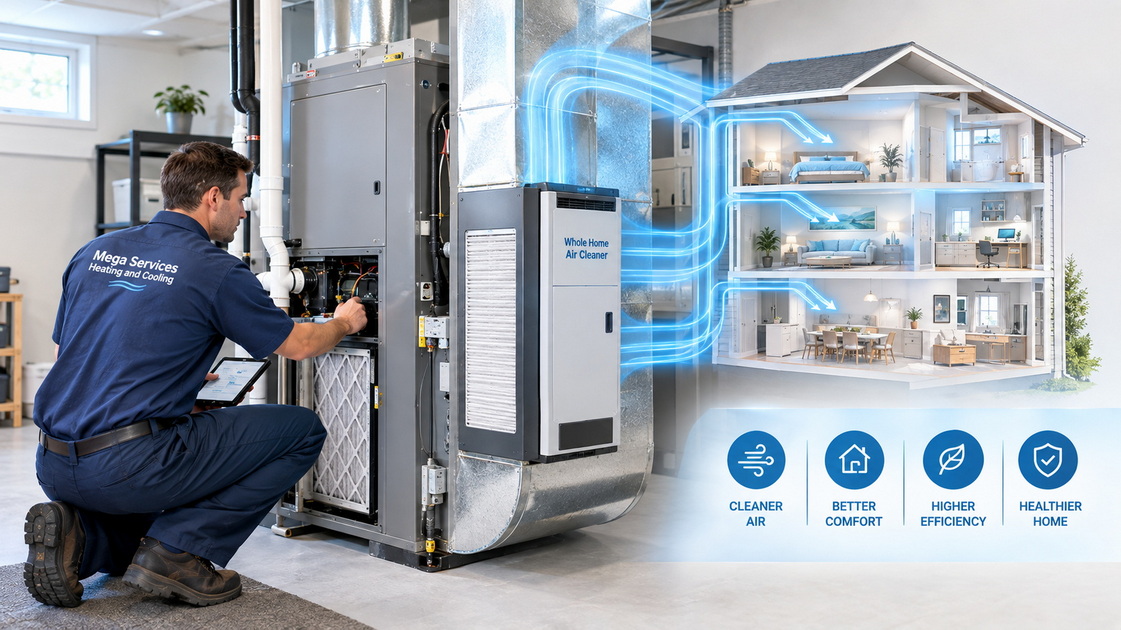
Portable purifiers are useful for targeted room-by-room support. Whole-home options can provide a more comprehensive approach when paired with a properly maintained heating and cooling system.
| Solution | Best For | Main Benefit | Important Consideration |
|---|---|---|---|
| Portable air purifier | One bedroom, office, nursery, or living room | Focused air cleaning in priority spaces | Does not clean the entire home |
| HVAC filter upgrade | Homes with central heating and cooling | Uses existing system airflow | Must be compatible with the system |
| Whole-home air cleaner | Homes needing broader coverage | Helps filter air moving through the HVAC system | Requires proper installation and maintenance |
| Ventilation improvement | Homes that feel stuffy or retain odors | Supports fresh-air exchange when conditions allow | Must be designed for climate and humidity |
| Whole-home dehumidifier | Damp homes or high-humidity areas | Helps manage comfort and moisture | Does not replace particle filtration |
A whole-home air cleaner is usually installed near the HVAC air handler or ductwork. It works with your heating and cooling system to filter air moving through the home.
However, whole-home equipment should not be chosen based only on a product description. The HVAC system must have appropriate airflow, return-air capacity, filter fit, duct condition, and maintenance support. A poorly fitted filter or restricted return can affect system performance and comfort.
Air purification is most effective when it is part of a complete home comfort plan.
A dirty HVAC filter can reduce airflow and make heating and cooling equipment work harder. Use the correct filter size and type for your system, and replace it according to the filter manufacturer's instructions and your household conditions.
Homes with pets, frequent occupancy, construction dust, or allergy concerns may need more frequent filter checks.
Furniture, rugs, storage boxes, and curtains can block airflow at return grilles and supply vents. Keep these areas open so your heating and cooling system can circulate air properly.
Cooking can release particles, odors, heat, and moisture into the home. A range hood that vents outdoors can help remove pollutants at the source.
When possible:
- Turn on the range hood before cooking
- Use rear burners when they are better captured by the hood
- Keep the hood running for several minutes after cooking
- Clean grease filters regularly
- Use an air purifier in the adjacent living area if needed
High humidity can make a home feel uncomfortable and may contribute to musty odors, condensation, and moisture-related concerns.
Look for signs such as:
- Condensation on windows
- Damp basement walls
- Musty smells
- Water stains
- Visible mold
- Persistent bathroom humidity
- Excessive moisture around supply vents
Fix leaks, use bathroom exhaust fans, maintain drainage systems, and consider professional humidity evaluation if moisture problems continue.
An air purifier can help capture some airborne particles, but reducing pollutants at the source is usually more effective.
Examples include:
- Avoid smoking indoors
- Store paint, chemicals, and cleaning products properly
- Choose lower-odor cleaning products when possible
- Keep pet bedding clean
- Vacuum regularly using effective filtration
- Address combustion or exhaust problems promptly
- Repair water leaks quickly
Professional heating and cooling maintenance can help identify issues that affect comfort, airflow, energy use, and indoor conditions.
A maintenance visit may identify:
- Dirty components
- Restricted airflow
- Improper filter fit
- Condensate drainage problems
- Blower performance concerns
- Duct leakage
- Uneven heating or cooling
- Humidity concerns
- Equipment wear that may affect reliability
Consider a two-story, 2,000-square-foot home with three bedrooms, a downstairs family room, a dog, and one family member who experiences seasonal allergies.
One purifier in the downstairs living room may help the family room, but it will not provide the same benefit in upstairs bedrooms. A more practical plan could include:
- One properly sized purifier in the allergy-sensitive person's bedroom
- One larger purifier in the primary family room
- Regular HVAC filter replacement
- Use of the kitchen exhaust fan during cooking
- Routine heating and cooling system maintenance
- Inspection of return airflow and filter fit
- A whole-home air-cleaning evaluation if the household wants broader support
This approach focuses on the rooms where exposure and occupancy are highest while also improving the airflow and filtration system that supports comfort throughout the home.
The best place to put an air purifier is in an open, frequently used room where airflow is not blocked and where people spend meaningful amounts of time. Bedrooms, family rooms, home offices, nurseries, and pet areas are often the most valuable locations.
For most households, one correctly sized purifier in each priority room is more effective than one small device placed in a hallway or moved from room to room. Use room size, ceiling height, CADR, noise level, and the type of indoor air concern to choose the right unit.
Portable purifiers can be valuable tools, but they work best alongside proper HVAC maintenance, clean filters, moisture control, ventilation, and source reduction. A complete indoor air quality plan supports a safer, more comfortable, and more energy-efficient home.
Mega Services Heating & Cooling provides professional support for heating, cooling, HVAC maintenance, airflow, filtration, humidity management, and whole-home air quality solutions. Our team helps homeowners understand how their system and living environment work together to improve everyday comfort.
Start with one properly sized purifier in each priority room, especially bedrooms and main living spaces. You may not need a purifier in every room, but one small unit usually cannot clean a multi-room home effectively.
Place it in an open area with clear space around the intake and outlet. Keep it several feet from the bed so it does not blow directly at your face. Avoid placing it behind curtains, furniture, or beside a heat source.
Follow the manufacturer's instructions. Larger units are often designed for floor placement, while compact models may be suitable for a stable table, dresser, or countertop. Make sure the air intake is not blocked by carpet, bedding, or nearby objects.
Generally, no. Portable purifiers are designed for one room or a defined open area. They do not reliably clean separate rooms, upstairs bedrooms, or spaces behind closed doors.
Yes. A properly sized purifier can help reduce airborne pet dander and other particles in the room where it operates. Regular cleaning, vacuuming, pet bedding maintenance, and HVAC filter replacement are also important.
Some purifiers can reduce airborne particles and certain odors, especially units with odor-adsorbing filtration. However, using a range hood vented outdoors remains the best way to control cooking pollutants at the source.
No. A purifier cannot repair water leaks, stop condensation, lower excessive humidity, or remove hidden mold growth. Moisture problems should be identified and corrected at the source.
It depends on your needs. A portable purifier is useful for focused cleaning in one room. A whole-home air cleaner may be more appropriate when you want support throughout the home and have a properly functioning central HVAC system.
1. U.S. Environmental Protection Agency.. Guidance on portable air cleaner placement, CADR, room sizing, airflow, and filtration.
2. U.S. Environmental Protection Agency.. Information on indoor pollutant source control, ventilation, portable air cleaners, and HVAC filtration.
3. Association of Home Appliance Manufacturers.. Information on Clean Air Delivery Rate ratings, room-size guidance, and air-cleaner performance standards.
4. ENERGY STAR.. Consumer guidance on air-cleaner selection, CADR, energy use, airflow, and room-size considerations.
5. Washington State Department of Health.. Guidance on selecting portable air cleaners for smoke, room size, and indoor air concerns.
6. One Hour Heating & Air Conditioning.. Topic coverage reviewed for comparative content planning.


