
Views: 213 Author: Mega Services Publish Time: 2026-09-26 Origin: Site


Content Menu
● What Do the ABCs of Air Conditioning Mean?
● Why Airflow Problems Can Resemble Refrigerant Problems
● How a Technician Checks Airflow Before Charge
>> 1. Understand the Comfort Problem
>> 2. Inspect Filters, Coils, and Blower Components
>> 3. Measure Airflow When Appropriate
>> 4. Correct Air-Side Problems
>> 5. Evaluate Refrigerant Under the Right Conditions
● What Can a Homeowner Safely Check?
● Why a New Air Conditioner Still Needs Proper Airflow
● What Should Be in Your Service Report?
● When Should You Schedule Maintenance or Repair?
● The Bottom Line on Air Before Charge
>> 1. What are the ABCs of air conditioning?
>> 2. Does weak airflow mean my air conditioner is low on refrigerant?
>> 3. Can a dirty filter increase cooling costs?
>> 4. Should I ask for a refrigerant recharge if my AC is not cooling?
>> 5. How often should an air conditioner be serviced?

Your air conditioner is running, but the bedrooms still feel warm. Does it need more refrigerant? Maybe—but a dirty filter, restricted return, blower problem, or duct issue can also affect cooling. The ABCs of air conditioning offer a better starting point: air before charge. Before a technician evaluates or adjusts refrigerant charge, they should make sure air is moving properly through the system.
This principle matters whether you are troubleshooting an existing unit or installing a new one. It helps separate symptoms from causes and gives homeowners a practical question to ask: "What did you find when you checked the airflow?"
In this context, ABC stands for "air before charge." It describes the order in which a technician should evaluate a ducted air-conditioning system. Airflow across the indoor coil must be appropriate before refrigerant-charge readings can be interpreted reliably.
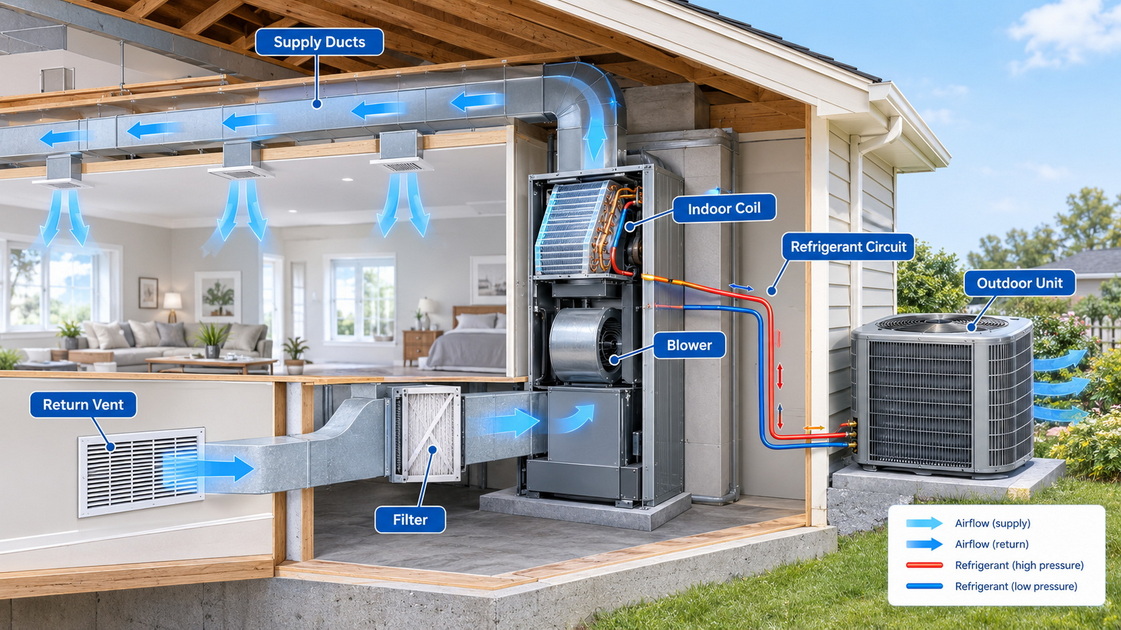
A central air conditioner depends on two connected processes. A blower moves indoor air across the evaporator coil, while refrigerant inside the coil absorbs heat. If too little air passes over the coil, the system may struggle to cool the house. Readings taken under those conditions may also lead to the wrong conclusion about refrigerant charge.
That does not mean every cooling problem is caused by airflow. A system can have an airflow problem, a refrigerant problem, or both. The point is to check the conditions that affect a charge assessment before deciding that refrigerant should be added or removed.
Homeowners often describe cooling problems by what they feel: weak air at the vents, a warm room, long run times, or a house that never reaches the thermostat setting. Those observations are useful, but they do not identify a cause on their own.
A loaded filter can restrict air entering the system. A dirty indoor coil, blower issue, or poorly performing duct system can also limit airflow. Low refrigerant can affect cooling, too. Because different faults can produce similar complaints, an inspection should test likely causes rather than assume the system needs a "recharge."
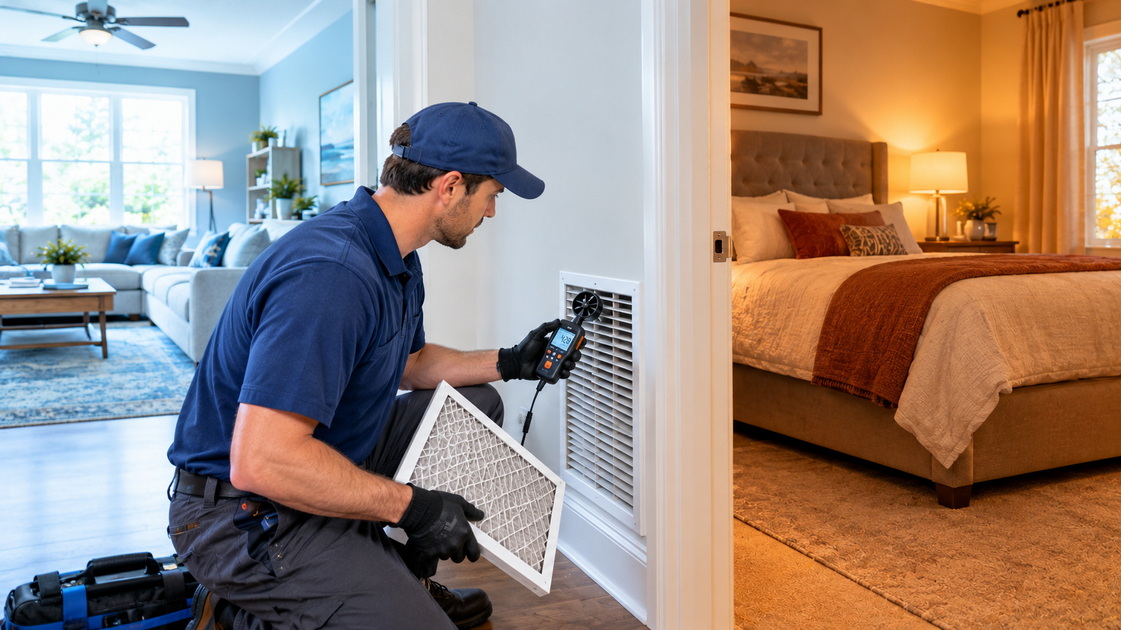
Airflow affects efficiency as well as comfort. Airflow problems can reduce system efficiency by up to 15 percent. That figure describes a potential impact, not the savings any one household should expect from a repair.
| What you notice | What it may suggest | Useful next step |
|---|---|---|
| Weak airflow at many vents | Filter, blower, return-air, or duct restriction | Check the filter and request an airflow evaluation. |
| One room stays warmer than others | Supply or return-air distribution issue | Ask for a room-by-room assessment. |
| Ice appears near the indoor unit | Restricted airflow or another system fault | Turn off cooling and arrange professional service. |
| Cooling is poor after installation | Possible airflow, sizing, duct, control, or charge issue | Ask for the installation measurements and test results. |
These are starting points, not diagnoses. A filter that looks clean does not rule out a dirty coil or duct problem. Likewise, finding a restricted return does not prove the refrigerant charge is correct.
A useful service visit begins with the complaint, then moves from visible conditions to measurements. The exact tests depend on the equipment, access, weather, and manufacturer instructions. For a typical ducted system, the process may include the following steps.

A technician should ask which rooms are affected, when the problem began, and whether anything recently changed. A new filter, thermostat, duct modification, or equipment installation can provide an important clue.
It also helps to distinguish a sudden failure from a longstanding issue. If one bedroom has been warm for years, its air distribution may deserve closer attention. If every room became warm yesterday, the technician may investigate a different set of possibilities.
The technician can check whether the filter fits correctly and needs replacement. They may also examine accessible return and supply openings, indoor and outdoor coils, blower components, and the condensate system.
A dirty coil or poorly performing blower should not be overlooked simply because the outdoor unit is running. These components affect how the system moves air and removes heat.
Depending on the system, a technician may measure static pressure and use manufacturer blower data or another suitable method to assess airflow. The appropriate airflow depends on the equipment and operating mode. There is no single number that homeowners should apply to every air conditioner.
Ask what was measured, what range the manufacturer specifies, and whether the result was within that range. A statement such as "the airflow seems fine" is less useful than a finding the technician can explain.
If testing identifies a loaded filter, dirty coil, blower-setting issue, or duct restriction, addressing it may change how the system operates. A correction should suit the equipment design. Simply making air feel stronger at one register does not necessarily mean the entire system is working properly.
Once airflow and other necessary operating conditions are verified, a qualified technician can assess refrigerant charge using the manufacturer's procedure. If the charge is low, ask what evidence supports that finding and whether a leak investigation is needed.
Air before charge does not mean refrigerant problems should be ignored. It means the technician should evaluate charge under conditions that make the result meaningful.
You can collect useful information before a service visit without opening electrical panels or touching the refrigerant circuit. A short check may also help you explain the problem more clearly.
1. Check the thermostat. Confirm that it is set to cool and that the requested temperature is below the room temperature. Note whether the indoor fan is running.
2. Look at the filter. If you know how to replace it safely, use the size and type recommended for your system. Record when it was last changed.
3. Check accessible vents and returns. Move furniture or other objects blocking them. Avoid closing multiple registers in an attempt to force air into another room.
4. Describe the pattern. Is airflow weak throughout the house or only in one area? Are rooms warm all day or mainly in the afternoon?
5. Watch for ice or water. If you see ice near the indoor unit, turn off cooling and arrange service rather than repeatedly restarting it. Report any water collecting nearby.
Check the filter every month, particularly during heavy-use periods, and replace it when dirty. General guidance suggests changing it at least every three months, but the right interval may differ for your equipment and filter. Follow the applicable manufacturer instructions.
Leave electrical testing, internal coil work, and refrigerant handling to trained professionals. A homeowner's observations are valuable; they do not need to become a do-it-yourself repair.
Replacing an older unit does not automatically solve uneven temperatures. New equipment still relies on suitable sizing, adequate airflow, and a duct system capable of distributing conditioned air throughout the home.
Improper installation can reduce system efficiency by up to 30 percent. That is a potential consequence, not a promise that correcting one installation issue will lower a particular bill by 30 percent. It illustrates why installation quality deserves as much attention as an efficiency rating.
A sound replacement proposal should consider three connected questions:
- How much heating and cooling does the home need?
- Which equipment can meet those needs under the expected conditions?
- Can the duct system deliver air to and from the rooms effectively?
Residential design methods address these questions through load calculations, equipment selection, and duct design. If you are replacing a system, ask the installer how they assessed your home rather than assuming the new unit should match the old unit's capacity.
If certain rooms have always been uncomfortable, point them out before approving a proposal. Ask whether the existing ducts were inspected and how airflow will be verified after installation. This creates an opportunity to address the distribution problem rather than carrying it into the next system.
A clear service record helps you understand what was found and what was done. It can also make future visits more productive if the problem returns.
Ask for a record of:
- The equipment model and the symptoms you reported.
- The condition of the filter, coils, and relevant blower components.
- Airflow-related measurements, if they were taken.
- The fault found and the repair performed.
- The procedure used if refrigerant charge was assessed.
- The reason refrigerant was added or removed, if applicable.
It is reasonable to ask the technician to separate confirmed findings from possibilities. "We measured a high pressure drop and recommend investigating the return path" tells you more than "your ducts are bad." Written findings make it easier to compare repair options without losing the details behind the recommendation.
Refrigerant-circuit work requires appropriate qualifications. Do not open the sealed system or attempt to judge charge by attaching gauges yourself.
An annual professional cooling checkup before the busiest part of the season can help identify developing problems. A typical visit may include checking controls and condensate drainage, inspecting coils, assessing blower components, and evaluating refrigerant level when appropriate.
Arrange service sooner if cooling suddenly declines, ice appears, water collects around the indoor unit, or the system behaves differently after a recent repair or installation. Tell the technician what changed, which rooms are affected, and what you have already checked.
Try not to prescribe the repair before the inspection. Asking for "more refrigerant" may steer the conversation toward a solution that does not address the cause. Asking for an airflow and system diagnosis keeps the focus on evidence.
A comfortable home depends on more than the amount of refrigerant in an air conditioner. Filters, coils, blower performance, ducts, system sizing, and charge all play a part. Checking airflow first gives a technician a sounder basis for interpreting the rest of the system.
If your AC runs but does not cool your home evenly, contact Mega Services Heating & Cooling to schedule an inspection. Share which rooms are uncomfortable, when the issue began, and what you have noticed at the vents. Ask your technician to walk you through the airflow findings and explain any recommended refrigerant work before repairs proceed.
In this article, ABC means "air before charge." The phrase reminds technicians to verify airflow before evaluating or adjusting refrigerant charge on a ducted cooling system.
Not necessarily. Weak airflow may be related to a dirty filter, blower problem, coil condition, restricted return, or duct issue. The symptoms need testing before a cause can be confirmed.
Yes. A dirty filter can slow airflow and make the system work harder. Check it regularly and replace it when needed, following the guidance for your equipment and filter.
Ask for a diagnosis instead. A technician should evaluate airflow and other operating conditions before deciding whether the charge needs correction. If the system is low, ask why and whether a leak investigation is appropriate.
An annual professional cooling checkup is a useful starting point. Do not wait for the next scheduled visit if the system suddenly stops cooling well, develops ice, or leaks water near the indoor unit.
1. Air Conditioning Contractors of America, "" — original explanation of the air-before-charge principle.
2. ENERGY STAR, "" — guidance on professional maintenance, coils, blower components, refrigerant level, and the potential efficiency impact of airflow problems.
3. ENERGY STAR, "" — filter guidance, duct considerations, and the potential efficiency impact of improper installation.
4. Air Conditioning Contractors of America, "" — descriptions of residential load calculation, equipment selection, and duct design methods.
5. U.S. Environmental Protection Agency, "" — certification requirements for covered refrigerant-handling work.
6. ENERGY STAR, "" — guidance on home evaluations, duct inspections, airflow measurements, and written proposals.


