
Views: 221 Author: Mega Services Publish Time: 2026-10-07 Origin: Site


Content Menu
>> Inline Fans vs. Register Fans
● When Are Duct Booster Fans Worth It?
>> When a Booster Fan May Help
>> When a Booster Fan Is the Wrong First Step
>> Duct Leakage Matters, but It Is Not Every Home's Problem
● Diagnose Uneven Airflow Before Buying
>> Follow a Simple Homeowner Checklist
>> Check the Return-Air Pathway
>> Ask for Evidence Behind the Recommendation
>> An Illustrative Bedroom Example
● Costs, Installation, and Long-Term Value
>> Evaluate the Complete Installed Cost
>> Separate Comfort Improvement From Energy Savings
>> Confirm Installation and Control Requirements
>> Compare Better Alternatives
>> Verify the Result After Installation
>> Choose the Solution Your Home Needs
>> 1. Do Duct Booster Fans Really Work?
>> 2. Will a Booster Fan Fix a Hot Upstairs Bedroom?
>> 3. Is an Inline Fan Better Than a Register Fan?
>> 4. Should I Seal Ducts Before Installing a Booster?
>> 5. Can I Install a Duct Booster Fan Myself?
>> 6. Why Does Opening the Bedroom Door Improve Comfort?
>> 7. How Can I Tell Whether the Fan Was Worth It?
Duct booster fans can be worth it when a specific room receives too little airflow from an otherwise properly functioning heating and cooling system. However, they are not a universal fix for hot upstairs bedrooms, cold offices, or weak air coming from vents. Their value depends on identifying the problem before choosing the product.
At Mega Services Heating & Cooling, our focus is helping families create safe, comfortable, and energy-conscious homes. When temperatures vary from room to room, the most useful starting point is not "Which fan should I buy?" It is "Why is this room uncomfortable?"
This guide explains how duct booster fans work, when they make sense, what to check before installation, and how to determine whether another solution would provide better long-term value.
A duct booster fan is an additional fan designed to assist airflow through part of a forced-air heating and cooling system. It works alongside the central blower rather than replacing it.
The two common options are inline duct booster fans and register booster fans. Although both aim to improve air delivery, they operate in different locations and involve different installation requirements.
An inline duct booster fan installs within an appropriate section of ductwork. Depending on the product, it may assist airflow through an individual branch serving a room or area.
Installation can involve modifying the duct, providing electrical power, and arranging suitable controls. Product suitability matters because not every inline fan is designed for residential heating and cooling supply air.
An inline fan should be selected for its intended application, not simply because its diameter matches the duct.
A register booster fan sits over or replaces a supply register inside the room. It helps draw additional air through that outlet.
These products are often easier to access than inline models. However, compatibility depends on register dimensions, placement, available power, and the product's operating controls.
A register fan cannot repair a crushed duct, reconnect a detached branch, or eliminate an inadequate return-air pathway.
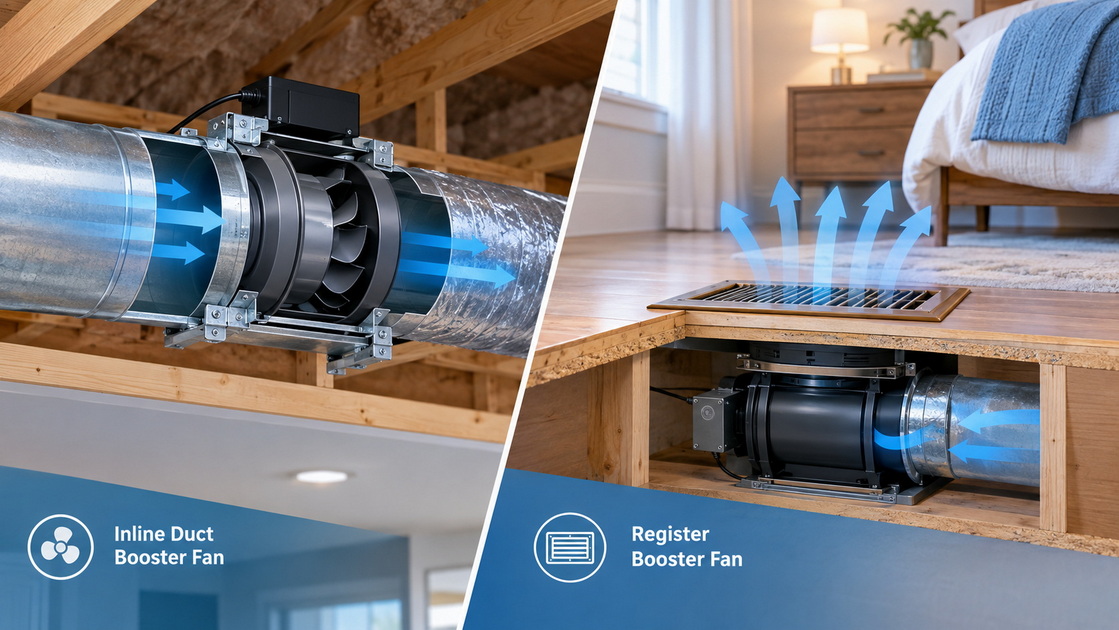
| Feature | Inline duct booster fan | Register booster fan |
|---|---|---|
| Location | Within an appropriate duct section | At the room's supply outlet |
| Installation | May require duct modification and electrical work | Often involves fitting a register-mounted device |
| Primary purpose | Assist airflow through a selected branch | Assist airflow through one register |
| Main consideration | Application compatibility and control arrangement | Register fit, noise, and room-level improvement |
| Maintenance access | Depends on duct location | Usually accessible inside the room |
Neither design creates additional heating or cooling capacity. A booster fan assists delivery; it does not correct every reason a home feels uncomfortable.
A duct booster fan deserves consideration when testing indicates insufficient airflow to a specific room and the underlying system is otherwise operating properly.
The strongest case is a targeted application with a clearly identified problem, a compatible product, and a practical way to verify the result.
A room served by a difficult duct branch may benefit from additional airflow assistance after obvious defects have been addressed.
Before considering a fan, confirm that:
- The central equipment is operating properly.
- The affected duct is intact and unobstructed.
- The room has an adequate return-air pathway.
- Insufficient delivered airflow is contributing to the discomfort.
- The proposed product is suitable for the installation location.
These conditions matter more than how far the room sits from the thermostat.
A distant bedroom is not automatically a good candidate. If its duct is leaking significantly or its return pathway is restricted, repairing that problem may provide a more meaningful improvement.
| Symptom | Better starting point |
|---|---|
| Weak airflow throughout the home | Evaluate filtration, equipment operation, and distribution |
| Visible damaged or disconnected ductwork | Repair the physical defect |
| Comfort worsens when the bedroom door closes | Investigate the return-air pathway |
| Normal airflow but persistent overheating | Evaluate heat gain, insulation, and room requirements |
| Several rooms have uneven temperatures | Assess the broader distribution system |
| Suspected duct leakage | Inspect the ducts and consider appropriate testing |
A fan can leave the original defect unresolved. That is why diagnosis should come before purchasing an airflow accessory.
In a typical house, approximately 20–30% of the air moving through the duct system can be lost through leaks, holes, and poorly connected ducts.
This is a useful reason to inspect ductwork, especially where it passes through unconditioned spaces. It is not a measurement of your home or a guarantee of potential utility savings.
If leakage exists, repair addresses a distribution problem. If the main issue is insufficient return airflow, adding sealant to intact supply ducts will not solve it.
The right improvement depends on the actual condition of the system.
A short, organized investigation can prevent spending money on a product that does not address the complaint.
Homeowners can document symptoms and check accessible components. A qualified technician can evaluate equipment performance, measure airflow, and investigate pressure or duct problems.
1. Identify whether the problem affects one room or several.
2. Note whether it occurs during heating, cooling, or both.
3. Check that supply registers and return grilles are unobstructed.
4. Inspect the filter according to the equipment instructions.
5. Compare room comfort with the door open and closed.
6. Record temperatures at consistent locations and times.
7. Note recent renovations or changes in room use.
Keep the observations specific.
"The bedroom gets warmer after the door closes during cooling" provides more useful information than "The upstairs air conditioner does not work."
Avoid removing equipment panels, modifying wiring, or adjusting internal components as part of a basic homeowner check.
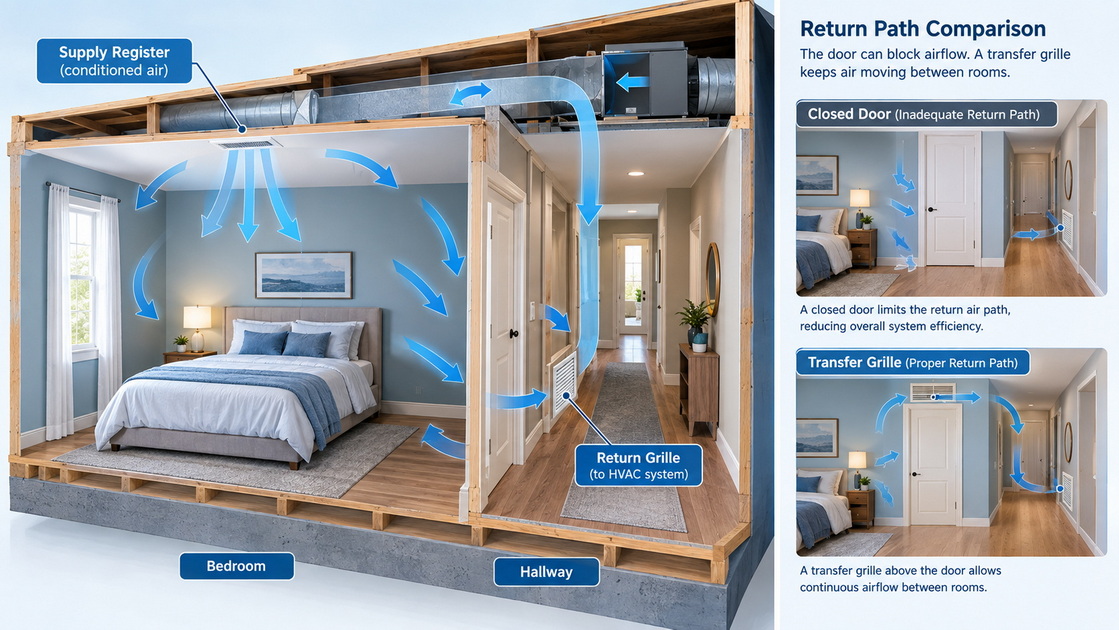
Air entering a room needs a route back to the central system.
When a bedroom door closes, an inadequate return pathway can affect pressure balance and circulation. This may contribute to discomfort even when the supply register is delivering air.
Depending on the home's design, possible improvements include a dedicated return, a transfer grille, or a jump duct.
Do not assume that the gap beneath a door always provides enough airflow. A technician can evaluate the pathway under normal operating conditions.
Adding more supply assistance without understanding the return path may leave the central problem unresolved.
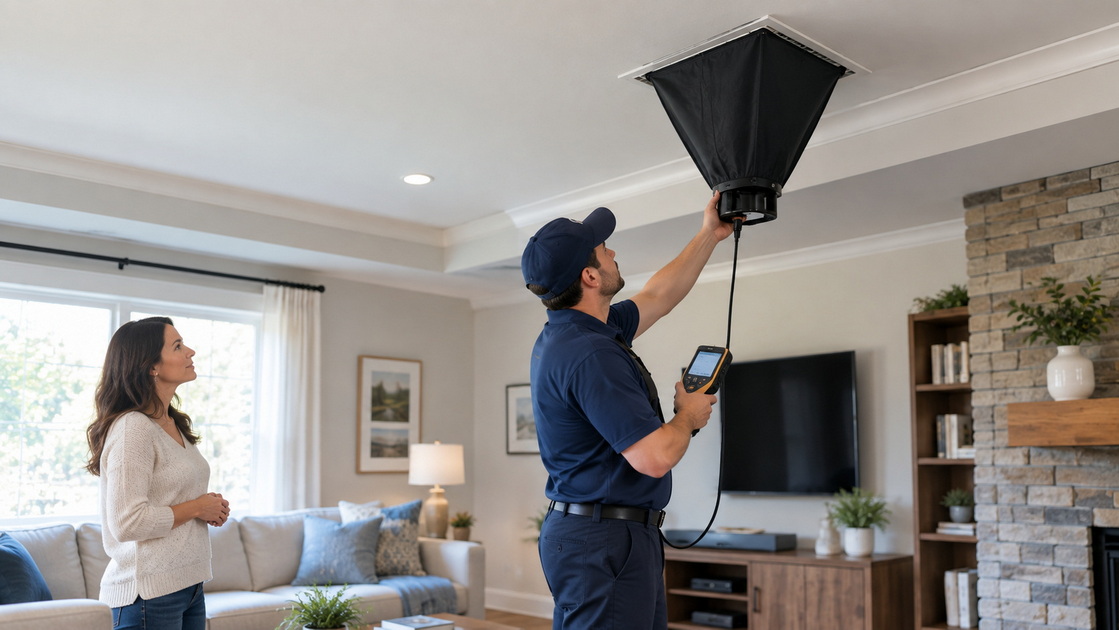
A useful diagnosis connects observed symptoms with measurements and physical findings.
Depending on the complaint, the evaluation may include:
- Supply airflow at the affected room
- Room pressure with the door closed
- Duct condition and accessible connections
- Filtration and equipment operation
- Broader supply and return performance
Before approving a booster fan, ask what evidence supports the recommendation, which defects have been ruled out, and how improvement will be verified.
A clear explanation should describe why the product fits your home—not merely why booster fans can work in general.
Consider a hypothetical upstairs bedroom that becomes uncomfortable overnight.
The homeowner notices weak-feeling airflow and plans to purchase a register booster. However, the room becomes more comfortable when its door stays open.
That observation suggests the return-air pathway deserves attention before adding supply assistance.
The appropriate next step is to investigate circulation and pressure balance, then determine whether a return-path improvement, duct correction, or booster is justified.
This example illustrates a diagnostic approach rather than a documented customer project.
The value of a duct booster fan depends on more than its purchase price. Installation requirements, operating cost, noise, and measurable comfort improvement all influence whether it is worthwhile.
Published product-price estimates have placed booster devices at approximately $75–$300. Actual prices vary, and a device price is not the same as a complete installed quote.
Request an estimate that identifies:
- The exact fan model
- The proposed installation location
- Required duct modifications
- Electrical work and controls
- Labor and access requirements
- Testing and follow-up provisions
A relatively inexpensive fan may involve substantial additional work if the suitable installation location is difficult to reach.
Conversely, a simple register-mounted product may be easier to trial, provided it suits the register and application.
A more comfortable room does not automatically mean lower utility bills.
The booster uses electricity, while the overall energy outcome depends on system operation and household thermostat choices.
For example, a hypothetical 20-watt fan operating eight hours daily for 30 days uses:
0.020 kW×8×30=4.8 kWh
This calculation describes the auxiliary fan's electricity consumption only. It does not predict changes in central-system runtime or net savings.
Treat claims of guaranteed savings cautiously unless they are supported by evidence relevant to your home.
Follow the specific manufacturer's instructions.
A suitable installation requires more than placing a fan wherever space is available. Confirm the permitted duct location, intended airflow direction, electrical requirements, and operating controls.
Ask how the fan will respond during heating and cooling cycles and how it can be accessed for maintenance.
For an inline installation involving duct modification or electrical work, use appropriately qualified assistance.
Do not assume that a ventilation fan marketed for another application is suitable for conditioned supply air.
Depending on the diagnosis, a more effective investment may be duct repair, sealing, return-path improvement, maintenance, or correction of an equipment problem.
Where ducts pass through unconditioned spaces, suitable insulation may also deserve attention.
The priority is to address the cause:
- Repair disconnected, crushed, or damaged ducts.
- Correct identified leakage with suitable materials.
- Improve inadequate return-air circulation.
- Resolve maintenance or equipment issues.
- Evaluate room heat gain where airflow is adequate.
A booster can remain an option after these issues are considered. It should not be used as a substitute for necessary repairs.
Record room conditions before and after the work.
Compare reasonably similar weather, thermostat settings, occupancy, and door positions. Otherwise, a cooler outdoor day may look like a successful repair.
Check whether the original complaint improves, whether the fan noise is acceptable, and whether neighboring rooms remain comfortable.
Where measurements identified the problem, repeat the relevant measurements after the work.
A successful installation means more than "the fan runs." It means the chosen solution produces a useful improvement.

Duct booster fans can be worthwhile for a specific airflow problem, but they are not the answer to every uncomfortable room. The best decision begins with understanding the supply path, return path, duct condition, and equipment performance.
Mega Services Heating & Cooling provides heating and air conditioning installation, repair, and maintenance. If a room remains too hot or too cold, contact our team to discuss the symptoms and an appropriate evaluation.
Tell us which rooms are affected, when the problem occurs, and whether closing doors changes comfort. Start with the cause, then choose the solution that fits your home.
They can assist airflow in suitable applications. However, they cannot repair damaged ducts, correct every distribution problem, or restore malfunctioning equipment. Their value depends on identifying an airflow problem and verifying that the installation improves comfort.
Possibly, when insufficient delivered airflow is the main issue. Upstairs discomfort can also involve heat gain, insulation, duct leakage, or restricted return circulation. Investigate those factors before assuming that additional supply airflow will solve the problem.
Neither is universally better. Inline fans operate within a duct branch, while register fans assist airflow at a room outlet. The better choice depends on the identified problem, installation access, product compatibility, controls, and acceptable noise.
Repair identified leaks or disconnected ducts before treating their symptoms with an accessory. However, sealing should follow inspection. It is not automatically necessary or sufficient for every uneven-temperature complaint.
Requirements vary by product. Some register-mounted devices are comparatively straightforward, while inline installations can require duct modification and electrical work. Follow the manufacturer's instructions and obtain qualified assistance where necessary.
Opening the door may improve the room's return-air pathway. If closing the door restricts circulation, investigate pressure balance and return airflow before purchasing a booster fan.
Compare the original symptoms before and after installation under reasonably similar conditions. Consider comfort, measured airflow where available, noise, operating cost, and any effect on other rooms. A noticeable breeze alone does not establish overall value.
-, updated December 5, 2025. Original article used for topic analysis, potential causes of uneven comfort, and the published device-price estimate.
-. Supports the typical 20–30% duct-air-loss estimate and guidance on sealing and insulation.
-. Supports return-path evaluation, closed-door pressure considerations, and potential return-air solutions.
-. Research addressing return pathways and airflow balance with bedroom doors closed.
-. Manufacturer guidance supporting branch-duct applications and model-specific installation considerations.
-. Technical background on residential air distribution, duct design, and pressure considerations.


