
Views: 221 Author: Mega Services Publish Time: 2026-09-28 Origin: Site


Content Menu
● What Does HVAC Tonnage Mean?
● How Can You Find Your Current AC Tonnage?
>> Can a Model Number Tell You the Size?
>> Why Your Old System May Be the Wrong Guide
● How Much HVAC Tonnage Does Your Home Need?
● What Happens When an AC Is Too Big or Too Small?
● How Should a Replacement System Be Sized?
>> 1. Calculate Heating and Cooling Loads
>> 2. Select Equipment for Those Loads
● Three Details Worth Checking Before You Buy
>> Humidity Control Matters Alongside Temperature
>> Heat Pump Cooling Size Is Not Its Winter Heating Plan
>> Home Improvements Can Change the Answer
● What Should You Ask When Comparing HVAC Quotes?
● Make Your Next System Fit Your Home
● Frequently Asked Questions About HVAC Tonnage
>> 1. Is a 3-Ton AC Right for a 2,000-Square-Foot House?
>> 2. How Many Btu/h Equal One Ton of Cooling?
>> 3. Does More Tonnage Mean Better Cooling?
>> 4. Can I Replace My AC With the Same Tonnage?
>> 5. Is HVAC Tonnage the Same as Energy Efficiency?
>> 6. Does a Heat Pump's Tonnage Tell Me How Well It Will Heat?
If you are shopping for a new air conditioner, you may hear that your home needs a "3-ton system." What does that number mean, and is it the right size for your house? HVAC tonnage describes how much heat a system can remove in an hour. It does not describe how heavy the equipment is or how much electricity it uses.
At Mega Services Heating & Cooling, we want homeowners to understand the decision behind a recommendation. A capacity label is useful, but comfort also depends on the home's heating and cooling needs, the equipment selected, and how well air reaches each room. Before replacing a system, look beyond the number of tons.
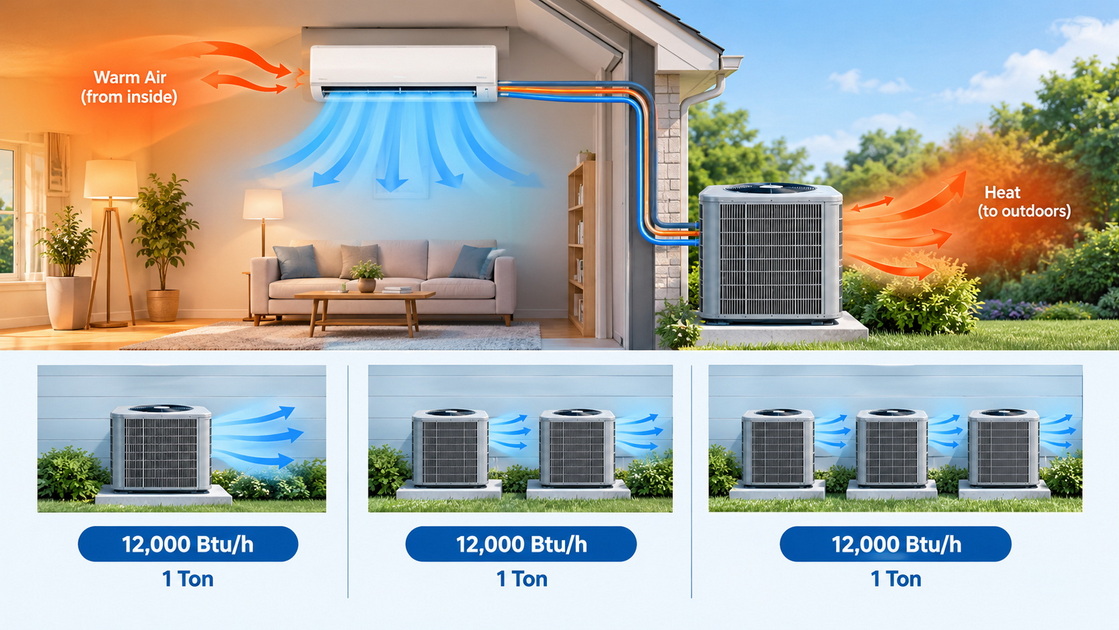
One ton of cooling capacity equals 12,000 British thermal units per hour (Btu/h). A British thermal unit is a measure of heat energy. "Per hour" matters because tonnage describes the rate at which a system can remove heat, not the total amount of cooling it will provide over a season.
To convert a stated cooling capacity to tons, divide the Btu/h figure by 12,000:
Cooling capacity in tons = Cooling capacity in Btu/h ÷ 12,000
| Nominal system size | Cooling capacity |
|---|---|
| 1.5 tons | 18,000 Btu/h |
| 2 tons | 24,000 Btu/h |
| 2.5 tons | 30,000 Btu/h |
| 3 tons | 36,000 Btu/h |
| 4 tons | 48,000 Btu/h |
| 5 tons | 60,000 Btu/h |
These figures explain capacity. They are not a chart of recommended home sizes. A 3-ton system is not automatically the right choice for every house with a particular floor area.
Tonnage is also different from efficiency. Two systems can have the same nominal cooling capacity while using different amounts of electricity to do the job. When comparing proposals, ask about both capacity and the efficiency of the complete equipment combination.
Your existing air conditioner or heat pump provides a useful starting point. You can usually begin with the manufacturer's label on the outdoor unit, your installation paperwork, or the equipment documentation.
1. Find the accessible label on the outdoor unit. Do not open an electrical or service panel to look for it.
2. Write down the manufacturer and complete model number.
3. Check whether the label or documentation states cooling capacity in Btu/h.
4. If it does, divide that number by 12,000.
5. If it does not, check the manufacturer's specifications or ask a qualified technician to identify the model.
For example, equipment listed at 36,000 Btu/h has a nominal cooling capacity of 3 tons.
Sometimes a model number contains a capacity clue. The sequence "036," for example, may indicate 36,000 Btu/h. But model-number formats vary. A partial number should not be treated as a universal sizing code.
Confirm the capacity against documentation for the full model number. If you are planning a replacement, identify the indoor equipment as well. The outdoor unit is only one part of the system being considered.
The size of your current system tells you what was installed—not necessarily what your home needs today. The original equipment may have been poorly sized. Your home may also have changed since that installation.
Think about any major differences:
- Have you added conditioned living space?
- Have you improved attic insulation or air sealing?
- Have you replaced windows or added shading?
- Have certain rooms always been difficult to cool?
- Does the system switch on and off frequently while the air still feels damp?
Each answer gives a contractor useful context. Replacing a 3-ton system with another 3-ton system without reviewing the home can carry an old problem into a new installation.
There is no reliable answer based on square footage alone. Floor area matters, but two homes of the same size can gain heat at very different rates.
Imagine two houses with identical floor plans. One has shaded windows, good attic insulation, and well-sealed ducts. The other receives intense afternoon sun, has air leaks, and sends cooled air through ducts in a hot attic. Their square footage matches; their cooling needs may not.
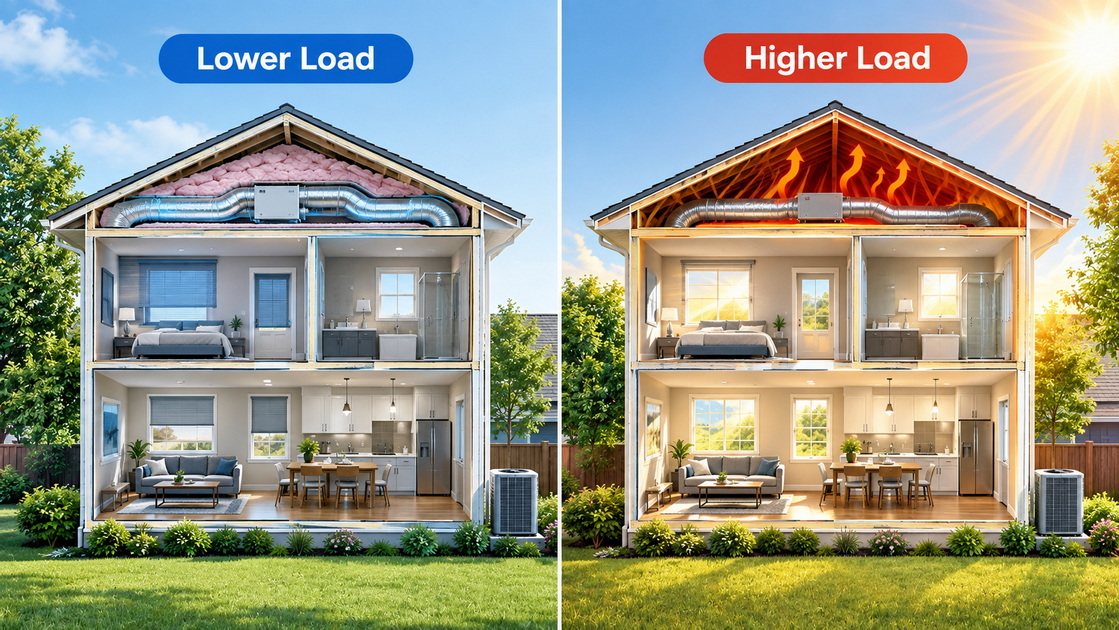
A home-specific assessment considers more than its dimensions:
- Local climate: Outdoor design conditions affect both cooling and heating needs.
- Insulation and air leakage: Heat can move through the building or enter through gaps.
- Windows and shading: Size, orientation, glazing, and direct sunlight affect individual rooms.
- Humidity and ventilation: The system may need to remove moisture as well as heat.
- People and indoor equipment: Occupants, lighting, and appliances add heat.
- Ductwork: Leaks, restrictions, and duct location affect how effectively conditioned air reaches the home.
A square-footage calculator can give you a rough conversation starter. It cannot inspect your attic, assess airflow, or determine whether a proposed unit will perform as expected in your house. Do not use a rule of thumb as the final basis for an equipment purchase.
It is tempting to think that extra cooling capacity provides extra protection on hot days. With a conventional system, too much capacity can create its own comfort problems.
| Possible issue | What you might notice | What it could mean |
|---|---|---|
| System is too large | It starts and stops often; the thermostat reaches its setting quickly, but rooms feel clammy. | Short run times may limit moisture removal and affect comfort. |
| System lacks adequate delivered cooling | It struggles to reach the set temperature during demanding weather. | Capacity may be insufficient, or maintenance and airflow problems may be limiting performance. |
| Air distribution is poor | Some rooms stay warmer than others; airflow is weak or noisy. | Ductwork, returns, restrictions, or room-level needs may require attention. |
Symptoms are clues, not a tonnage diagnosis. An air conditioner that runs for long periods might need repair or maintenance rather than replacement with a larger model. Likewise, a warm upstairs room does not prove that the whole house needs more cooling capacity.
Equipment that can vary its output may manage changing conditions differently from a conventional single-capacity system. Even so, it still needs to be selected for the home and installed as a properly matched system.
A sound recommendation follows a sequence: determine what the house needs, choose equipment that can meet those needs, and check whether the air-delivery system can support the choice. Ask your contractor to explain each step in plain language.
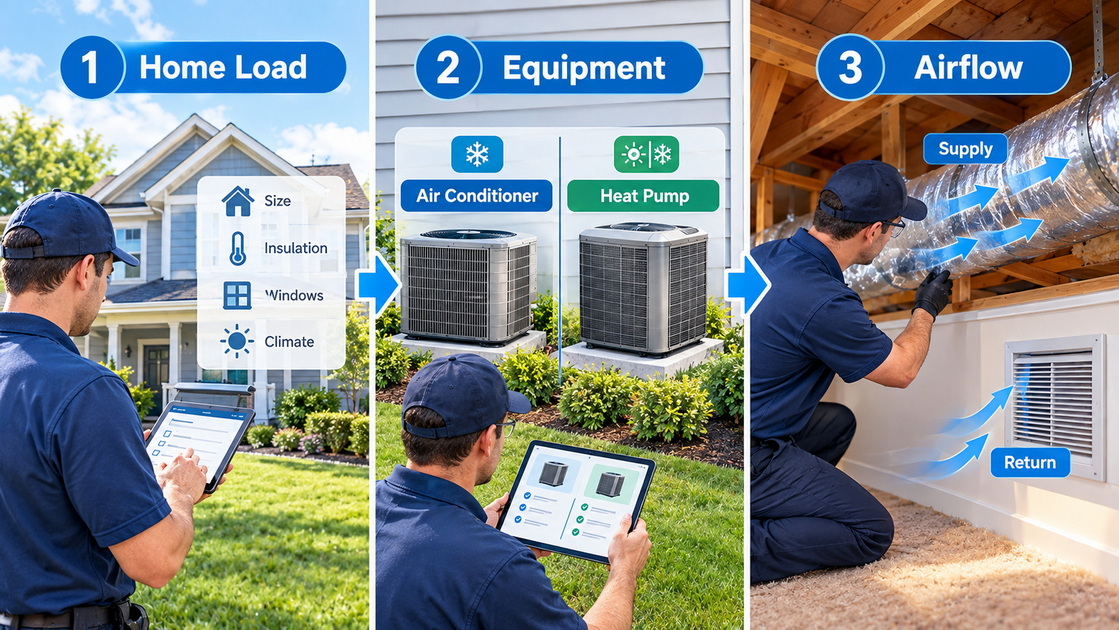
A residential load calculation estimates how much heating and cooling the home requires under design conditions. Manual J is the recognized residential method for this work. It accounts for details such as the building envelope, windows, outdoor conditions, ventilation, and other factors that affect the load.
If certain rooms are consistently uncomfortable, tell the contractor before the calculation begins. Ask how room-by-room needs will be considered, rather than relying only on a whole-house total.
The calculated load does not mean you can simply order a unit with the same number printed on its nameplate. Manual S addresses equipment selection using the loads and manufacturer performance information.
This matters because a proposed air conditioner or heat pump must be evaluated as an actual equipment combination. Ask which indoor and outdoor components are included in the quote and why that combination was chosen.
Even suitable equipment cannot keep every room comfortable if the duct system cannot deliver the required airflow. Manual D addresses duct design based on the selected equipment and the layout and characteristics of the ducts.
In an existing home, ask whether the contractor will assess supply and return airflow, duct restrictions, and visible leakage. If a proposal recommends more tonnage to fix uneven temperatures, the contractor should explain why duct or airflow issues are not the primary cause.
A thermostat tells you the air temperature at its location. It does not tell the whole story of comfort throughout the house. During cooling, the system also removes moisture. If a conventional unit cools the thermostat area quickly and shuts off repeatedly, the home may feel clammy despite reaching the selected temperature.
Tell your contractor about persistent humidity or rooms that feel uncomfortable even when the thermostat reading looks right. Ask how the proposed equipment and controls will address that concern. More tons are not automatically the solution to a damp-feeling home.
A heat pump can provide both cooling and heating, but its cooling tonnage alone does not establish how it will serve your home in winter. The home has a separate heating load. The equipment's heating output also needs to be considered at relevant outdoor temperatures.
If you are comparing heat pump proposals, ask:
- What heating load was calculated for the home?
- What heating performance is expected in local winter conditions?
- Will the system use backup heat, and when?
- Can the existing ducts and blower support the proposed equipment?
A clear answer helps you compare systems on year-round comfort, not just their summer cooling labels.
If you plan to add insulation, seal air leaks, replace windows, or finish a previously unconditioned space, tell your contractor before finalizing equipment size. These projects can change the loads the new system must meet.
This is especially important when several projects are happening close together. A calculation based on the house *before* a major improvement may no longer describe the house *afterward*. Make sure the proposal states which conditions it assumes.

A written proposal should make the reasoning behind the recommended size understandable. Use the same questions with each contractor so you can compare more than the price.
1. Will you provide and explain the heating and cooling load calculation?
2. What did you inspect or verify about the windows, insulation, air leakage, and conditioned rooms?
3. Which indoor and outdoor equipment models are included?
4. How does the selected equipment's performance compare with the calculated loads?
5. How will you check ducts, returns, and airflow?
6. Why is the proposed tonnage the same as—or different from—my existing system?
7. If this is a heat pump, how will it meet the winter heating load?
8. What installation checks and follow-up support are included?
If two bids recommend different sizes, ask each contractor to walk you through the assumptions. A lower or higher tonnage is not automatically better. What matters is whether the recommendation is supported by the home's needs and the performance of the proposed system.
HVAC tonnage is a useful number to understand, but it is only the beginning of a good replacement decision. The right system starts with your home's needs—not a guess based on square footage or an old equipment label. A thoughtful assessment can also reveal whether comfort problems involve sizing, airflow, maintenance, or a combination of factors.
If you are considering a new air conditioner or heat pump, contact Mega Services Heating & Cooling to discuss an in-home assessment. Share what you have noticed about hot rooms, humidity, repairs, or recent renovations. We can help you review the findings and choose a path toward a safer, more comfortable, and more energy-conscious home.
It might be, but square footage cannot confirm it. Climate, insulation, windows, air leakage, humidity, and ducts can change the result. Request a home-specific load calculation before choosing a size.
One ton equals 12,000 Btu/h. For example, 30,000 Btu/h divided by 12,000 equals 2.5 tons of nominal cooling capacity.
Not necessarily. A system that is too large may start and stop frequently and provide poor humidity control. The goal is suitable capacity for the home, paired with equipment and airflow that can deliver it.
You can use the old size as a reference, but do not assume it is correct. Have the current heating and cooling loads reviewed, particularly if comfort problems or home improvements have changed the situation.
No. Tonnage measures cooling capacity; an efficiency rating describes how efficiently equipment operates under its rating method. Compare both, along with installation quality and the condition of the duct system.
No. Cooling capacity alone does not show how much heat the equipment can deliver at the outdoor temperatures relevant to your home. Ask for an explanation of its heating performance and any backup-heat plan.
- One Hour Heating & Air Conditioning. "" Source article for the topic, basic capacity explanation, and current-equipment identification.
- Air Conditioning Contractors of America. "." Residential heating and cooling load-calculation standard.
- Air Conditioning Contractors of America. "." Overview of Manual J load calculations, Manual S equipment selection, and Manual D duct design.
- ENERGY STAR. "." Guidance on proper sizing, comfort, humidity, equipment matching, installation, and ductwork.
- U.S. Department of Energy. "." Explanation of the limitations of square-footage sizing estimates.
- U.S. Department of Energy, Building Science Education Solution Center. "." Guidance on heating and cooling loads, heat pump selection, and the effect of home efficiency improvements.


