
Views: 213 Author: Mega Services Publish Time: 2026-10-03 Origin: Site


Content Menu
● Why a Multimeter Is Important in HVAC Service
● Electrical Safety Must Come First
>> The Safe Diagnostic Process
>> Why Homeowners Should Avoid Live Electrical Testing
● How HVAC Technicians Use a Multimeter
>> Step 1: Confirm the Reported Problem
>> Step 2: Verify Incoming Electrical Power
>> Step 3: Check Thermostat and Low-Voltage Controls
>> Step 4: Evaluate Contactors, Relays, and Safety Switches
>> Step 5: Test HVAC Capacitors
>> Step 6: Test Motors and Compressor Circuits
● Common HVAC Electrical Symptoms Explained
● A Better Way to Diagnose HVAC Problems
● When You Should Schedule Professional HVAC Service
● Preventing HVAC Electrical Problems
● Reliable Heating and Cooling Support for Your Home
>> 1. Can I use a multimeter to fix my own air conditioner?
>> 2. What does a multimeter test in an HVAC system?
>> 3. Why does my air conditioner hum but not start?
>> 4. Why does my furnace breaker keep tripping?
>> 5. Can a bad capacitor stop my air conditioner from cooling?
A multimeter is one of the most valuable diagnostic tools used in heating and cooling service. At Mega Services Heating & Cooling, our technicians use it to identify electrical issues accurately, explain what is happening inside the system, and recommend repairs based on evidence rather than guesswork.
Your furnace, air conditioner, heat pump, or air handler depends on a connected network of electrical components. When one part of that network fails, your home can lose heating, cooling, airflow, or essential safety protection. Professional electrical diagnosis helps restore reliable comfort while reducing the risk of unnecessary part replacement.
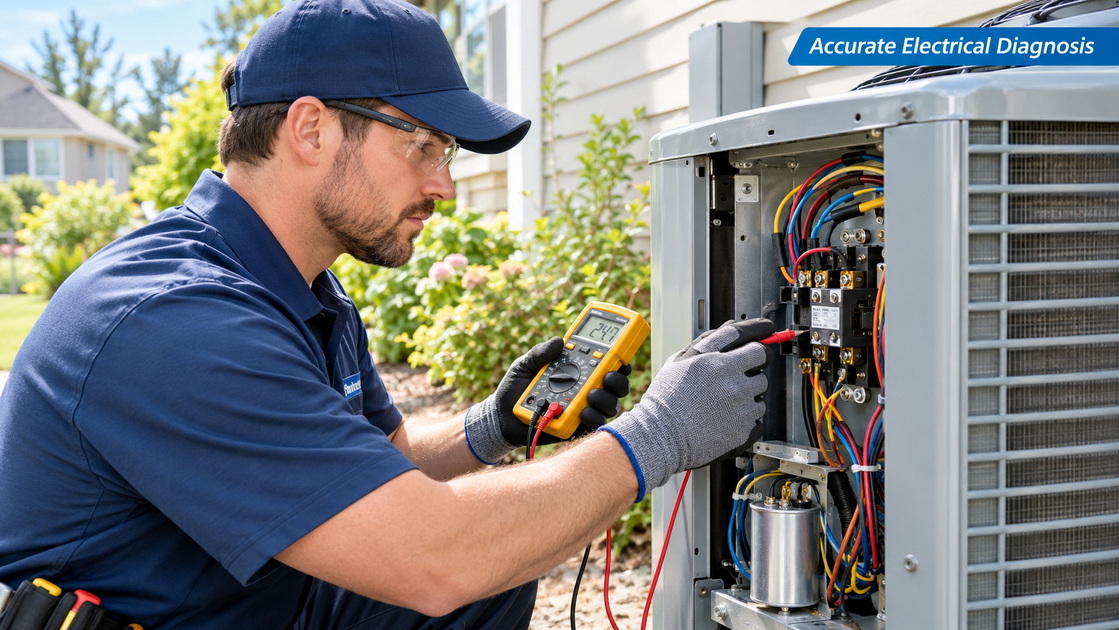
Modern HVAC equipment relies on electricity to control nearly every stage of operation. The thermostat signals the system to start. Low-voltage wiring communicates that request. Relays, contactors, motors, capacitors, transformers, safety switches, and control boards then need to respond in the right order.
When an electrical component fails, homeowners may notice that the system:
- Does not turn on
- Runs but does not heat or cool properly
- Trips a breaker
- Makes clicking, humming, buzzing, or grinding noises
- Starts and stops too frequently
- Blows warm air during cooling mode
- Fails to ignite during heating mode
- Shows a flashing error code
- Has an indoor blower that runs continuously
- Has an outdoor unit that will not start
A multimeter gives a trained technician a way to measure electrical conditions inside the system. It helps identify where power, communication, or component performance breaks down.
| Multimeter Function | What It Can Help Diagnose |
|---|---|
| AC voltage | Whether electrical power is reaching the equipment or component |
| DC voltage | Low-voltage controls, sensors, and certain electronic systems |
| Resistance | Wiring, switches, heating elements, motor windings, and electrical continuity |
| Continuity | Whether a circuit path is complete or interrupted |
| Capacitance | Whether a run capacitor or dual-run capacitor performs within its rated range |
| Amperage | Electrical load and operating condition of motors and compressors |
| Frequency or microamps | Specialized tests for flame sensors, ignition systems, and advanced equipment |
A meter reading by itself does not tell the whole story. A qualified technician must understand the equipment's wiring diagram, electrical specifications, operating sequence, manufacturer requirements, and installed components before reaching a conclusion.
Heating and cooling equipment can contain 120-volt and 240-volt electrical circuits. Some systems also include 24-volt thermostat circuits, high-voltage components, stored electrical energy in capacitors, moving fan blades, sharp sheet metal, gas connections, combustion systems, and hot surfaces.
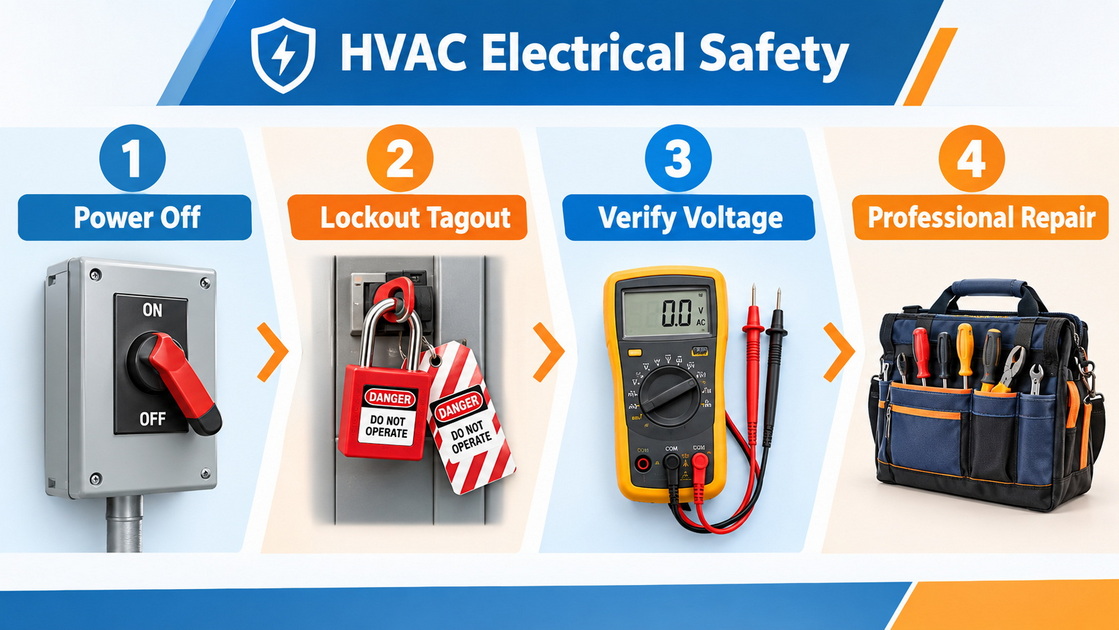
For this reason, electrical diagnosis should never begin with assumptions.
A system may appear to be powered off while still receiving electricity from another source. A breaker may be mislabeled. A disconnect may not fully isolate the equipment. A capacitor can retain an electrical charge even after power is removed.
Professional technicians follow safe procedures before testing or servicing electrical components.
A typical professional electrical diagnostic sequence includes:
1. Reviewing the equipment and identifying possible power sources
2. Turning off the system using the appropriate controls
3. Disconnecting electrical power at the breaker, disconnect, or approved isolation point
4. Preventing unexpected re-energization when service procedures require it
5. Confirming that the multimeter is operating correctly
6. Testing for the absence of voltage before touching internal components
7. Addressing stored electrical energy safely when necessary
8. Restoring power only when controlled live testing is required
This process helps protect the technician, the homeowner, and the HVAC equipment.
Many electrical HVAC problems look simple from the outside. A homeowner may see a capacitor, contactor, relay, or wire that appears to be the cause of the issue. In reality, the component may only be one part of a larger problem.
For example, a failed contactor may be caused by overheating, loose wiring, corrosion, insect damage, a damaged low-voltage control circuit, or excessive system cycling. Replacing the contactor without identifying the contributing condition may lead to another failure later.
Live electrical testing also presents serious hazards. Contact with energized terminals can cause electrical shock, burns, equipment damage, or a short circuit. Incorrect meter settings or improper probe placement can damage sensitive control boards and create unsafe conditions.
Homeowners can safely check thermostat settings, replace approved air filters, confirm that supply vents are open, and observe error codes or unusual sounds. Electrical panels, internal wiring, capacitors, and energized components should be inspected by a qualified HVAC professional.
A thorough diagnostic visit follows the system's sequence of operation. Rather than replacing parts based only on symptoms, the technician tracks where the expected voltage, signal, or electrical response stops.
The diagnostic process starts with the homeowner's experience.
A technician may ask:
- Does the issue happen during heating, cooling, or both?
- Did the problem begin after a storm, power outage, thermostat replacement, or renovation?
- Does the breaker trip immediately or only after the system runs?
- Is the indoor blower operating while the outdoor unit stays silent?
- Does the furnace start and shut down a few seconds later?
- Are there flashing lights or error codes on the furnace or air-handler board?
- Has the system been making new noises?
- Is there a burning or electrical odor?
These details help guide the initial inspection. They also help distinguish between a system that has no power, a system that receives a thermostat call but does not respond, and a system that starts but cannot complete its operating cycle.
The technician first checks whether the HVAC equipment is receiving the proper electrical supply.
Depending on the system and symptom, voltage may be checked at:
- The electrical panel or circuit breaker
- The outdoor disconnect box
- The furnace or air-handler disconnect
- The line side and load side of a contactor
- The terminals supplying a motor
- The transformer that powers low-voltage controls
- Heating elements or electric heat strips
If proper power is not reaching the equipment, replacing a capacitor, motor, or thermostat may not solve the problem. The root cause could be a tripped breaker, damaged disconnect, loose wiring connection, failed contactor, electrical panel issue, or another supply-side fault.
Technicians compare readings with the system's electrical specifications and equipment nameplate. Power can be present but still be outside the acceptable operating range.
Most residential HVAC systems use a 24-volt control circuit. This circuit allows the thermostat to communicate with the furnace, air handler, heat pump, or outdoor air-conditioning unit.
When a homeowner changes the thermostat setting, the thermostat sends a signal to the system. The system then follows a programmed sequence to provide heating, cooling, or airflow.
A technician may check terminals such as:
| Terminal | Typical Purpose |
|---|---|
| R | Power from the transformer |
| C | Common side of the low-voltage circuit |
| Y | Cooling call |
| W | Heating call |
| G | Indoor blower call |
| O/B | Heat-pump reversing valve control |
Testing this circuit can help determine whether the problem is connected to the thermostat, transformer, fuse, control board, wiring, safety switch, or outdoor-unit controls.
For example, if the thermostat calls for cooling but the outdoor unit does not start, the technician checks whether the cooling signal reaches the appropriate equipment terminals. If the signal is missing, the issue may be upstream in the thermostat circuit. If the signal is present but the outdoor equipment does not respond, the technician continues testing the contactor, power supply, capacitor, motor, and compressor circuits.
Contactors and relays are electrically controlled switches. They allow one circuit to control another circuit.
In a typical outdoor air-conditioning unit, a low-voltage signal tells the contactor to close. Once the contactor closes, high-voltage power can reach the compressor and condenser fan motor.
A technician may use a multimeter to determine whether:
- The contactor is receiving the required low-voltage signal
- The contactor closes when the system calls for cooling
- High-voltage power is present on the line side
- Power passes through the contactor to the load side
- The contactor contacts show signs of heat damage or wear
- A safety switch is open or closed when it should be
- A relay or control board is sending the correct output
This testing prevents unnecessary replacement. A contactor may appear defective when the actual cause is a thermostat issue, failed transformer, low-voltage fuse, open safety switch, or damaged control wire.
Capacitors play an important role in many air-conditioning and heat-pump systems. They help certain motors start and continue operating efficiently.
A weak or failed capacitor can contribute to problems such as:
- Outdoor-unit humming
- A condenser fan that will not start
- Hard starting
- Compressor overheating
- Intermittent cooling
- Short cycling
- Higher electrical strain on motors
- An air conditioner that stops cooling
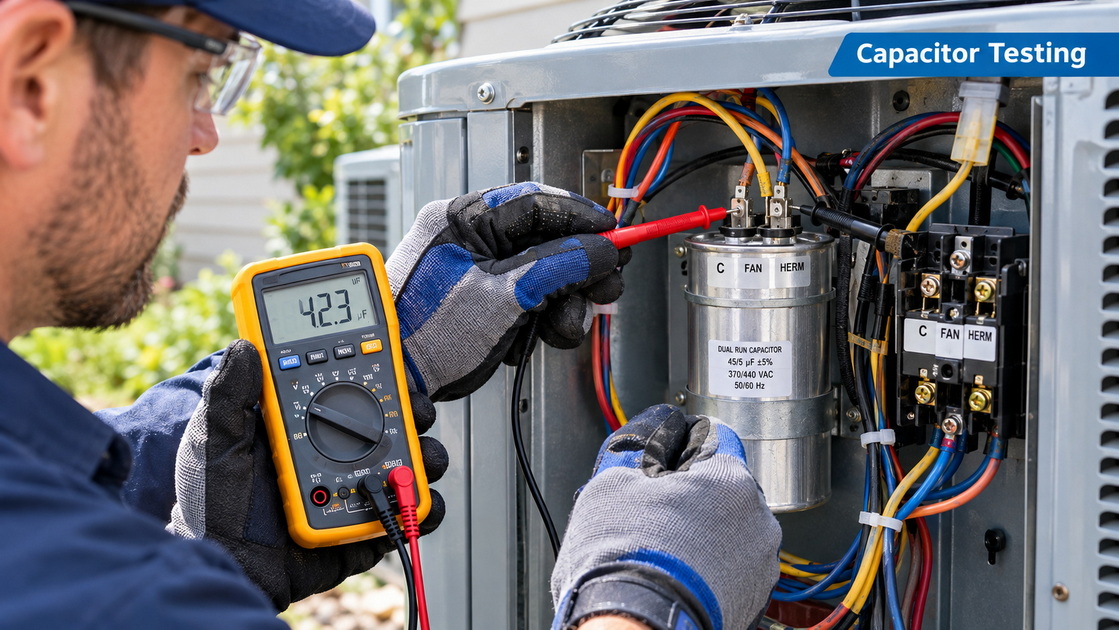
Technicians test capacitors only after safely disconnecting electrical power and confirming the equipment is not energized. The capacitor's measured value is compared with the microfarad rating printed on the component.
A capacitor may appear normal even when it is weak. It may also look swollen, leaking, rusted, or damaged when it has clearly failed. Visual inspection is helpful, but electrical testing provides the more reliable answer.
HVAC systems use several motors, including:
- Indoor blower motors
- Outdoor condenser fan motors
- Furnace inducer motors
- Heat-pump fan motors
- Compressor motors
- Variable-speed motor modules
If a motor does not run, runs intermittently, overheats, or makes unusual sounds, the technician must determine whether the issue is electrical, mechanical, or both.
Multimeter testing may include checking:
- Voltage supplied to the motor
- Continuity through motor windings
- Resistance between designated terminals
- Possible short-to-ground conditions
- Capacitor performance
- Relay, control-board, or contactor output
- Wiring condition
- Electrical connections
- Motor-control signals in advanced equipment
A resistance reading does not always tell the complete story. A motor can pass a basic resistance test but still fail when operating under load. A compressor may show acceptable winding readings but have internal mechanical damage or an overheating condition.
This is why experienced technicians combine electrical readings with operating data, amperage measurements, airflow checks, temperature readings, refrigerant-system observations, and manufacturer procedures.
The same symptom can be caused by different electrical, mechanical, airflow, or control problems. Proper diagnosis helps avoid replacing the wrong part.
| Symptom | Possible Electrical Causes | Other Possible Causes |
|---|---|---|
| Air conditioner will not turn on | Tripped breaker, blown fuse, failed contactor, thermostat issue, damaged wiring | Float switch activation, thermostat setting, equipment safety lockout |
| Outdoor unit hums but fan does not run | Weak capacitor, failed fan motor, contactor problem | Fan blade obstruction, bearing failure |
| Furnace will not ignite | Igniter circuit issue, control-board problem, pressure-switch circuit issue | Gas supply issue, venting issue, dirty flame sensor |
| Breaker keeps tripping | Short circuit, damaged wiring, motor or compressor fault | Mechanical compressor issue, overloaded circuit |
| Blower runs continuously | Thermostat wiring issue, relay malfunction, control-board failure | Incorrect thermostat configuration |
| System short cycles | Control issue, wiring defect, safety-switch interruption | Dirty filter, airflow restriction, refrigerant issue, oversized equipment |
| System turns on but does not cool | Capacitor issue, contactor failure, compressor circuit problem | Refrigerant issue, frozen coil, airflow restriction |
A good HVAC repair starts with identifying the actual reason for the failure. Replacing a part based only on a visible symptom can create additional cost, delay the repair, and leave the original problem unresolved.
A quality service visit should give homeowners clear answers.
When Mega Services Heating & Cooling evaluates an electrical problem, we focus on explaining the condition of the equipment in practical language. We believe homeowners should understand what was found, what the system needs, and why the recommendation matters.
A complete diagnosis should address:
- The symptom reported by the homeowner
- The inspection findings
- The tests performed
- The condition of the affected component
- Whether the issue affects safety, comfort, reliability, or energy use
- Whether nearby wiring or components show heat damage, corrosion, or wear
- The recommended repair options
- Potential consequences of delaying the repair
- Steps that may help prevent similar issues in the future
For example, if a contactor fails because its contacts are burnt, the inspection should also consider loose wiring, excessive heat, contamination, voltage concerns, and system cycling. A replacement is more valuable when it includes an effort to understand why the part failed.
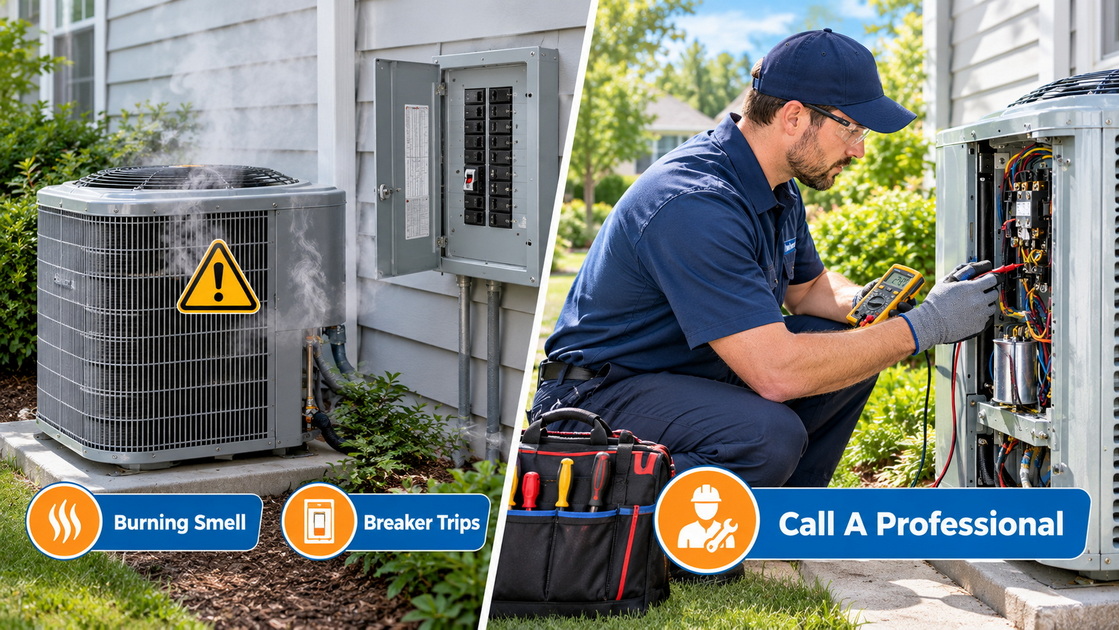
Some HVAC issues require fast attention. Turn the system off if it can be done safely and schedule professional service if you notice:
- A burning-plastic or electrical odor
- Smoke, sparks, or visible arcing
- Scorch marks or melted wire insulation
- A breaker that trips repeatedly
- Loud buzzing or humming that does not stop
- A furnace or air handler that repeatedly shuts down
- Water near electrical components
- A carbon monoxide alarm activation
- Loss of heat during cold weather
- Loss of cooling during extreme heat
If your home uses a gas furnace, boiler, fireplace, water heater, or other fuel-burning appliance, regular professional inspection is especially important. Heating equipment should be maintained carefully to support safe operation, dependable comfort, and proper ventilation.
Not every electrical failure can be prevented. Components eventually wear out, power events happen, and equipment can develop problems as it ages. However, regular maintenance can identify warning signs early.
A professional maintenance visit may include:
- Inspecting visible wiring and electrical connections
- Checking capacitors, contactors, relays, and control components
- Measuring operating voltage and amperage when appropriate
- Inspecting indoor blower and outdoor fan operation
- Checking filters and airflow
- Verifying thermostat performance
- Inspecting safety controls
- Looking for corrosion, moisture intrusion, pest damage, and heat damage
- Evaluating furnace ignition and venting components when applicable
- Checking the general condition of the heating and cooling system
Homeowners can also help protect their HVAC system by replacing filters regularly, keeping outdoor units clear of leaves and debris, avoiding blocked supply and return vents, and scheduling maintenance before the heating or cooling season begins.
Electrical problems in HVAC systems should not be handled through guesswork. A multimeter can provide valuable information, but the most important part of the process is the professional judgment used to interpret the readings safely and accurately.
Mega Services Heating & Cooling is committed to helping homeowners create safer, more comfortable, and more energy-efficient living environments. Whether your system is tripping breakers, failing to start, producing unusual sounds, or struggling to maintain the right temperature, our team can identify the underlying issue and provide clear recommendations.
Your home comfort system should give you confidence—not uncertainty. Accurate diagnosis, careful service, and well-informed repairs help protect that confidence throughout every season.
A multimeter can measure electrical values, but it does not make HVAC electrical work safe for an untrained person. Air-conditioning systems may involve high-voltage electricity, stored capacitor energy, moving equipment, and sensitive control boards. Homeowners should avoid opening electrical panels or testing energized components.
HVAC technicians use multimeters to test voltage, continuity, resistance, capacitance, and sometimes amperage. These readings can help diagnose problems with thermostats, transformers, contactors, capacitors, motors, control boards, safety switches, and wiring.
A humming air conditioner may have a weak capacitor, failing fan motor, stuck compressor, damaged contactor, wiring issue, or mechanical problem. Because several faults can create the same sound, professional testing is needed to identify the actual cause.
A repeatedly tripping breaker can indicate an overloaded circuit, damaged wiring, a short circuit, failing blower motor, electrical component failure, or another serious condition. Avoid repeatedly resetting the breaker, as this can increase risk and potentially damage the system.
Yes. A weak or failed capacitor may prevent the compressor or condenser fan motor from starting or operating correctly. This can cause loss of cooling, overheating, or repeated shutdowns. Proper testing is needed to confirm whether the capacitor is the source of the problem.
1. Air Conditioning Contractors of America.
2. Occupational Safety and Health Administration.
3. U.S. Consumer Product Safety Commission.
4. Fieldpiece Instruments.
5. HVAC School.


