
Views: 212 Author: Mega Services Publish Time: 2026-09-22 Origin: Site


Content Menu
● What Is a Ton of Air Conditioning?
● Why Is AC Capacity Measured in Tons?
● AC Tonnage Is Not the Same as Energy Efficiency
● Why a Bigger Air Conditioner Is Not Always Better
>> Common Problems With an Oversized AC System
● How HVAC Professionals Determine the Right System Size
>> Key Factors That Affect AC and Heat Pump Size
>> Understanding a Manual J Load Calculation
>> Why Existing Equipment Size May Be Misleading
● How Ductwork Affects Air Conditioner Performance
● AC Capacity, Humidity, and Indoor Comfort
● A Real-World Example: Similar Homes, Different Tonnage Needs
>> A Better HVAC Replacement Process
● Questions to Ask Before Replacing Your AC or Heat Pump
● When Should You Request an HVAC Capacity Review?
● Create Reliable Comfort With the Right HVAC System
>> 1. Is a 3-ton air conditioner always 36,000 BTU?
>> 2. How many square feet can one ton of air conditioning cool?
>> 3. Does a bigger air conditioner cool a house faster?
>> 4. Does AC tonnage refer to the physical weight of the unit?
>> 5. Can a heat pump replace both an air conditioner and a furnace?
>> 6. Why does my home feel humid when the air conditioner is running?
>> 7. Should I replace my old system with the same tonnage?
When a Mega Services Heating & Cooling technician recommends a "3-ton air conditioner," they are not talking about a unit that weighs 6,000 pounds. In heating and cooling, a ton is a measurement of cooling capacity: the amount of heat an air conditioner or heat pump can remove from your home in one hour.
One ton of cooling capacity equals 12,000 British thermal units per hour, commonly written as BTU/h. Understanding this term can help homeowners compare replacement options, ask better questions, and make confident decisions about their home comfort system.
A larger system is not automatically a better system. The right equipment size, careful installation, balanced airflow, and regular maintenance work together to create a safer, more comfortable, and more energy-conscious home.

In air conditioning, one ton represents 12,000 BTU/h of cooling capacity.
A BTU is a unit used to measure heat energy. It is approximately the amount of heat needed to raise the temperature of one pound of water by 1°F. Air conditioners and heat pumps do not create cold air in the same way a furnace creates heat. Instead, they remove heat from indoor air and release it outside through a refrigeration cycle.
The greater the system's capacity, the more heat it can remove per hour.
| Air Conditioner Capacity | Cooling Output |
|---|---|
| 1 ton | 12,000 BTU/h |
| 1.5 tons | 18,000 BTU/h |
| 2 tons | 24,000 BTU/h |
| 2.5 tons | 30,000 BTU/h |
| 3 tons | 36,000 BTU/h |
| 3.5 tons | 42,000 BTU/h |
| 4 tons | 48,000 BTU/h |
| 5 tons | 60,000 BTU/h |
For example, a 3-ton central air conditioner is designed to remove approximately 36,000 BTUs of heat per hour under standard operating conditions. However, this does not mean every 3-ton system performs exactly the same in every home, climate, or installation.
Actual performance can be influenced by the equipment combination, ductwork, airflow, thermostat settings, insulation, refrigerant charge, outdoor temperature, and the condition of the home itself.
The term "ton" comes from the early history of cooling with ice.
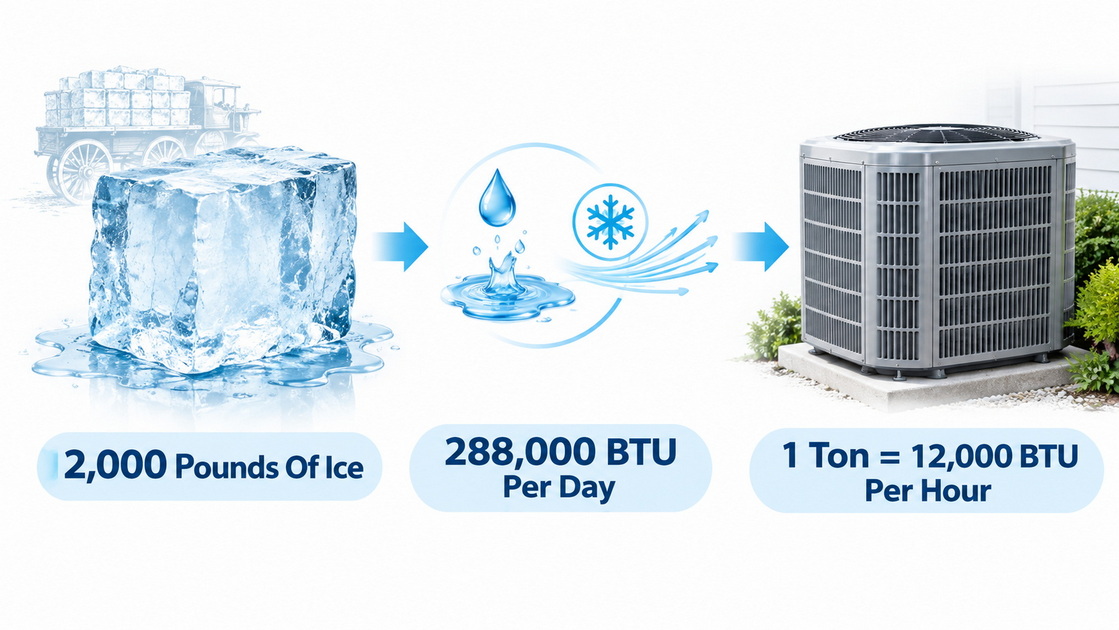
Before modern refrigeration and central air conditioning, people used harvested ice to preserve food and cool buildings. Engineers needed a reliable way to compare the cooling power of ice with the capacity of mechanical refrigeration equipment.
The benchmark became the amount of heat needed to melt one ton of ice over 24 hours.
A standard ton of ice weighs 2,000 pounds. When ice melts at 32°F, each pound absorbs approximately 144 BTUs of heat. That means one ton of ice absorbs:
2,000 pounds×144 BTU per pound=288,000 BTUs
When that number is divided by 24 hours, the result is:
288,000 BTUs÷24 hours=12,000 BTU/h
That calculation became the standard definition of one ton of refrigeration.
Today's air conditioners, furnaces, and heat pumps are far more advanced than early ice-based cooling systems. Still, the term remains useful because it provides a simple way to describe how much cooling capacity a system can deliver.
Homeowners often see several numbers on heating and cooling equipment proposals. Tonnage is only one of them.
Tonnage answers this question:
> How much heat can the system remove?
Efficiency answers a different question:
> How much electricity does the system use to deliver that cooling?
A 3-ton air conditioner may have a different efficiency level than another 3-ton air conditioner. The systems may also use different compressor technologies, fan motors, controls, refrigerants, and indoor coil configurations.
Several factors influence how efficiently a system operates:
- Equipment design and efficiency rating.
- Indoor and outdoor equipment compatibility.
- Duct leakage and airflow restrictions.
- Refrigerant charge.
- Thermostat programming.
- Home insulation and air sealing.
- Window type and sun exposure.
- System maintenance.
- Quality of installation.
A high-efficiency system may help reduce energy use, but equipment performance depends on the entire comfort system. Even premium equipment can struggle if ductwork leaks, airflow is restricted, the refrigerant charge is incorrect, or the system is not matched to the home's actual needs.
A common assumption is that a larger air conditioner will cool a home faster and provide better comfort. In reality, an oversized unit can create comfort problems.
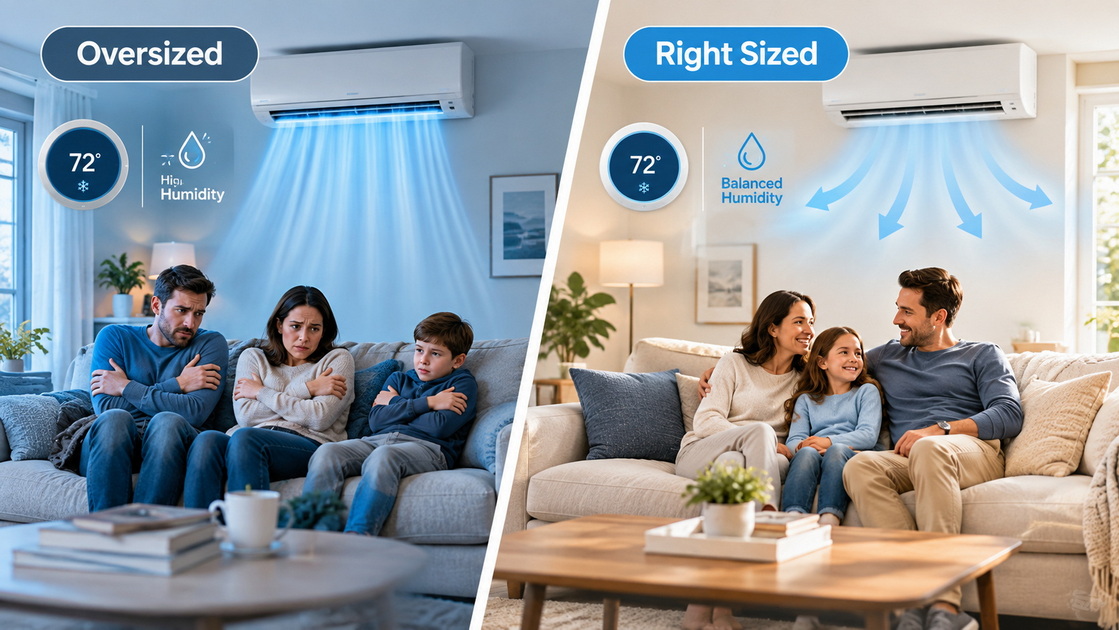
When an air conditioner is too large, it may cool the area near the thermostat very quickly. The system then shuts off before it has had enough time to remove moisture from the air. The temperature may appear comfortable, but the home can still feel humid, sticky, uneven, or clammy.
This frequent starting and stopping is often called short cycling.
An oversized system may lead to:
- Short and frequent cooling cycles.
- Reduced humidity control.
- Uneven temperatures between rooms.
- Hot upstairs areas or uncomfortable bedrooms.
- Increased wear from repeated starts and stops.
- Higher initial equipment costs.
- Less consistent comfort throughout the day.
- Difficulty maintaining stable indoor conditions.
A system that is too small can also cause problems. It may run for very long periods during hot weather, struggle to reach the thermostat setting, and place extra strain on system components.
The goal is not to choose the largest or smallest system. The goal is to select a system that is properly matched to the home.
Square footage matters, but it is only one part of the calculation.
Two homes with the same square footage can require very different heating and cooling capacities. A 2,000-square-foot home with modern insulation, efficient windows, shade trees, sealed ducts, and a well-maintained attic may need significantly less cooling than a similarly sized home with old windows, poor insulation, heavy sun exposure, high ceilings, and duct leakage.
A professional sizing evaluation considers how the home actually gains and loses heat.

A detailed heating and cooling evaluation may include:
- Local outdoor temperatures and climate conditions.
- Total conditioned square footage.
- Ceiling height and open floor plans.
- Number and size of windows.
- Window direction and solar exposure.
- Attic insulation and wall insulation.
- Air leakage around doors, windows, and penetrations.
- Roofing materials and attic heat.
- Number of people living in the home.
- Heat from lighting, appliances, and electronics.
- Ductwork design, condition, and location.
- Airflow balance between rooms.
- Additions, converted garages, sunrooms, or finished attics.
This is why online size charts should be treated only as general education tools. They cannot accurately account for every condition in an individual home.
A Manual J load calculation is a detailed method used to estimate a home's heating and cooling requirements. It evaluates the building, not just the square footage.
The calculation helps identify how much cooling a home needs during warm weather and how much heating it needs during cold weather. It can also reveal room-by-room differences that may contribute to uneven comfort.
For example, a bedroom with several west-facing windows may need more cooling than a shaded interior room. A properly designed system considers those differences through equipment selection, duct design, airflow adjustments, and zoning options where appropriate.
A careful load calculation helps prevent common replacement mistakes, including installing equipment based only on the size of the old system.
Many homeowners assume their existing system must be the correct size because it has been running for years. However, an older system may have been oversized, undersized, poorly installed, or selected before home improvements changed the heating and cooling load.
Changes that can affect the correct system size include:
- New windows.
- Additional insulation.
- Roof replacement.
- Attic ventilation improvements.
- Home additions.
- Converted garages.
- Finished basements.
- New appliances.
- Solar shading changes.
- Duct repairs or duct replacement.
- Air-sealing improvements.
Replacing an old 4-ton system with another 4-ton system without evaluating the home may repeat an earlier design problem.
Your air conditioner or heat pump is only one part of the comfort system. Ductwork is responsible for moving conditioned air through the home and returning indoor air to the equipment.
Poor duct design or damaged ducts can reduce comfort even when the equipment itself is new and properly sized.
Common duct-related issues include:
- Air leaks in attics, crawlspaces, garages, or wall cavities.
- Crushed or disconnected flexible ducts.
- Undersized supply ducts.
- Inadequate return-air pathways.
- Dirty or restricted filters.
- Improperly balanced airflow.
- Rooms located far from the central equipment.
- Ducts exposed to very hot attic temperatures.
A system can have the correct tonnage and still deliver poor comfort if air cannot move properly. In many homes, solving airflow or duct issues can make a significant difference in room-to-room temperature consistency.
Comfort is about more than temperature.
During cooling season, an air conditioner removes sensible heat and latent heat. Sensible heat is the heat that changes the air temperature. Latent heat is associated with moisture in the air.
When humidity remains high, a home may feel uncomfortable even when the thermostat shows a reasonable temperature. This is why a home set to 74°F can feel very different at high humidity than it does at balanced indoor humidity.
An oversized air conditioner may not run long enough to remove adequate moisture. Other possible causes of humidity discomfort include:
- Poor airflow.
- Improper refrigerant charge.
- Duct leakage.
- Outdoor air infiltration.
- Insufficient insulation.
- Bathroom or kitchen ventilation issues.
- Moisture entering through crawlspaces or basements.
- Thermostat settings.
- A system that is not operating correctly.
Variable-speed and variable-capacity systems can provide more flexibility in many homes. They may operate at lower output for longer periods when full cooling capacity is not required. Longer, steadier operation can help support more consistent temperatures and humidity control.
However, advanced equipment should always be paired with proper system design and installation.
Imagine two neighboring homes, each with 2,200 square feet of conditioned living space.
Home A has upgraded attic insulation, low-emissivity windows, sealed ducts, shade from mature trees, and a well-sealed building envelope.
Home B has older windows, a large west-facing glass area, duct leakage in a hot attic, limited insulation, and higher indoor heat gain from occupants and appliances.
A simple square-footage estimate might recommend the same system size for both homes. However, a detailed evaluation could show that Home A requires less cooling capacity while Home B needs a combination of building improvements, duct repairs, and carefully selected equipment.
This is why the most dependable comfort solution looks at the whole home rather than focusing on a single equipment number.
A thoughtful heating and cooling replacement process should include:
1. Listening to comfort concerns and reviewing the home's history.
2. Measuring the home and evaluating key building conditions.
3. Reviewing insulation, windows, sun exposure, and air leakage.
4. Inspecting ductwork and airflow pathways.
5. Calculating heating and cooling requirements.
6. Selecting compatible indoor and outdoor equipment.
7. Reviewing efficiency, comfort features, and operating expectations.
8. Installing the system with attention to safety and workmanship.
9. Testing airflow, refrigerant operation, drainage, thermostat control, and overall performance.
10. Explaining maintenance needs and recommended service intervals.
Before approving a heating and cooling replacement proposal, ask clear questions about the recommended system.
- How was the equipment size determined?
- Was a detailed load calculation completed for my home?
- What cooling and heating capacity does my home require?
- Why is this system size appropriate for my house?
- Will the ductwork be inspected as part of the project?
- Are the indoor and outdoor units designed to operate together?
- How will airflow be measured and adjusted?
- How will the system be tested after installation?
- What maintenance does the new system require?
- What should I expect during extremely hot or cold weather?
A reliable contractor should be willing to explain recommendations in plain language. Homeowners should understand what they are purchasing, why it was selected, and how it is expected to perform.
A professional evaluation can be especially helpful if you notice any of the following conditions:
- The AC runs constantly but the home still feels warm.
- The home feels cool but humid.
- Certain rooms are consistently too hot or too cold.
- The system starts and stops frequently.
- Your energy bills have increased unexpectedly.
- You are planning a home addition or major renovation.
- You have upgraded insulation, windows, or roofing.
- You are converting a garage, attic, or basement into living space.
- You have received different equipment-size recommendations.
- Your current system is aging or needs frequent repairs.
These issues do not always mean that a larger system is needed. They may point to airflow, ductwork, insulation, maintenance, thermostat, or equipment-performance concerns.
Understanding air conditioner tonnage is useful, but it is only one part of choosing the right heating and cooling system.
One ton equals 12,000 BTU/h of cooling capacity. Yet the ideal system for your home depends on much more than square footage or the capacity of the equipment you already own. Home design, insulation, windows, ductwork, airflow, humidity, climate, and installation quality all affect comfort.
Mega Services Heating & Cooling helps homeowners make informed decisions about air conditioning, heating, heat pumps, maintenance, repairs, airflow, and indoor comfort. Our team takes the time to evaluate your home's needs and explain practical options clearly, so you can choose a solution built around comfort, safety, and efficient operation.
For dependable heating and cooling guidance, schedule a home comfort assessment with Mega Services Heating & Cooling and get clear answers about your system's performance, capacity, and replacement options.
A 3-ton system is generally associated with 36,000 BTU/h of nominal cooling capacity. Actual performance may vary based on the specific indoor and outdoor equipment combination, airflow, refrigerant charge, thermostat operation, installation quality, and outdoor conditions.
There is no single accurate answer for every home. Square footage is only one sizing factor. Insulation, window area, climate, ceiling height, sun exposure, ductwork, air leakage, and occupancy can all change the amount of cooling a home needs.
A larger unit may cool the thermostat area more quickly, but it can reduce overall comfort if it shuts off too soon. Oversized systems may short-cycle, remove less moisture, and create uneven temperatures. Proper sizing is usually more important than maximum capacity.
No. Tonnage refers to cooling capacity, not physical weight. One ton of air conditioning equals 12,000 BTU/h of cooling capacity.
In many homes, a heat pump can provide both cooling and heating. Whether it is the right option depends on local climate, home design, electrical capacity, utility costs, insulation, comfort priorities, and the home's heating load.
Humidity can be affected by an oversized system, poor airflow, duct leakage, incorrect refrigerant charge, outdoor air infiltration, ventilation issues, moisture in crawlspaces or basements, thermostat settings, or maintenance needs. A professional inspection can help identify the underlying cause.
Not automatically. The existing system may have been incorrectly sized, and your home may have changed over time. Insulation upgrades, new windows, additions, roof work, duct repairs, and air-sealing improvements can all affect the appropriate system size.
1. Air Conditioning Contractors of America.
2. U.S. Department of Energy.
3. ENERGY STAR.
4. ENERGY STAR.
5. Air-Conditioning, Heating, and Refrigeration Institute.
6. Air-Conditioning, Heating, and Refrigeration Institute.


