
Language
Views: 213 Author: Mega Services Publish Time: 2026-10-23 Origin: Site


Content Menu
● Is There Still an R-454B Refrigerant Shortage?
● What Caused the R-454B Shortage?
>> Demand Shifted Faster Than Expected
>> Cylinders and Packaging Became Bottlenecks
>> Factory Demand and Field Demand Were Different
● What Did Manufacturers Do to Improve Supply?
● R-454B vs. R-410A: What Actually Changes?
● Do You Need to Replace an Existing R-410A System?
>> Repair May Be Reasonable When
>> Replacement Deserves Consideration When
● Is R-454B Safe for Residential Use?
● Can R-454B Be Mixed With Another Refrigerant?
● Can an R-454B System Be Recharged After a Leak?
● How to Evaluate an R-454B Installation or Repair Quote
● What Should You Do if Your Installation Is Delayed?
● How to Protect Comfort and Energy Performance
● Plan Your Next Step With Mega Services Heating & Cooling
>> 1. Has the R-454B refrigerant shortage ended?
>> 2. Can I keep using my R-410A air conditioner?
>> 3. Can R-454B replace R-410A in my existing unit?
>> 4. Will R-454B automatically lower my electricity bill?
>> 5. Should I buy refrigerant before a future shortage?
>> 6. Does every new installation need extra R-454B?
>> 7. Can a technician simply top off a leaking system?
The R-454B refrigerant shortage raised understandable concerns for homeowners planning air conditioner repairs, heat pump installations, or system replacements. Would cooling equipment arrive on time? Would refrigerant costs increase? Could an older system still be repaired?
The situation has changed since the supply disruptions of 2025. Current manufacturer guidance describes R-454B as widely available, although that does not guarantee immediate stock at every local distributor.
At Mega Services Heating & Cooling, our focus is helping families create safe, comfortable, energy-conscious homes. Our approach to refrigerant uncertainty is straightforward: understand your equipment, verify availability, and avoid rushed decisions.
This guide explains what caused the shortage, what has changed, and how to protect your comfort and budget.
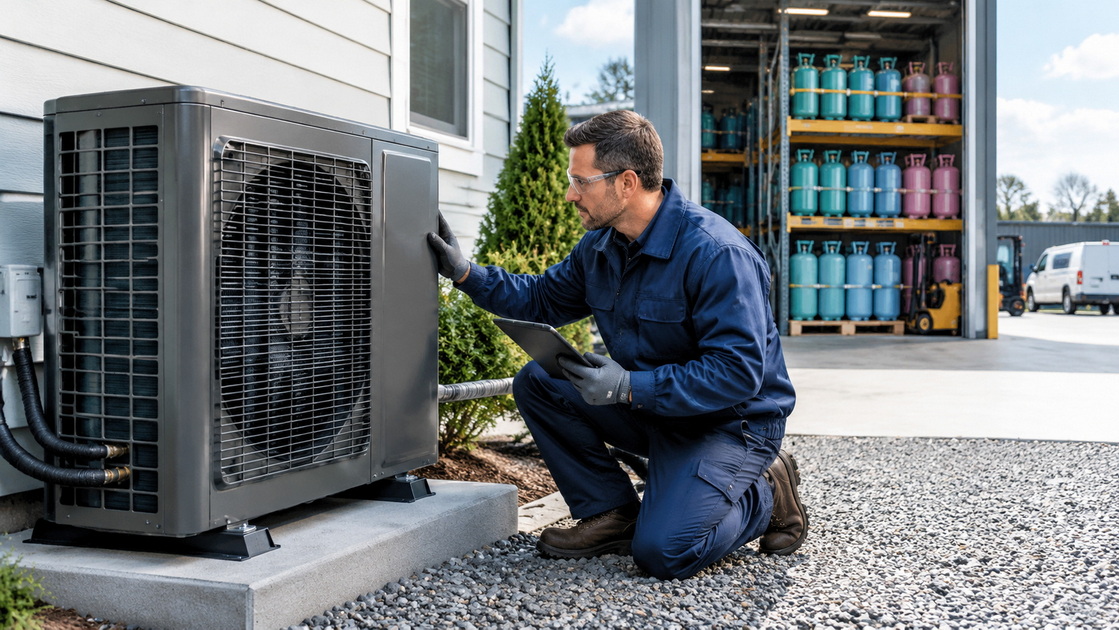
The broad availability picture is more encouraging than it was during the 2025 disruption. However, national availability and readiness for your installation are different questions.
A distributor may have refrigerant but not your selected equipment. Another may have the outdoor unit while waiting for a compatible indoor component.
For homeowners, the most useful question is not simply, "Has the shortage ended?" It is:
Availability: "Are the equipment, compatible components, and refrigerant needed for my specific job confirmed?"
Before scheduling work, request confirmation of:
- The outdoor and indoor equipment model numbers.
- The refrigerant specified for those models.
- Availability of any additional installation charge.
- The anticipated installation date and outstanding dependencies.
Treat a projected delivery date as an estimate until the necessary materials are secured.
The shortage developed when several parts of the supply chain struggled to accommodate a rapid transition.
During early 2025, contractors moved from remaining R-410A equipment inventories to newer refrigerant systems.
That shift created concentrated demand for R-454B. Forecasts that anticipated a gradual transition did not adequately capture the speed of purchasing.
The challenge extended beyond refrigerant already inside factory-built equipment. Contractors also needed cylinders for installation adjustments and service work.
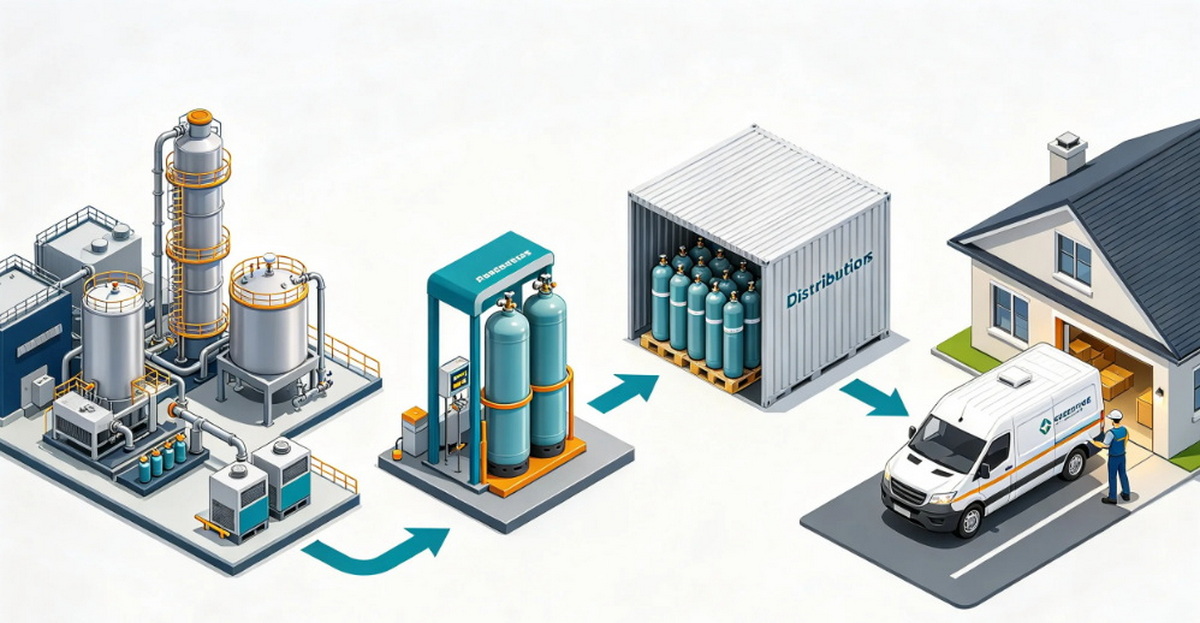
Producing refrigerant is only one step toward making it available to technicians.
It must also be blended, packaged in suitable containers, transported, and delivered through distribution networks. During the disruption, cylinder availability and packaging capacity limited access to usable field supplies.
This distinction matters: a supplier can have refrigerant in bulk while contractors still struggle to obtain appropriately packaged cylinders.
Manufacturers could forecast refrigerant needed for equipment production more readily than the additional quantities contractors would need onsite.
Longer refrigerant lines and installation-specific requirements added demand outside factory planning.
The result was a coordination problem across chemical producers, cylinder suppliers, equipment manufacturers, and distributors—not simply a shortage of one chemical ingredient.
Industry responses addressed several different bottlenecks.
Producers increased staffing and expanded blending and packaging operations. Cylinder manufacturers increased output. Equipment manufacturers also adjusted factory charging practices to reduce the additional refrigerant required for some installations.
During the 2025 industry discussion, Carrier described increasing the line-length allowance covered by factory charge on its equipment. Trane also described adding charge to certain units.
These measures helped reduce pressure on field supplies, but they were not universal installation rules.
A factory charge covers specified conditions. Actual requirements still depend on the equipment model, line length, and manufacturer instructions.
For homeowners, the takeaway is practical: "precharged" does not automatically mean an installation will need no additional refrigerant.
R-454B is a refrigerant used in new equipment designed specifically for it. It is not a universal replacement fluid for older systems.
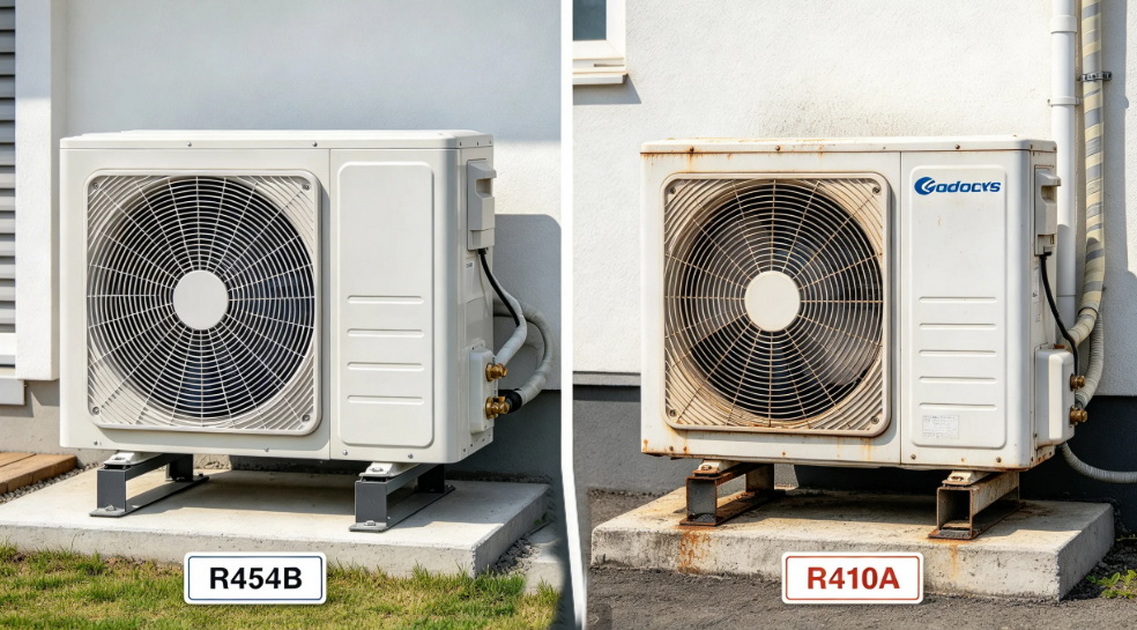
| Feature | R-454B | R-410A |
|---|---|---|
| Typical application | New equipment designed for R-454B | Existing equipment and qualifying legacy inventory |
| Global warming potential | 466 | 2,088 |
| Safety classification | A2L: lower toxicity, mildly flammable | A1: lower toxicity, no flame propagation under classification tests |
| Interchangeability | Cannot be substituted into an R-410A system | Must remain in equipment specified for it |
| Service requirements | Manufacturer-specific procedures and appropriate A2L practices | Procedures specified for the existing equipment |
R-454B's lower global warming potential reduces the potential climate impact of refrigerant emissions compared with R-410A.
That does not translate directly into an equivalent reduction in electricity consumption. Energy use depends on the complete system, installation quality, operating conditions, and home.
Choose equipment based on documented performance and suitability—not refrigerant branding alone.
No. The refrigerant transition does not automatically require homeowners to replace functioning R-410A equipment.
Existing systems can still be serviced. A repair decision should consider the actual fault, equipment condition, repair scope, and likely ownership costs.
- The problem is identifiable and repairable.
- The remaining equipment is in serviceable condition.
- Compatible replacement parts are available.
- The repair cost is reasonable compared with replacement.
- A major failure requires a substantial investment.
- Refrigerant leaks recur.
- Comfort problems persist despite appropriate repairs.
- Multiple aging components need attention.
Avoid making the decision solely because someone says R-410A is "banned."
There is also an important 2026 regulatory update: the federal installation deadline was removed for qualifying residential and light-commercial legacy systems assembled from eligible pre-2025 components.
That is not permission to assemble any new R-410A system from any available parts. Eligibility requirements and applicable state or local rules still require verification.
R-454B is used in residential equipment designed and approved for its characteristics.
Its A2L classification means lower toxicity and mild flammability. That makes appropriate equipment design, installation practices, and service procedures important.
Depending on the equipment and application, requirements may include refrigerant detection, mitigation controls, installation-space considerations, and specified service tools.
Homeowners should ask whether their contractor is familiar with the selected equipment and its A2L requirements.
Do not attempt refrigerant charging, recovery, or equipment conversion yourself. These are professional service tasks, not household maintenance projects.
No. Mixing refrigerants is not an acceptable way to solve a supply problem.
An R-410A system should not be topped off with R-454B. Likewise, an R-454B system should not receive R-32 or another product simply because that refrigerant is available.
Equipment is designed around a specified refrigerant and operating envelope.
An unauthorized substitution can create performance problems, complicate future service, and affect warranty coverage. Adding a mildly flammable refrigerant to equipment not designed for it also introduces safety concerns.
The correct response to unavailable refrigerant is a documented sourcing or scheduling plan—not improvisation.
Potentially, yes. However, the service procedure must follow the equipment manufacturer's instructions and account for the system's condition.
One technical distinction deserves attention: R-454B has low temperature glide. It should not be described as a refrigerant that necessarily becomes unusable whenever a leak occurs.
Temperature glide describes the temperature change that occurs as a refrigerant blend evaporates or condenses at a given pressure.
Low glide does not mean every leaking system should receive a routine top-off.
A technician should assess:
1. Where the leak occurred.
2. How much refrigerant may have escaped.
3. Whether contamination or other damage is present.
4. Whether the manufacturer permits adding refrigerant under those conditions.
5. Whether recovery and a complete recharge are necessary.
The priority is diagnosing and addressing the leak rather than repeatedly adding refrigerant without understanding the loss.
A useful quote explains the work—not just the total.
When comparing proposals, ask for enough detail to understand what each contractor includes.

| Quote item | What to clarify |
|---|---|
| Equipment | Exact models and compatible component combination |
| Refrigerant | Whether the price includes any required additional charge |
| Refrigerant lines | Whether existing lines can be reused under manufacturer instructions |
| Diagnostics | What testing supports the proposed repair |
| Leak work | Whether locating and repairing a leak are included |
| Installation | Applicable permits, electrical work, and startup procedures |
| Warranty | Equipment coverage, labor terms, and exclusions |
| Scheduling | Confirmed materials versus items still awaiting delivery |
A low headline price can be misleading if essential work remains outside the proposal.
Similarly, an expensive quote is not automatically justified by a general reference to the shortage. Ask which specific material, labor requirement, or supply constraint affects your project.
Start by asking exactly what is missing.
An equipment delay, refrigerant delay, permit issue, and scheduling conflict require different solutions.
1. Identify the bottleneck. Request a specific explanation rather than a general shortage statement.
2. Confirm the next milestone. Ask when the supplier expects an update.
3. Evaluate your existing system. Determine whether a reasonable repair can bridge the delay.
4. Discuss compatible alternatives. Any proposed substitution should be approved for the complete system.
5. Document the agreement. Record scheduling expectations, payment terms, and cancellation provisions.
If cooling is essential for a medically vulnerable household member, explain that immediately. Temporary arrangements may need to take priority over the permanent installation schedule.
Do not accept an incompatible refrigerant or incomplete safety setup simply to finish sooner.
Refrigerant choice is only one part of reliable heating and cooling.
A new system cannot fully compensate for poor airflow, incorrect sizing, duct problems, or an installation that does not follow specifications.
When planning replacement, discuss:
- How the equipment capacity was selected.
- Whether airflow and duct conditions need evaluation.
- What startup measurements will be recorded.
- How thermostat and heat pump settings will be configured.
- Which maintenance tasks the homeowner should perform.
These questions shift the conversation from "Which refrigerant is newer?" to "Will this system work properly in my home?"
That is the more useful measure of value.
A refrigerant transition should not pressure you into an unnecessary replacement—or leave you accepting an unclear repair plan.
Mega Services Heating & Cooling provides air conditioning and heating installation, repair, and maintenance with a focus on safe, comfortable, energy-conscious living.
Contact our team to schedule an assessment. Ask us to explain your system's refrigerant, the recommended work, available options, and any supply-related scheduling considerations before you approve the job.
Current manufacturer guidance describes R-454B as widely available. However, local stock and project requirements can differ. Confirm availability for your equipment and installation rather than relying on a nationwide statement.
Yes. A working R-410A system does not require replacement solely because newer equipment uses a different refrigerant. Its condition and repair needs should guide your decision.
No. R-454B is not a drop-in replacement. It requires equipment designed and approved for that refrigerant, including applicable safety provisions.
No. Refrigerant selection alone does not determine energy consumption. System efficiency, sizing, airflow, installation quality, weather, and household operation all affect electricity use.
For homeowners, arranging professional service is more useful than purchasing cylinders. Your contractor should determine the correct refrigerant and quantity and handle sourcing, storage, and charging.
No. Some installations fall within the factory-charge allowance. Others require additional refrigerant because of line length or configuration. The equipment instructions determine the correct charge.
Sometimes adding refrigerant is permitted, but the correct procedure depends on manufacturer instructions and system condition. The leak should be investigated rather than treated as a recurring refill requirement.
1., June 18, 2025. Original industry-panel reporting supporting the historical discussion of demand forecasting, cylinder constraints, factory charging changes, and manufacturer responses. Its projected relief dates are historical forecasts, not current availability guarantees.
2., by Travis Baugh, expert review by Michelle Notaro. Supports current manufacturer availability guidance, refrigerant composition, GWP figures, safety classifications, equipment compatibility, and installation considerations.
3.. Technical product information supporting the low-temperature-glide clarification, A2L classification, GWP, and use in new equipment. Product-level top-off guidance does not override equipment-specific service instructions.
4., updated July 28, 2026. Official rulemaking history and materials covering the 2026 reconsideration of residential and light-commercial refrigerant-transition requirements.
5., published May 26, 2026; effective July 27, 2026. Primary legal source for the regulatory update.
6., July 29, 2026. Explains qualifying legacy inventory, eligible pre-2025 components, and the distinction between new installations and service components.
7.. Supports the explanation that R-454B is not a drop-in replacement for R-410A. Historical installation deadlines on this page should be read alongside the subsequent 2026 final rule.


