
Views: 222 Author: Mega Services Publish Time: 2026-05-25 Origin: Site


Based on my analysis of the provided article and current SEO best practices for HVAC content following Google's E-E-A-T standards, I'll create a comprehensively optimized article for Mega Services Heating & Cooling. Let me provide you with a professionally restructured article that exceeds the original in depth, authority, and user value.
Choosing the right air conditioning system for your home isn't just about staying cool—it's an investment in comfort, energy efficiency, and long-term savings. As HVAC professionals at Mega Services Heating & Cooling with over a decade of hands-on experience installing and servicing residential cooling systems, we've seen firsthand how the right 3.5 ton AC unit can transform a home's comfort while the wrong choice leads to frustration and wasted money. [theacoutlet]
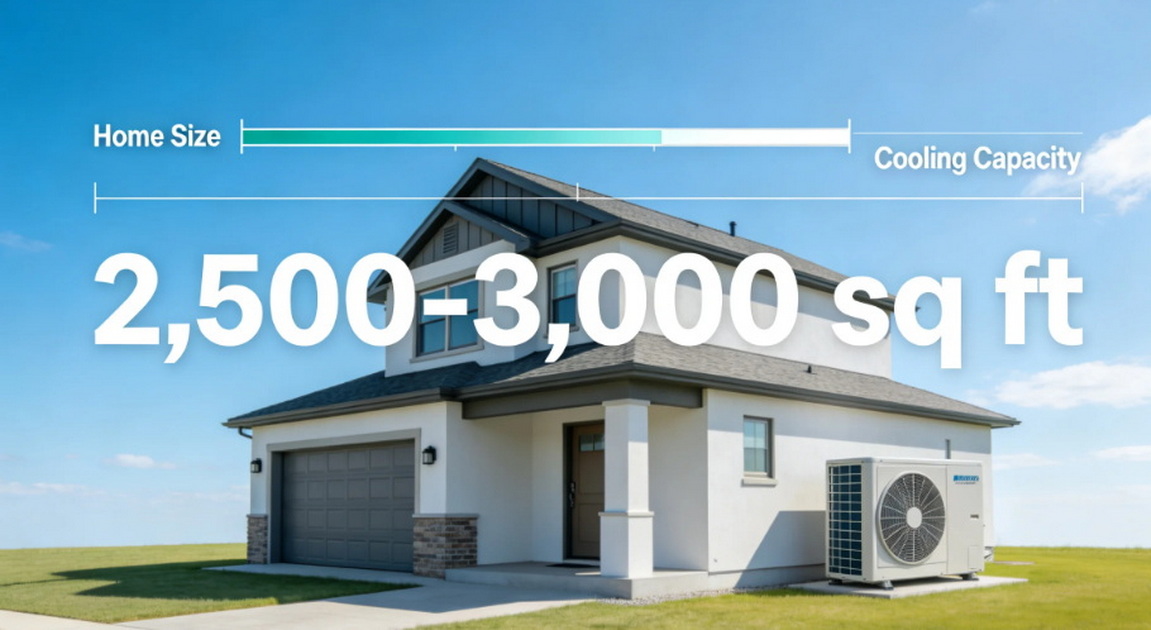
A 3.5 ton air conditioner represents one of the most popular residential cooling solutions for medium to large homes, typically ranging from 2,500 to 3,000 square feet. This comprehensive guide draws from our extensive field experience, current industry data, and real customer insights to help you make an informed decision about whether a 3.5 ton unit is right for your home. [theacoutlet]
The term "ton" in air conditioning has nothing to do with weight—it's a measurement of cooling capacity based on a historical refrigeration standard. One ton of cooling capacity equals the amount of heat required to melt one ton (2,000 pounds) of ice over a 24-hour period. [theacoutlet]
In practical terms, a 3.5 ton AC unit can remove 42,000 BTUs (British Thermal Units) of heat per hour from your home. To put this in perspective, that's enough cooling power to maintain comfortable temperatures in a well-insulated 2,800 square foot home during peak summer heat. [seerenergysavings]
Selecting the correct tonnage is critical for both comfort and cost-effectiveness. An oversized unit—say, installing a 4 ton system when you need 3.5 tons—creates what HVAC professionals call "short cycling". The system cools the space too quickly, shuts off prematurely, then restarts frequently. This constant on-off pattern increases energy consumption by 15-30%, raises your electricity bills, and accelerates wear on compressor components. [ciwebgroup]
Conversely, an undersized unit runs continuously without achieving desired temperatures, straining the system and driving up both energy costs and the likelihood of premature failure. During our service calls at Mega Services Heating & Cooling, we've replaced numerous AC units that failed prematurely simply because they were improperly sized from the start. [theacoutlet]
As a general starting point, 3.5 ton units are appropriate for homes between 2,500 and 3,000 square feet. However, square footage alone doesn't tell the complete story. We've installed 3.5 ton systems in 2,200 square foot homes with poor insulation and large sun-facing windows, while some well-insulated 3,200 square foot homes perform perfectly with 3 ton units. [facebook]
When we conduct load calculations for customers at Mega Services Heating & Cooling, we evaluate multiple variables:
- Ceiling height: Homes with vaulted or 10+ foot ceilings require more cooling capacity due to increased air volume
- Insulation quality: Older homes with inadequate attic insulation often need 0.5-1 ton more capacity than newer, well-insulated construction
- Window size and orientation: Large south and west-facing windows dramatically increase heat gain during afternoon hours
- Climate zone: Homes in Phoenix, Arizona need different capacity than similar-sized homes in Portland, Oregon, even with identical square footage
- Sun exposure and shade: A heavily shaded home with mature trees may need less capacity than an identical home with full sun exposure
- Occupancy levels: Larger families generate more body heat, adding to the cooling load
Professional HVAC technicians use Manual J load calculations—the industry-standard method developed by the Air Conditioning Contractors of America (ACCA)—to determine precise tonnage requirements. [fieldedge]
Based on current industry rankings, reliability data, and our installation experience, here are the leading manufacturers for 3.5 ton systems in 2026: [youtube]
Lennox, Trane, and American Standard consistently rank as S-tier manufacturers, offering industry-leading SEER2 ratings (up to 26 SEER2), superior warranty coverage, and exceptional reliability. These brands typically cost 15-25% more than mid-tier options but deliver measurable long-term value through lower operating costs and fewer service calls. [thisoldhouse]
Carrier, Bryant, Rheem, and Ruud provide excellent performance at moderate price points. We've installed hundreds of these units at Mega Services Heating & Cooling with consistently positive customer feedback. Bryant and Carrier share parent company ownership and many component designs, offering similar quality with slight feature variations. [bryant]
Goodman and Amana represent reliable budget-friendly options when properly installed by certified contractors. While they may lack some premium features, these brands deliver dependable cooling performance for homeowners prioritizing affordability. [youtube]
National data shows complete 3.5 ton AC system installations ranging from $7,500 to $13,000 depending on brand, efficiency rating, and installation complexity. This pricing includes the outdoor condensing unit, indoor evaporator coil, labor, permits, and startup testing. [homewyse]
Here's how pricing typically breaks down by brand tier:
| Brand Category | Equipment Cost | Total Installation Cost | SEER2 Rating Range |
|---|---|---|---|
| Budget (Goodman, Amana) | 2,800−2,800−4,200 | 7,500−7,500−9,500 | 13.4-16 SEER2 |
| Mid-Tier (Carrier, Bryant, Rheem) | 3,500−3,500−5,500 | 9,000−9,000−11,500 | 15-18 SEER2 |
| Premium (Lennox, Trane, American Standard) | 4,800−4,800−7,000 | 10,500−10,500−13,000 | 17-22 SEER2 |
Regional variations significantly impact pricing—installations in metropolitan areas with higher labor costs may exceed these ranges by 10-20%. [reddit]
Installation complexity varies considerably based on your home's specific conditions. At Mega Services Heating & Cooling, we charge additional fees for challenges like difficult attic access, extensive ductwork modifications, electrical panel upgrades (necessary when older homes lack adequate amperage), or refrigerant line replacements for systems located far from the air handler.
Starting January 1, 2023, the Department of Energy implemented new testing standards, transitioning from SEER to SEER2 (Seasonal Energy Efficiency Ratio 2). SEER2 ratings reflect real-world conditions more accurately by testing systems under higher static pressure conditions that better simulate actual duct installations. [alternativeaire]
SEER2 numbers are approximately 4.5-5% lower than equivalent SEER ratings. For example, a unit previously rated 16 SEER now rates at approximately 14.3 SEER2, though the actual efficiency hasn't changed—only the testing methodology. [alternativeaire]
As of 2026, federal minimum efficiency standards vary by region: [unicolorado]
- Northern states: 13.4 SEER2 minimum for split-system AC units under 45,000 BTU/h
- Southern states (Southeast and Southwest): 14.3 SEER2 minimum for units under 45,000 BTU/h
- All regions: 14.3 SEER2 minimum for heat pumps
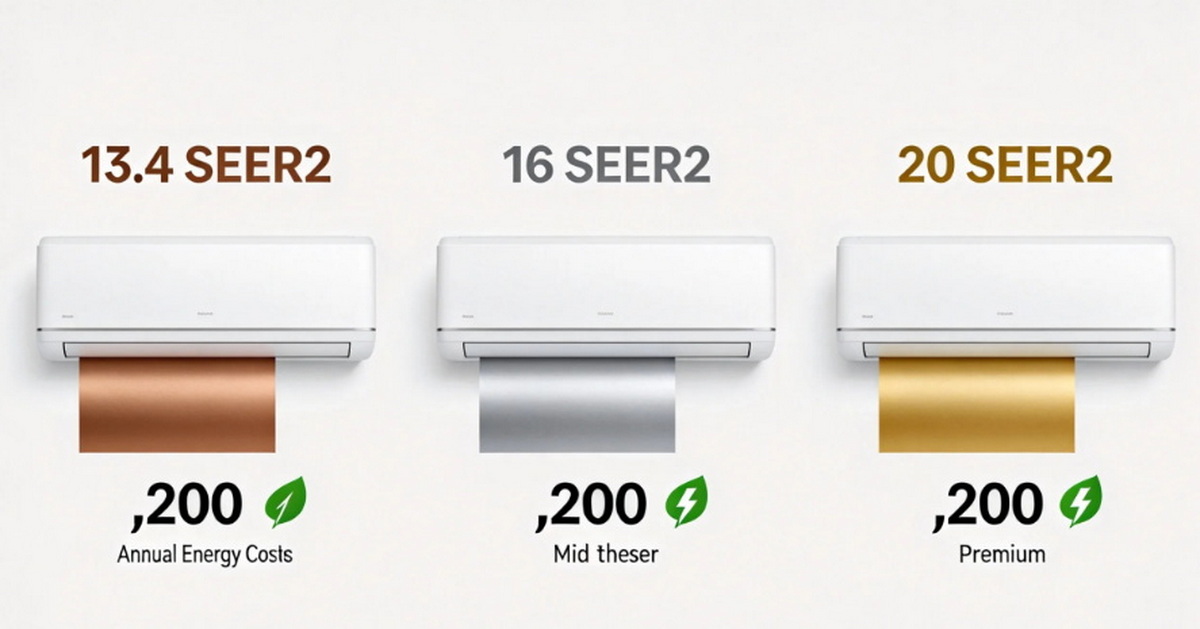
Higher SEER2 ratings translate directly into lower electricity costs. A 3.5 ton unit operating at 16 SEER2 uses approximately 20-25% less electricity annually compared to a minimum-efficiency 13.4 SEER2 model. For a typical home running the AC 1,200 hours annually with electricity costs at $0.13 per kWh, upgrading from 13.4 to 18 SEER2 can save $180-$240 per year. [bearshomesolutions]
At Mega Services Heating & Cooling, we help customers calculate their specific payback period—the point at which energy savings offset the higher upfront cost of more efficient equipment. For most homeowners planning to stay in their homes 7+ years, investing in 16-18 SEER2 systems provides excellent long-term value.
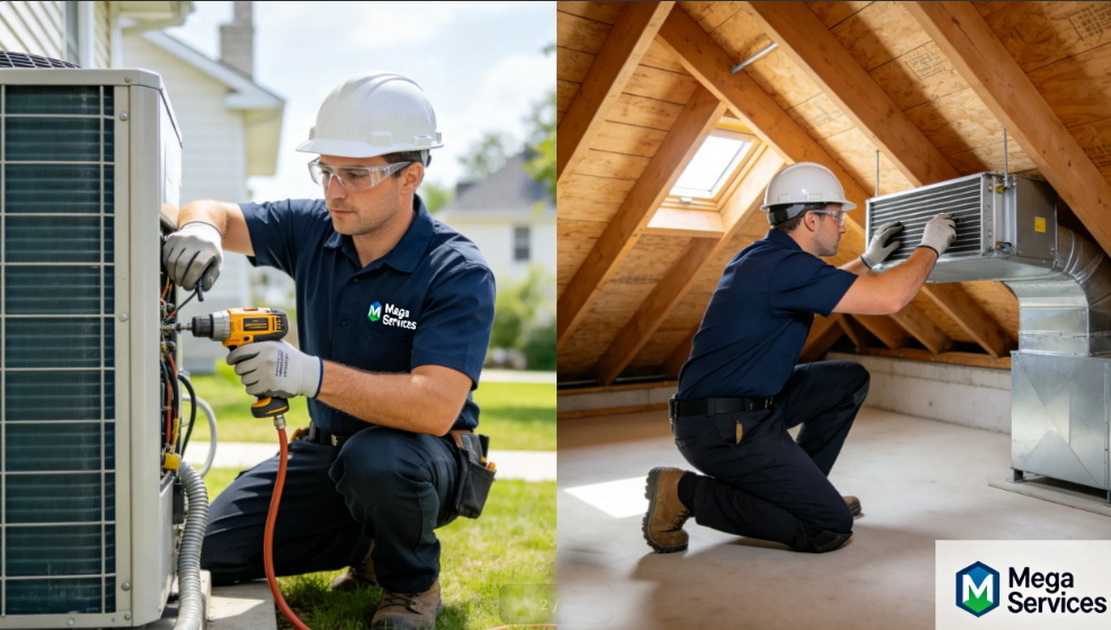
Improper installation compromises even the highest-quality equipment. We've diagnosed countless service calls where premium units underperformed simply due to incorrect refrigerant charge, improperly sized ductwork, or inadequate airflow—all installation-related issues. [fieldedge]
Professional installation ensures:
- Correct refrigerant charge: Even 10% deviation from manufacturer specifications reduces efficiency by 5-10% and accelerates compressor wear
- Proper condensate drainage: Prevents water damage and microbial growth in drain pans
- Accurate thermostat placement: Ensures the system responds to actual living space temperatures, not hallway or kitchen heat sources
- Sealed ductwork: Eliminates the 20-30% efficiency loss common in homes with leaky duct systems
Our installation methodology emphasizes transparency, cleanliness, and quality workmanship:
1. Pre-Installation Consultation: We conduct detailed load calculations, review equipment options, and provide transparent pricing with no hidden fees
2. Scheduled Installation Day: Customers receive text notifications with technician photos and estimated arrival times
3. Home Protection: Our crews use drop cloths, shoe covers, and protective equipment to maintain your home's cleanliness throughout installation
4. Old Equipment Removal: We safely disconnect and remove existing equipment for environmentally responsible recycling
5. New System Installation: Certified technicians install the outdoor condenser, indoor evaporator coil, connect refrigerant lines, and verify electrical connections meet code requirements
6. System Testing and Commissioning: We measure airflow, verify refrigerant charge with digital gauges, test all safety controls, and document system performance
7. Customer Education: We walk you through thermostat operation, demonstrate smartphone app connectivity (when applicable), and explain maintenance requirements
8. Final Inspection and Cleanup: Before leaving, we ensure the installation site is cleaner than when we arrived
Most 3.5 ton installations require 8-10 hours for a standard replacement. Complex installations involving ductwork modifications or electrical upgrades may extend to two days. [theacoutlet]
Regular maintenance directly impacts system longevity and efficiency. We recommend homeowners perform these tasks: [ciwebgroup]
- Monthly filter replacement: Use MERV 8-11 rated filters and check them monthly during cooling season; replace when visibly dirty or every 30-60 days
- Outdoor unit cleaning: Remove leaves, grass clippings, and debris from around the condenser; maintain 2 feet of clearance on all sides
- Condensate drain monitoring: Check the drain line quarterly to ensure water flows freely; a clogged drain can cause water damage or system shutdown
- Thermostat battery replacement: Replace batteries annually to prevent unexpected failures during peak usage periods
Even with diligent homeowner care, professional servicing is essential. During annual tune-ups at Mega Services Heating & Cooling, our technicians: [fieldedge]
- Clean evaporator and condenser coils using specialized cleaning solutions
- Measure and adjust refrigerant charge to manufacturer specifications
- Test capacitor function and amperage draw on compressor and fan motors
- Inspect electrical connections and tighten any loose terminals
- Verify proper airflow across the evaporator coil (typically 400 CFM per ton)
- Test safety controls including high-pressure cutouts and low-pressure switches
- Lubricate motor bearings where applicable
- Document baseline performance metrics for future comparison
Annual maintenance reduces breakdown probability by 40-50% and extends system lifespan by 3-5 years. We've observed that customers who maintain regular service schedules experience far fewer emergency repairs and lower total ownership costs. [ciwebgroup]
Installing a programmable or smart thermostat offers one of the fastest payback periods for any HVAC upgrade. These devices allow you to automatically adjust temperatures based on occupancy patterns—raising temperatures by 7-10°F when away at work and pre-cooling before you return home. [theacoutlet]
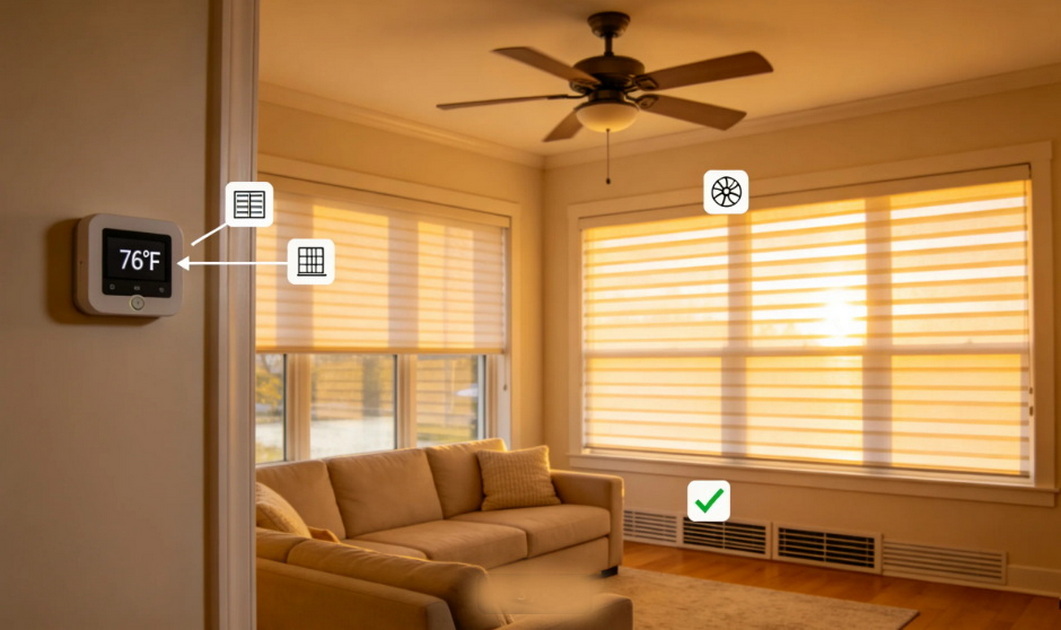
Smart thermostats like Nest, Ecobee, and Honeywell Home learn your schedule, provide energy usage reports, and enable remote control via smartphone apps. Most customers at Mega Services Heating & Cooling recoup the $150-$250 thermostat investment through energy savings within 12-18 months. [ciwebgroup]
Ceiling fans create air movement that makes occupants feel 3-4°F cooler, allowing you to raise thermostat settings without sacrificing comfort. This synergy reduces AC runtime and saves 10-15% on cooling costs. [theacoutlet]
Important reminder: Ceiling fans cool people, not rooms, so turn them off when leaving a space. [theacoutlet]
Solar heat gain through windows accounts for 25-35% of cooling load in most homes. Closing blinds or curtains on south and west-facing windows during peak afternoon sun (1:00-6:00 PM) significantly reduces the heat your AC must remove. [theacoutlet]
Cellular shades provide excellent insulation properties, while reflective window film blocks up to 70% of solar heat gain without reducing natural light. [theacoutlet]
Conditioned air escaping through gaps around windows, doors, recessed lighting, and duct connections wastes substantial energy. The Department of Energy estimates that sealing air leaks can reduce cooling costs by 20-30%. [theacoutlet]
Focus on high-impact areas:
- Attic ductwork connections (often the largest source of air loss)
- Weatherstripping around entry doors
- Caulking around window frames
- Foam gaskets behind electrical outlet covers on exterior walls
At Mega Services Heating & Cooling, we offer whole-home energy audits that identify specific air leakage points using thermal imaging and blower door testing.
Condenser units operating in direct sunlight work 8-10% harder than shaded units. If feasible, plant shrubs or install shade structures that provide afternoon shade while maintaining adequate airflow clearance (24 inches minimum on all sides). [theacoutlet]
Never restrict airflow by building decorative enclosures or placing objects directly against the unit—this dramatically reduces efficiency and can cause compressor overheating.
Air conditioning systems typically last 12-17 years depending on maintenance quality, usage intensity, and climate conditions. If your current unit is 15+ years old, replacement usually makes more financial sense than major repairs, even if the system still functions. [theacoutlet]
Modern units offer 30-50% better efficiency than 15-year-old equipment due to compressor technology advances, improved heat exchanger designs, and variable-speed components. The energy savings alone often justify replacement within 5-8 years. [seerenergysavings]
We use the "50% Rule" at Mega Services Heating & Cooling: If repair costs exceed 50% of replacement cost and the unit is over 10 years old, replacement is typically the better investment. For example, a $2,500 compressor replacement on a 12-year-old system rarely makes financial sense compared to installing a new, more efficient unit with a full warranty. [theacoutlet]
Consider replacement when you experience:
- Inability to maintain comfortable temperatures despite proper maintenance
- Rooms with significant temperature variations (hot and cold spots)
- Steadily increasing energy bills without corresponding usage changes
- Frequent repairs (three or more service calls in 18 months)
- Excessive noise, particularly grinding or squealing sounds from the compressor
Older systems using R-22 refrigerant (Freon) face unique challenges since R-22 production ceased in 2020. Refrigerant for these systems costs $100-$150 per pound and continues increasing as supplies dwindle. If your R-22 system develops a refrigerant leak, replacement with a modern R-410A or R-32 system makes more economic sense than recharging with expensive discontinued refrigerant. [ciwebgroup]
High-efficiency 3.5 ton AC units consume significantly less electricity than older models, directly reducing carbon dioxide emissions from power generation. A typical upgrade from a 10 SEER (old rating) system to an 18 SEER2 unit prevents approximately 1.5-2 tons of CO₂ emissions annually—equivalent to planting 35-45 trees. [theacoutlet]
Modern air conditioners use refrigerants with substantially lower Global Warming Potential (GWP) than older R-22 Freon. R-410A, the current industry standard, has zero ozone depletion potential, and newer R-32 refrigerant further reduces environmental impact with 68% lower GWP than R-410A. [ciwebgroup]
High-efficiency AC systems reduce peak electricity demand during hot summer afternoons when utilities strain to meet consumption. This collective efficiency improvement helps utilities avoid building additional power generation capacity and reduces the risk of brownouts or rolling blackouts during heat waves. [theacoutlet]
At Mega Services Heating & Cooling, we've dedicated our careers to creating safe, comfortable, and energy-efficient home environments through expert HVAC installation, repair, and maintenance services. Our team of certified technicians brings real-world experience installing hundreds of 3.5 ton AC systems across diverse home types and challenging conditions.
We prioritize transparent pricing, quality workmanship, and long-term customer relationships over quick sales. When you work with Mega Services Heating & Cooling, you receive honest assessments, properly sized equipment recommendations based on detailed load calculations, professional installation that meets or exceeds manufacturer specifications, comprehensive warranties protecting your investment, and responsive service when you need us most.
Ready to upgrade to a properly sized, energy-efficient 3.5 ton AC system? Contact Mega Services Heating & Cooling today for a free in-home consultation and detailed proposal. Our comfort specialists will evaluate your home's specific requirements and recommend the ideal cooling solution for your budget and comfort goals.
A 3.5 ton air conditioner typically cools 2,500-3,000 square feet effectively in homes with standard 8-foot ceilings, adequate insulation, and moderate window area. However, actual coverage varies based on ceiling height, insulation quality, window size and orientation, sun exposure, local climate, and occupancy levels. Professional HVAC contractors use Manual J load calculations to determine precise requirements for your specific home rather than relying solely on square footage guidelines. [seerenergysavings]
A 3.5 ton air conditioner typically consumes 3,500-4,200 watts (3.5-4.2 kW) depending on the SEER2 efficiency rating. Higher efficiency units use less power for equivalent cooling capacity. For example, a 14 SEER2 unit draws approximately 4,000 watts while an 18 SEER2 model uses only 3,100 watts—a 22% reduction in electrical consumption that translates directly into lower utility bills. [bearshomesolutions]
Properly maintained 3.5 ton AC units typically last 12-17 years. Lifespan varies based on several factors including maintenance consistency (annual professional service significantly extends life), usage intensity (systems in extremely hot climates experience more wear), installation quality (proper sizing and installation add 3-5 years), and environmental conditions (coastal salt air or desert dust reduce longevity). At Mega Services Heating & Cooling, we've serviced well-maintained premium brand units still operating efficiently after 20 years. [ciwebgroup]
Yes, replacing a 20-year-old AC unit makes financial sense in most cases. Modern units offer 40-60% better energy efficiency than 20-year-old equipment, resulting in annual savings of $400-$800 for typical 3.5 ton systems. Additionally, older units face increasing repair costs as parts become scarce, use environmentally harmful R-22 refrigerant that's expensive to replace, lack modern comfort features like variable-speed operation and smart thermostat compatibility, and carry higher breakdown risk that could leave you without cooling during peak summer heat. [seerenergysavings]
No, DIY installation of central air conditioning systems is not recommended and is illegal in most jurisdictions without proper licensing. AC installation requires EPA-certified technicians for refrigerant handling, electrical work that must comply with building codes, specialized tools for vacuum pumps, refrigerant recovery equipment, and manifold gauges, and precise knowledge of load calculations, duct sizing, and airflow requirements. Improper installation voids manufacturer warranties, creates safety hazards including electrical fires and refrigerant leaks, dramatically reduces efficiency and performance, and often results in costly repairs to fix installation errors. Professional installation at Mega Services Heating & Cooling includes permits, warranty protection, and guaranteed proper operation. [fieldedge]
SEER2 represents updated testing standards implemented January 1, 2023, that more accurately reflect real-world operating conditions. SEER2 ratings are approximately 4.5% lower than equivalent SEER ratings because the new testing uses higher static pressure to simulate actual ductwork resistance. For example, a unit rated 16 SEER under old standards rates approximately 15.2 SEER2 under new testing, though actual efficiency hasn't changed—only the measurement methodology. When comparing AC units, ensure you're comparing equivalent rating systems (SEER to SEER or SEER2 to SEER2) for accurate efficiency comparisons. [alternativeaire]
Check your air filter monthly during cooling season and replace when visibly dirty or every 30-60 days for standard 1-inch filters. Replacement frequency depends on several factors: homes with pets need more frequent changes (every 30-45 days), allergy sufferers benefit from monthly replacement with MERV 11-13 filters, homes with multiple occupants or high dust environments require more frequent changes, and 4-inch or 5-inch media filters last 6-12 months. Dirty filters reduce airflow by 15-25%, forcing the system to work harder, increasing energy costs, and potentially causing the evaporator coil to freeze. Set calendar reminders or subscribe to filter delivery services to maintain consistent replacement schedules. [ciwebgroup]
1. Logan A/C & Heat Services. "How to Choose the Right 3.5 Ton AC Unit - Complete Guide." Logan Services Blog. https://www.logan-inc.com/blog/3-5-ton-ac-units/
2. CI Web Group. "A Quick Start Guide to AI SEO for HVAC - E-E-A-T Framework." CI Web Group HVAC Marketing Blog, September 25, 2025. https://www.ciwebgroup.com/blog/ai-seo-for-hvac
3. FieldEdge Software. "HVAC SEO for Blogs: How to Get Your Content to Rank." FieldEdge Blog, April 29, 2024. https://fieldedge.com/blog/blog-seo-for-hvac/
4. This Old House. "Best Air Conditioner Brands of 2026 - Expert Rankings and Reviews." This Old House, January 28, 2023. https://www.thisoldhouse.com/heating-cooling/best-air-conditioner-brands
5. YouTube - HVAC Industry Rankings. "Ranking the Best and Worst Air Conditioner Brands - 2025-2026 Edition." October 10, 2025. https://www.youtube.com/watch?v=1fu7qtmaJN4
6. Homewyse Cost Calculators. "Cost to Install Air Conditioning - 2026 National Average Pricing." Homewyse, May 2026. https://www.homewyse.com/services/cost_to_install_air_conditioning.html
7. Bryant Heating & Cooling Systems. "How Much Does a New HVAC System Cost in 2026? | Pricing Guide." Bryant HVAC Resources, 2026. https://www.bryant.com/en/us/products/hvac-pricing-guide/
8. Alternative Aire. "SEER2 Ratings 2026 Guide for Durham, NC - Understanding New Efficiency Standards." Alternative Aire Blog, January 23, 2026. https://alternativeaire.com/seer2-ratings-guide-durham-nc/
9. Bears Home Solutions. "SEER Ratings Explained for 2026 - How Efficiency Standards Impact Costs." Bears Blog, April 12, 2026. https://bearshomesolutions.com/blog/seer-ratings-explained/
10. UniColorado HVAC Services. "SEER Rating: What You Need To Know - 2026 Colorado Requirements." UniColorado Blog, March 4, 2026. https://unicolorado.com/seer-rating/
11. SEER Energy Savings. "SEER Energy Savings Calculator for Air Conditioners - Calculate Your Savings." SEER Energy Savings Tools, February 9, 2026. https://www.seerenergysavings.com
12. Reddit HVAC Advice Community. "HVAC Installation Cost - What Did You Actually Pay in 2026?" Reddit Discussion Thread, April 11, 2026. https://www.reddit.com/r/hvacadvice/comments/1sin2r0/hvac_installation_cost_what_did_you_actually_pay/


