
Views: 216 Author: Mega Services Publish Time: 2026-08-26 Origin: Site


Content Menu
● Quick Answer: What Is the Best Air Conditioner Brand?
● Why Installation Quality Matters as Much as the Brand
>> What a Complete HVAC Evaluation Should Include
● How to Choose the Right Air Conditioner
>> Proper AC Sizing Comes First
>> Why a Bigger Air Conditioner Is Not Always Better
>> Consider Noise, Humidity, and Comfort Features
● Top Air Conditioner Brands to Consider
>> Carrier
>> Trane
>> Lennox
>> Daikin
>> Amana
>> Goodman
>> York
● Central Air Conditioner vs. Ductless Mini-Split
>> When Central Air Is the Better Choice
>> When Ductless Mini-Splits Make More Sense
● What to Know About New AC Refrigerants
● Questions to Ask Before Buying a New AC System
● How to Keep Your Air Conditioner Running Efficiently
● A Smarter Way to Choose Home Comfort
>> 1. Which air conditioner brand is the most reliable?
>> 2. Is a higher SEER2 rating always worth the additional cost?
>> 3. How do I know what size air conditioner my home needs?
>> 4. Is central air better than a ductless mini-split?
>> 5. Should I replace my working R-410A air conditioner?
>> 6. How often should an air conditioner be serviced?
>> 7. What should be included in an air conditioner installation quote?
Choosing the best air conditioner brand is an important decision, but the logo on the outdoor unit is only one part of long-term home comfort. The right system should keep your family cool, manage humidity, operate efficiently, and fit the specific needs of your home.
At Mega Services Heating & Cooling, we work with homeowners who want more than a quick replacement. They want dependable cooling, lower operating costs, safer equipment performance, and clear answers about what they are buying. From our experience, the best air conditioner is not simply the most expensive model or the brand with the highest advertised efficiency rating. It is the system that is correctly sized, professionally installed, properly matched to the home, and maintained over time.
This guide explains how to compare leading air conditioner brands, understand the features that matter, and choose a central air conditioner, heat pump, or ductless mini-split with confidence.

There is no single best air conditioner brand for every home. Carrier, Trane, Lennox, Daikin, Rheem, American Standard, Goodman, York, Amana, and Mitsubishi Electric all offer systems that can be excellent choices in the right application.
The better question is:
> Which air conditioning system is properly sized, installed by experienced technicians, supported by local service, and designed for my home's comfort needs?
A high-end system can still perform poorly if the equipment is too large, the ductwork leaks, airflow is restricted, or the installation is rushed. On the other hand, a well-selected mid-range system can provide years of reliable cooling when the full system is designed and installed correctly.
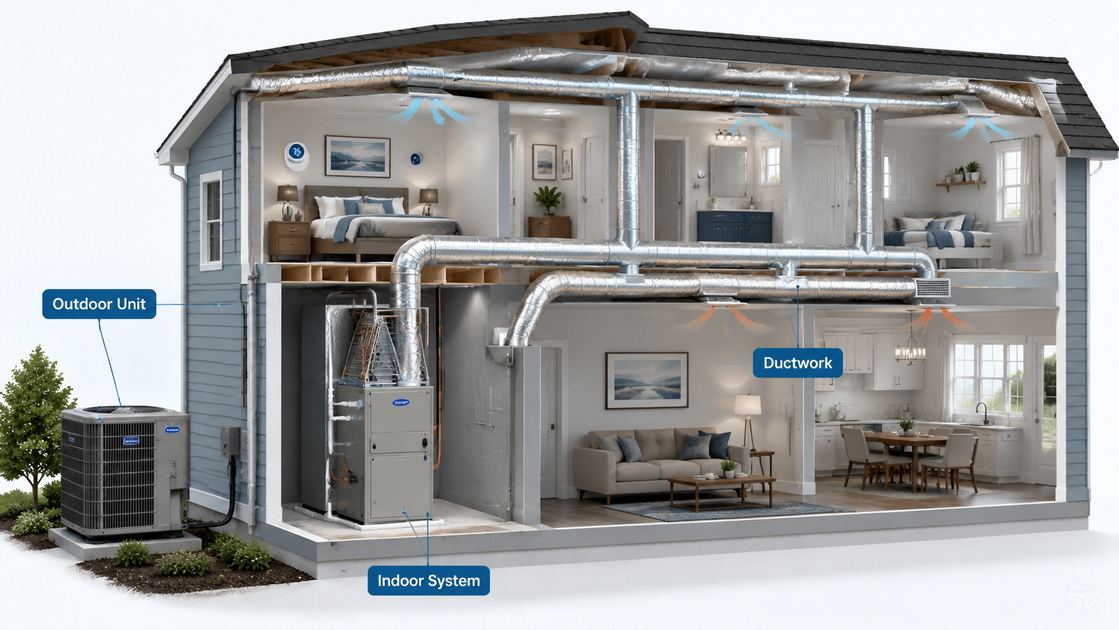
An air conditioner is not just the outdoor unit. It is a connected comfort system made up of several important components:
- Outdoor condenser or heat pump
- Indoor evaporator coil
- Furnace or air handler
- Refrigerant lines
- Electrical connections
- Thermostat and controls
- Supply and return ductwork
- Condensate drainage system
- Air filtration components
Every part must work together. If one part is undersized, oversized, poorly connected, or neglected, comfort and efficiency can suffer.
For example, a homeowner may replace an old system with a higher-efficiency unit but still experience warm rooms upstairs. The problem may not be the equipment. It may be inadequate return airflow, undersized ducts, leaking duct connections, poor attic insulation, or an incorrect equipment size.
Before selecting a new AC system, a qualified technician should consider:
1. Total home size and floor plan
2. Ceiling heights and room volume
3. Insulation levels in walls and attic spaces
4. Window size, direction, shading, and solar heat gain
5. Air leakage around doors, windows, and penetrations
6. Existing ductwork condition and airflow capacity
7. Local summer temperatures and humidity levels
8. Rooms that are consistently too hot or too cold
9. Household comfort priorities, including allergies and indoor air quality
10. Electrical capacity, equipment location, and drainage requirements
A recommendation based only on square footage is incomplete. Two homes with the same floor area can have very different cooling requirements because of window exposure, insulation, layout, occupancy, and duct design.
Air conditioner capacity is usually measured in BTUs or tons. One ton of cooling capacity equals 12,000 BTUs per hour.
Many homeowners hear general sizing rules based on square footage. While these estimates may provide a starting point, they should not be used as the final basis for equipment selection. The correct size depends on the entire home, not just its square footage.
A properly sized system should cool the home steadily during hot weather while also controlling indoor humidity.
An oversized AC system may cool a house quickly, but that does not always mean it is providing better comfort.
An oversized system can:
- Start and stop too frequently
- Remove less humidity from the air
- Create uneven temperatures between rooms
- Increase component wear
- Use more electricity than necessary
- Leave the home feeling cool but damp
- Create more noticeable temperature swings
A system that is too small can also create problems. It may run continuously during hot weather, struggle to maintain comfortable indoor temperatures, and experience unnecessary strain.
The goal is balance: enough cooling capacity for demanding summer conditions without installing more capacity than the home can use effectively.
SEER2 stands for Seasonal Energy Efficiency Ratio 2. It is used to describe how efficiently an air conditioning system cools over a typical season.
In general, a higher SEER2 rating means the system can use less electricity to deliver the same amount of cooling. However, a higher rating usually comes with a higher purchase price.
A higher-efficiency system may be a strong choice if:
- You run air conditioning for long periods each year
- Your electricity costs are high
- You expect to remain in the home for many years
- You want quieter operation
- You value more consistent indoor temperatures
- You want improved humidity control
A standard or mid-efficiency unit may be a better fit if your budget is limited, your cooling season is shorter, or the additional cost of premium equipment would not provide a practical return for your household.
The best value is not always the highest efficiency number. It is the system that provides dependable comfort, reasonable energy use, and an investment level that makes sense for your home.
When comparing air conditioner brands and models, do not focus only on cooling capacity and efficiency. Comfort features can significantly affect how your home feels every day.
Important features to compare include:
- Sound level: A quieter outdoor unit can be valuable near bedrooms, patios, and neighboring homes.
- Cooling stages: Single-stage systems operate at one level. Two-stage and variable-capacity systems can adjust output more gradually.
- Humidity control: Longer, lower-output cooling cycles can improve comfort in humid conditions.
- Thermostat compatibility: Smart thermostats can provide scheduling, remote access, and more precise temperature management.
- Air filtration options: Improved filtration may help reduce dust, pet dander, and airborne particles.
- Zoning capabilities: Zoning can help manage different temperatures in upstairs rooms, additions, bedrooms, and other areas.
Variable-capacity systems generally offer the most refined comfort control. Instead of switching fully on and off repeatedly, they can adjust output based on current conditions. This may provide steadier indoor temperatures and quieter operation, although these systems usually require a greater upfront investment.
The following brands are widely available in the residential HVAC market. The right option will depend on the product line available in your area, the installer's experience, your home's requirements, and your budget.
Carrier offers central air conditioners, heat pumps, furnaces, air handlers, and ductless systems. Its product range includes practical entry-level options as well as advanced systems designed for high efficiency, quieter operation, and improved comfort control.
Carrier may be a good fit for homeowners who want a wide selection of equipment options and established central HVAC solutions.
Trane is a well-known residential HVAC brand with air conditioners, heat pumps, furnaces, and whole-home comfort systems. It is commonly considered by homeowners who value durable equipment designs and broad service availability.
Trane offers options across several performance and efficiency levels, making it useful for homeowners comparing standard replacement systems with premium comfort upgrades.
American Standard offers many comparable residential heating and cooling solutions and is frequently considered alongside Trane. Its equipment can be a good choice when supported by an experienced local contractor who can match the system correctly to the home.
American Standard may appeal to homeowners looking for a balance of dependable central air conditioning, heat pump options, and whole-home comfort features.
Lennox is known for high-efficiency air conditioners, heat pumps, smart controls, and premium comfort products. Some Lennox systems are designed for homeowners who prioritize low operating costs, quiet performance, and advanced temperature management.
Lennox may be a strong choice for homeowners who are prepared to invest in higher-efficiency equipment and want advanced system features.
Daikin offers central HVAC equipment, heat pumps, ductless mini-splits, and inverter-driven systems. It is particularly recognized for ductless and variable-capacity comfort solutions.
Daikin may be a good fit for homes without existing ductwork, room additions, converted garages, upstairs spaces, or homeowners who want more precise zone-by-zone comfort control.
Amana is part of the Daikin family and is often considered by homeowners looking for a practical central HVAC option with competitive warranty coverage. Its product lineup includes air conditioners, heat pumps, furnaces, and air handlers.
Amana can be a strong option for buyers comparing value, warranty terms, and reliable whole-home heating and cooling equipment.
Rheem and Ruud provide residential air conditioners, heat pumps, furnaces, and water-heating products. These brands are frequently considered for balanced performance, accessible equipment options, and familiar product designs.
They may be a good fit for homeowners seeking practical comfort solutions across a range of budgets.
Goodman is widely known as a value-oriented HVAC brand. It can be a sensible choice for homeowners who need a budget-conscious system replacement without overlooking proper equipment selection and installation quality.
A Goodman system can provide reliable cooling when it is properly sized, matched with compatible indoor equipment, and maintained consistently.
York offers central air conditioners, heat pumps, furnaces, packaged systems, and other residential equipment. It is often considered when local technicians have strong familiarity with the brand and can provide dependable service support.
York may be appropriate for homeowners comparing locally available equipment options and straightforward central AC replacements.
Mitsubishi Electric is one of the most recognized names in ductless mini-split and zone-based comfort systems. Its products are commonly used in homes without ductwork, room additions, converted garages, home offices, sunrooms, and areas with uneven temperatures.
Mitsubishi Electric may be a strong choice for homeowners who want individual temperature control in different rooms or need targeted cooling without major ductwork modifications.
The best cooling system for your home depends largely on whether you have suitable ductwork and whether you need whole-home cooling or targeted comfort in specific rooms.
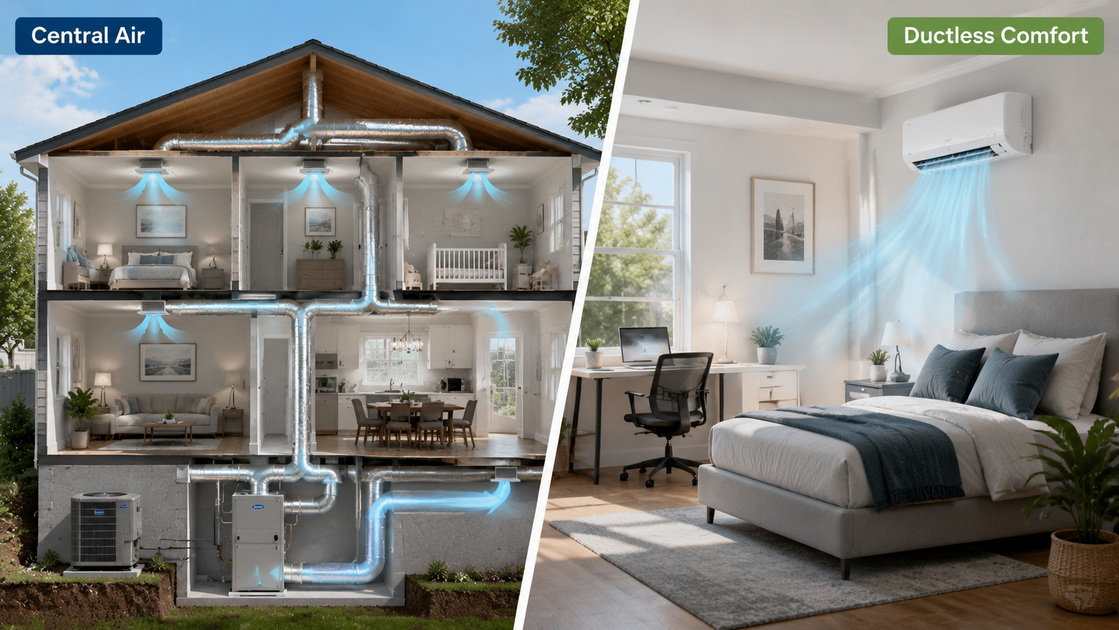
| System Type | Best For | Main Benefits | Important Considerations |
|---|---|---|---|
| Central air conditioner | Homes with functional ductwork | Whole-home cooling, hidden indoor components, broad equipment options | Duct condition and airflow affect comfort and efficiency |
| Heat pump | Homes needing heating and cooling | Efficient electric heating and cooling in one system | Requires climate-appropriate planning and compatible backup heat when needed |
| Ductless mini-split | Additions, older homes, garages, rooms without ducts | Zoned cooling, quiet operation, no major ductwork required | Indoor units are visible and placement should be planned carefully |
| Dual-fuel system | Homes in colder climates with gas service | Heat pump efficiency with furnace support | System design can be more complex and may require a larger investment |
Central air conditioning is often the best option when a home already has well-designed ductwork. It can cool the entire house from one system and keeps most components out of sight.
Central air may be ideal if:
- Your current ductwork is in good condition
- You want a single whole-home cooling system
- You prefer hidden indoor equipment
- You are replacing an existing central AC system
- You want to integrate cooling with a furnace or ducted heat pump
Ductless mini-splits are useful where ductwork does not exist or where certain rooms do not receive enough conditioned air.
Ductless systems may be ideal if:
- Your home has no existing ducts
- You are cooling an addition or converted garage
- Your upstairs rooms stay too warm
- You want individual temperature control by room
- You are finishing an attic, basement, or home office
- You want an alternative to a window air conditioner
Some homes benefit from a combined approach. For example, central air can cool the main living areas while a ductless mini-split provides targeted comfort in an upstairs bedroom, bonus room, or home addition.
Homeowners replacing an older air conditioner may notice that new systems use different refrigerants than equipment installed several years ago.
Many newer residential systems are transitioning away from R-410A and toward refrigerants with lower environmental impact, including R-454B and R-32. The refrigerant used depends on the manufacturer and the specific equipment line.
If your current R-410A system is operating safely and reliably, replacement may not be necessary solely because of its refrigerant. However, it is important to discuss refrigerant type when comparing a major repair with a full system replacement.
Ask your HVAC professional:
- What refrigerant does the proposed system use?
- Is the outdoor unit matched with a compatible indoor coil or air handler?
- Does the installation require changes to the refrigerant line set?
- What safety procedures apply to the new equipment?
- What are the future maintenance and service considerations?
Indoor and outdoor HVAC components must be properly matched. Replacing only one part of a system without confirming compatibility can reduce efficiency, affect reliability, and create performance problems.
Before you approve an air conditioner replacement, ask for clear answers to these questions:
1. Will a detailed cooling-load calculation be completed for my home?
2. Will the ductwork, return air, and airflow be inspected?
3. What is the system's SEER2 rating and sound level?
4. Are the indoor and outdoor components matched correctly?
5. What refrigerant does the new system use?
6. Does the quote include electrical work, drainage improvements, permits, thermostat installation, and equipment pad work?
7. How will airflow and refrigerant charge be verified after installation?
8. What manufacturer warranty applies to the equipment?
9. Is a labor warranty included with installation?
10. What maintenance is recommended to protect performance and warranty coverage?
A detailed proposal should make it easy to understand what equipment is being installed, what work is included, and what comfort improvements are expected.
Even the best air conditioner brand requires regular care. Basic maintenance can help improve comfort, protect equipment, and reduce the risk of unexpected breakdowns.
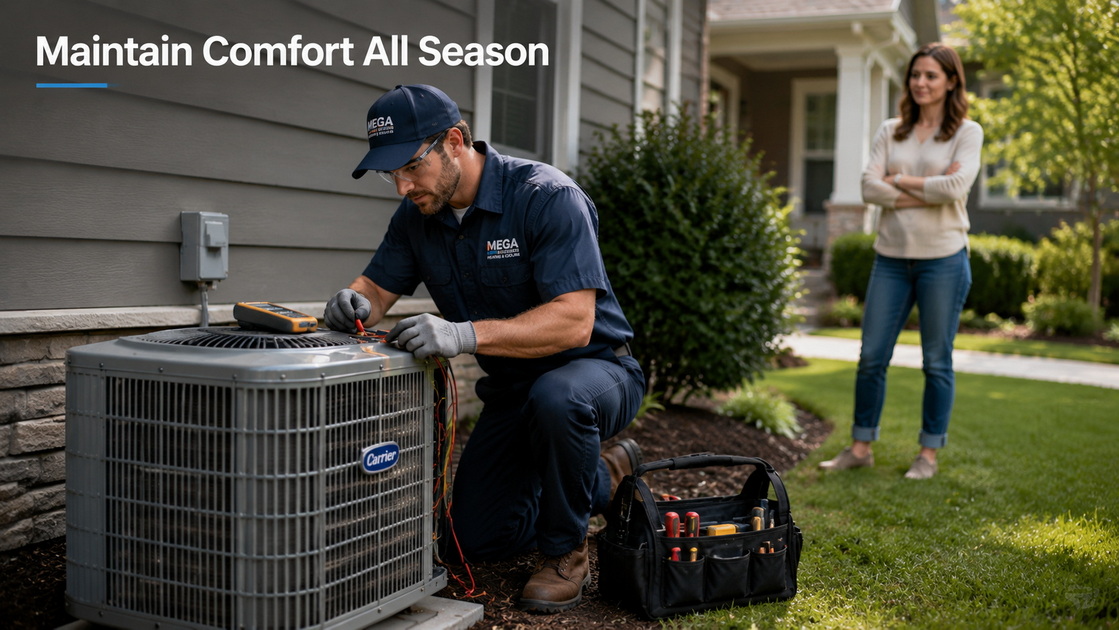
Homeowners should:
- Replace or clean air filters according to the manufacturer's guidance.
- Keep supply vents and return grilles open and unobstructed.
- Remove leaves, grass clippings, and debris from around the outdoor unit.
- Avoid placing shrubs or storage items too close to the condenser.
- Watch for water around the indoor equipment or condensate drain.
- Use thermostat schedules that match your household routine.
- Schedule professional maintenance before the cooling season.
- Address unusual noises, weak airflow, warm air, frequent cycling, or rising utility bills promptly.
Regular maintenance can identify dirty coils, airflow restrictions, drainage issues, electrical wear, thermostat problems, and other concerns before they become costly repairs.
The best air conditioner brand is the one that works correctly in your home every day. It should be properly sized for your cooling needs, installed with attention to airflow and system matching, supported by qualified local technicians, and maintained throughout its service life.
At Mega Services Heating & Cooling, we believe every family deserves a home that feels safe, comfortable, and energy-conscious. Whether you are comparing air conditioner brands, replacing an aging system, considering a heat pump, or exploring ductless mini-split options, the right solution starts with understanding your home—not simply selecting a brand name.
Mega Services Heating & Cooling is ready to help you make a clear, informed decision about your home's heating and cooling needs.
Reliability depends on more than the brand. Carrier, Trane, Lennox, Daikin, Rheem, American Standard, Goodman, York, Amana, and Mitsubishi Electric all offer systems that can perform well when they are correctly selected, professionally installed, and maintained. Local service availability and installer experience should also influence your decision.
Not always. A higher SEER2 system may lower electricity use, but its value depends on your local energy rates, the length of your cooling season, the system's installed price, and how long you expect to stay in the home. A properly sized and installed mid-efficiency system may offer better practical value for some households.
The most reliable method is a detailed cooling-load calculation. It considers your home's floor plan, insulation, windows, ceiling heights, air leakage, local climate, and other heat-gain factors. Avoid choosing a system size based only on the size of your old unit or a basic square-footage estimate.
Central air is often the best option for homes with functional ductwork and whole-home cooling needs. Ductless mini-splits are excellent for homes without ducts, room additions, garages, bonus rooms, offices, and spaces with uneven temperatures. In some homes, combining both systems provides the best result.
A working R-410A system does not need immediate replacement solely because newer equipment uses different refrigerants. However, if the system is old, inefficient, requires expensive repairs, or has recurring problems, comparing repair costs with a modern replacement can be worthwhile.
Most residential air conditioning systems should receive professional maintenance at least once per year, ideally before the cooling season begins. Homes with pets, heavy system use, high dust levels, or indoor air quality concerns may benefit from more frequent attention.
A complete quote should identify the exact equipment model, efficiency rating, refrigerant type, indoor and outdoor component compatibility, thermostat, electrical work, drainage work, permits, warranty terms, labor coverage, and startup procedures. It should also explain any recommended ductwork repairs or airflow improvements.
1. Air Conditioning Contractors of America. "Technical Manuals."
https://www.acca.org/standards/technical-manuals
2. Air Conditioning Contractors of America. "Residential System Design Review Forms & Examples."
https://www.acca.org/viewdocument/residential-system-design-review-forms-examples
3. ENERGY STAR. "Historical National HVAC Design Report."
https://www.energystar.gov/sites/default/files/2025-01/Historical%20National%20HVAC%20Design%20Report_Rev%2013.pdf
4. American Standard. "What Is a Manual J Calculation?"
https://www.americanstandardair.com/resources/glossary/what-is-manual-j-calculation/
5. Rheem. "What to Know About the 2025 HVAC Refrigerant Change."
https://www.rheem.com/air-conditioning/articles/what-to-know-about-the-2025-hvac-refrigerant-change/
6. Lennox. "Homeowner's Guide to the 2025 New Refrigerant Transition."
https://www.lennox.com/residential/lennox-life/consumer/new-hvac-refrigerant-2025
7. Logan A/C & Heat. "Best Air Conditioner Brands."
https://www.logan-inc.com/blog/best-air-conditioner-brands/


