
Views: 222 Author: Mega Services Publish Time: 2026-05-23 Origin: Site


As an HVAC consultant at Mega Services Heating & Cooling, I've seen one simple issue quietly drain hundreds of dollars from families every year: leaky ductwork. Aeroseal duct sealing is a modern, computer-controlled method that seals those hidden leaks from the inside of your duct system, helping your home feel more comfortable while cutting wasted energy. [greensealenergy]
Traditional duct sealing requires tearing into walls or crawling through hot attics to tape or brush sealant over joints one by one. Aeroseal takes a different approach: we temporarily block vents and registers, gently pressurize your ducts, and inject microscopic sealant particles that are carried by the air to the leaks where they accumulate and close gaps up to a defined size. This inside‑out process allows us to reach leaks that would be almost impossible to access with tape or mastic alone, especially in tight, finished spaces. [aeroseal]
n many homes we inspect, 20–30% of conditioned air is lost through leaky ducts before it ever reaches the rooms you are trying to heat or cool. That lost air is air you already paid to heat or cool, so your system must run longer and harder, driving up monthly utility bills. [palmetto]
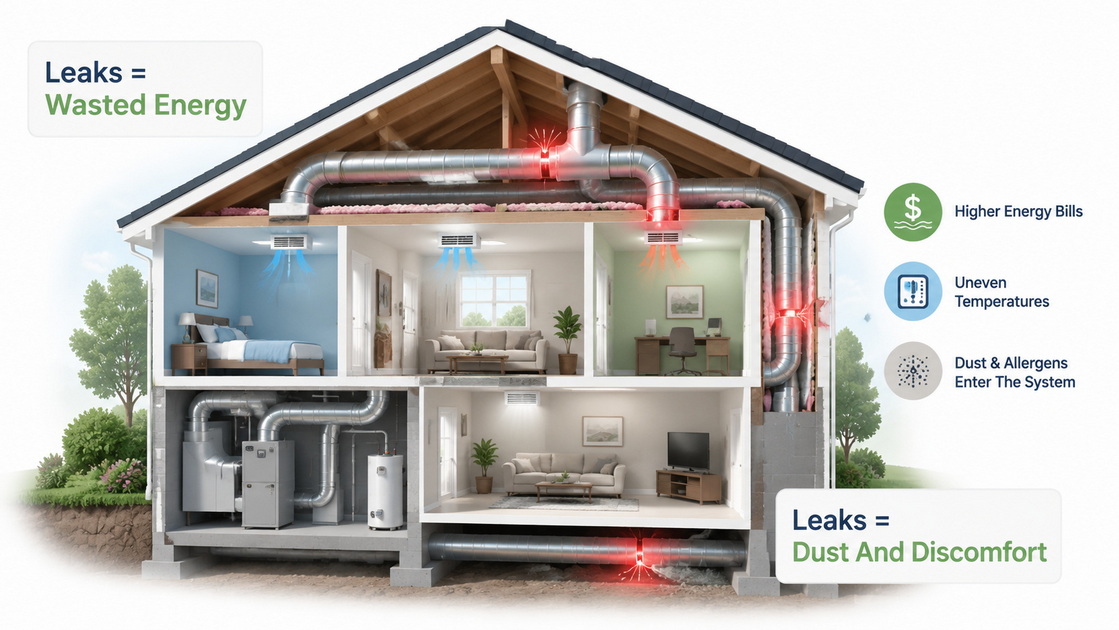
Industry studies, including data referenced by Energy Star and the U.S. Department of Energy, suggest that improving air sealing around the home (including duct sealing) can deliver whole‑house energy savings of 10–20%, often translating into $300–$700 per year for typical households. When we compare pre‑ and post‑seal data in the field, homeowners are often surprised to see how much airflow was being wasted into attics, crawlspaces, and wall cavities instead of living spaces. [onehourheatandair]
rom a homeowner's perspective, the first sign of leaky ducts isn't an energy report—it's comfort. Uneven temperatures between rooms, a bedroom that never quite cools down in summer, or a living room that stays chilly even when the system runs constantly are classic indicators of duct leakage. [nadca]
Because air escapes through cracks and poorly sealed joints, some rooms are starved for conditioned air while others may get more than they need. I often hear comments like, "The thermostat says 72, but this room feels like a different house," which usually means air is bypassing the intended supply path and dumping into unconditioned areas. [patgreenair]
eaky ducts are a two‑way street: air doesn't just escape, it can also be sucked in from attics, garages, crawlspaces, or wall cavities. This can pull dust, insulation fibers, moisture, and even combustion byproducts into your air stream, degrading indoor air quality and aggravating allergies or respiratory symptoms. [facebook]
In some cases, leaky return ducts located near water heaters or furnaces can contribute to "back‑drafting," where combustion gases are drawn into the home instead of safely vented outdoors. Sealing ductwork correctly, and verifying it with proper testing, is an important step in creating a safer and healthier home environment. [patgreenair]
key advantage of Aeroseal is that it starts with data, not guesswork. Before we apply any sealant, we connect specialized equipment to your duct system and pressurize it to measure total leakage in real time, usually shown in CFM (cubic feet per minute). [aeroseal]
During this test, you can actually watch your leakage number on the computer screen, which helps turn an invisible problem into something very tangible. For homeowners who like quantifiable results, this baseline test becomes the "before" snapshot we'll compare to after the sealing process is complete. [nadca]

nce we have your baseline leakage, we temporarily seal off registers and vents, protect sensitive components, and connect the Aeroseal machine to your duct system. The system then injects an aerosolized, water‑based polymer sealant into the ducts while maintaining controlled pressure. [greensealenergy]
As air carries these microscopic particles through the system, they escape only where there are cracks, gaps, or holes; the particles collide at the leak sites, stick to the edges, and gradually build up a durable seal—without coating the entire interior of the duct. The whole process typically takes a few hours and is monitored by software that shows leakage dropping in real time as leaks are sealed. [greensealenergy]
t the end of the sealing, we run another leakage test using the same equipment so you can see your "after" numbers. Aeroseal systems generate a detailed report with pre‑ and post‑leakage values, percentage reduction, and in many cases estimated energy savings. [aeroseal]
For homeowners who have been frustrated by vague promises or "rule of thumb" fixes, this data‑driven verification is one of the most reassuring parts of the process. You're not just taking our word for it—you're seeing measurable evidence that your duct system is tighter and more efficient than before. [nadca]
HVAC professionals typically rely on several methods to seal ducts, each with its own strengths. [anytimeserviceguys]
- Mastic sealant: A thick, paste‑like material brushed over seams and joints to create a durable, long‑lasting seal. [palmetto]
- Foil tape: A pressure‑sensitive metal tape designed for HVAC applications, often used for smaller gaps or in combination with mastic. [anytimeserviceguys]
- Mechanical fasteners and clamps: Hardware used to secure flexible duct connections and reduce air loss at junctions. [anytimeserviceguys]
- Aerosol‑based sealing (Aeroseal): A computer‑controlled system that seals leaks from the inside using aerosolized sealant. [greensealenergy]
| Method | Where it works best | Access requirement | Typical use case |
|---|---|---|---|
| Mastic sealant | Exposed joints and seams | Physical access to ducts | Attics, basements, mechanical rooms palmetto |
| Foil tape | Small gaps and straight seams | Physical access to ducts | Spot repairs and new installations palmetto |
| Clamps / fasteners | Flex duct connections | Physical access to joints | Securing loose or sagging ducts anytimeserviceguys |
| Aeroseal duct sealing | Hidden and hard‑to‑reach leaks | Minimal access at one point | Finished homes, complex duct runs greensealenergy |
From an expert standpoint, the choice isn't either/or—it's often a combination. We may use mastic or tape on accessible trunk lines and then deploy Aeroseal to handle the hidden leaks inside walls, ceilings, and tight chases. [onehourheatandair]
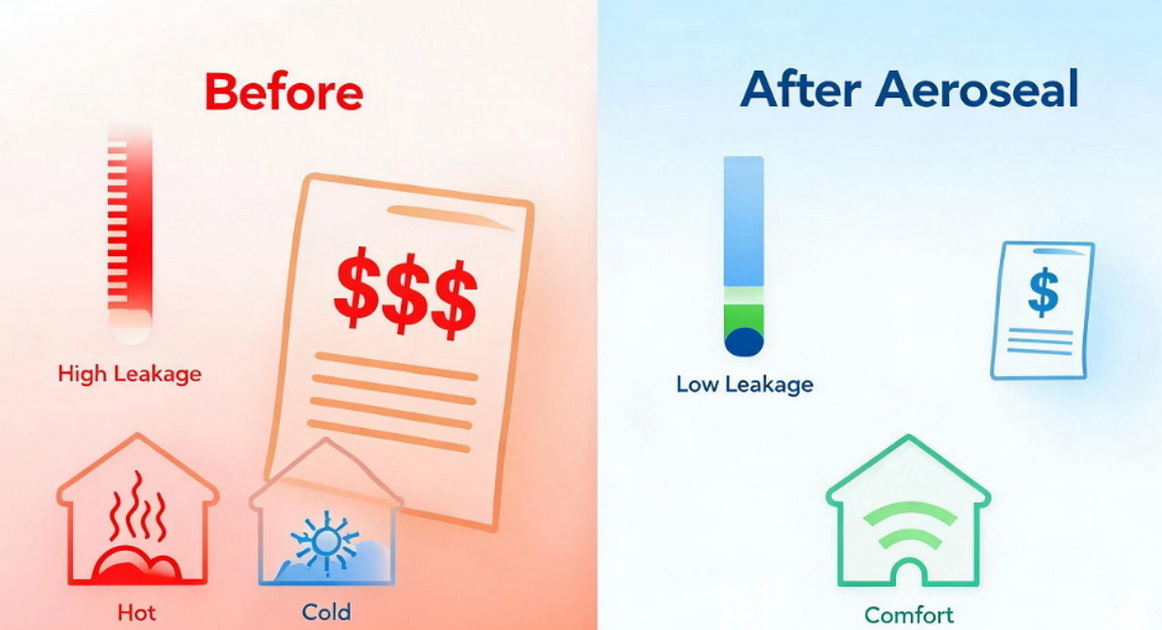
Because leaky ducts can reduce system efficiency by as much as 20%, sealing them often delivers some of the fastest payback of any HVAC upgrade. Homeowners frequently see meaningful reductions in utility bills within the first year, especially in regions with long cooling or heating seasons. [facebook]
When you combine those savings with improved comfort and extended equipment life (your system doesn't have to run as long or as often to maintain set temperatures), Aeroseal becomes a strategic investment rather than a cosmetic upgrade. For families planning to stay in their home several years, cumulative savings can easily exceed the cost of the service. [beckwithheatcool]
After sealing projects, two pieces of feedback come up repeatedly: "The house finally feels even" and "The system doesn't seem to run as long." With leaks reduced, conditioned air reaches the intended rooms more efficiently, which helps eliminate hot and cold spots and stabilizes temperatures across floors. [cooltimeshvac]
In some cases, we also see reductions in duct noise and whistling, because high‑velocity air is no longer escaping through narrow cracks and joints. That creates a more peaceful and consistent indoor environment—especially important for bedrooms, nurseries, and home offices. [cooltimeshvac]
Sealing return and supply ducts helps control where your home's air comes from and where it goes. By reducing leaks in attics, crawlspaces, and other dusty or damp areas, Aeroseal can cut down on the amount of particulate matter, allergens, and humidity pulled into your system. [patgreenair]
Homeowners with asthma or allergy concerns often notice less dust accumulation on surfaces and fewer symptoms, particularly when duct sealing is combined with proper filtration and routine maintenance. For us as a heating and cooling company, this is one of the most compelling reasons to prioritize duct integrity, not just temperature control. [facebook]
While a professional test is the gold standard, there are several DIY indicators that suggest your ducts may be leaking. [onehourheatandair]
Try the following:
1. Walk room to room and note any persistent temperature differences when your system is running. [nadca]
2. Check accessible duct runs in the attic, basement, or crawlspace for visible gaps, disconnected sections, or old dried duct tape. [onehourheatandair]
3. Turn on your HVAC system and carefully feel along exposed ducts for noticeable air blowing out of seams. [onehourheatandair]
4. Light an incense stick and move it slowly along joints; watch for smoke that wavers or gets pulled into cracks. [nadca]
5. Review your past utility bills to see if costs have climbed without changes in usage or local rates. [palmetto]
If you check several of these boxes, there is a strong chance you would benefit from a professional duct leakage test and potentially Aeroseal sealing.
Organizations like NADCA (National Air Duct Cleaners Association) recommend systematic inspection and testing of duct systems using tools like duct blasters and smoke pencils to quantify leakage. At Mega Services Heating & Cooling, we follow these industry standards when evaluating your ductwork so that recommendations are anchored in objective data, not just visual guesses. [onehourheatandair]
This standards‑based approach is especially important for homes with older systems, additions, or DIY modifications where ductwork may have been extended, altered, or partially reconnected over the years. [nadca]
From an industry perspective, Aeroseal duct sealing tends to deliver exceptional value in a few specific scenarios. [beckwithheatcool]
- Homes with finished basements or ceilings where most ductwork is hidden.
- Multi‑story homes with persistent temperature imbalances between floors.
- Older houses with extended or modified duct systems serving new additions.
- Families planning major efficiency upgrades (heat pumps, high‑efficiency furnaces) who want the ducts to match the performance of the equipment.
Because Aeroseal works from the inside, we can address leaks that would require extensive demolition to reach with traditional methods. In these cases, the technology effectively turns your existing ducts into a more modern, tight distribution system without rebuilding from scratch. [beckwithheatcool]
There are also situations where conventional approaches are the right first step. If you have sections of duct that are crushed, disconnected, or severely undersized, those design and repair issues must be corrected before any sealing solution can deliver its full benefit. [palmetto]
Likewise, if the majority of your ductwork is fully exposed and easily accessible, a combination of mastic, foil tape, and proper insulation may address most of your leakage at a lower cost. As experts, we routinely evaluate both the physical condition and accessibility of your system before recommending Aeroseal so that the solution fits your specific home and priorities. [anytimeserviceguys]

At Mega Services Heating & Cooling, duct sealing projects follow a clear, homeowner‑friendly workflow based on best practices used across the HVAC industry. We start with a conversation about your comfort complaints, review your system layout, and perform a professional leakage test so you know exactly where you stand. [cooltimeshvac]
If Aeroseal is a good fit, we walk you through the expected results, share similar case outcomes, and schedule the work at a time that minimizes disruption to your household routine. Throughout the process, our goal is to combine technical expertise with clear communication so that you understand both the "how" and the "why" behind every recommendation. [beckwithheatcool]
If your home struggles with stubborn hot or cold rooms, rising energy bills, or excessive dust, your duct system may be quietly working against you. Aeroseal duct sealing offers a proven, data‑driven way to reclaim that lost comfort and efficiency, often with measurable results in a single day. [patgreenair]
To find out whether Aeroseal is right for your home, contact Mega Services Heating & Cooling to schedule a professional duct leakage test and consultation. Our team will evaluate your system, walk you through your options, and help you choose the most effective path to a safer, more comfortable, and more energy‑efficient home.
Aeroseal uses a water‑based, non‑toxic polymer sealant that has been tested for safety in residential applications. It does not coat the entire interior surface of your ducts; instead, it accumulates only at leak sites where air escapes, creating a targeted seal. [greensealenergy]
Field experience and manufacturer data indicate that Aeroseal seals are designed to last for many years under normal operating conditions. Because the sealant forms a flexible, durable bond at leak edges, it can withstand typical duct expansion, contraction, and airflow without cracking or flaking away. [aeroseal]
Most homeowners notice improvements in comfort and system run time shortly after sealing, particularly during peak heating or cooling seasons. Actual bill reductions depend on your starting leakage level, local energy rates, and how you use your system, but studies have shown annual savings of several hundred dollars in many cases. [palmetto]
You can certainly address accessible ducts using mastic and foil tape, and we often encourage simple DIY fixes where appropriate. However, DIY methods cannot reach the hidden sections inside walls and ceilings, which is where Aeroseal's inside‑out approach provides a significant advantage. [greensealenergy]
Light dust in the ducts does not usually prevent Aeroseal from working, but heavy debris or major contamination should be addressed first. A professional inspection will determine whether cleaning is advisable so that the sealant adheres properly and system airflow remains unobstructed. [nadca]
1. Green Seal Energy – "Benefits of Aeroseal Duct Sealing." https://greensealenergy.com/benefits-of-aeroseal-duct-sealing/
2. Palmetto – "Duct Sealing Can Save You Money and Energy." https://palmetto.com/home-electrification/duct-sealing-can-save-you-money-and-energy
3. Beckwith Heating & Cooling – "Why Aeroseal Is a Must for Energy Efficiency." https://beckwithheatcool.com/blog/why-aeroseal-is-a-must-for-energy-efficiency-according-to-experts/
4. Pat Green Heating & Cooling – "Effective Ductwork Repair & Sealing." https://patgreenair.com/duct-sealing/
5. Aeroseal – "13 Questions Homeowners Ask About Aeroseal." https://aeroseal.com/blog/questions-homeowners-ask-about-aeroseal/
6. Anytime Service Guys – "5 Effective HVAC Duct Sealing Methods for Energy Efficiency." https://anytimeserviceguys.com/5-effective-hvac-duct-sealing-methods-for-energy-efficiency/
7. Facebook Homeowner Discussion – Aeroseal effectiveness overview. https://www.facebook.com/groups/livingincochrane/posts/7095476713912656/
8. Cool Times Heating and Cooling – "Aeroseal®, Industry‑Leading Duct Sealing Technology." https://www.cooltimeshvac.com/services/aeroseal/
9. One Hour Heating & Air Conditioning, Corpus Christi – "Aeroseal Duct Sealing Services in Corpus Christi, TX." https://www.onehourheatandair.com/corpus-christi/about-us/blog/2023/february/aeroseal-duct-sealing/
10. NADCA – "A Beginner's Guide to Duct Sealing." https://nadca.com/blog/beginners-guide-duct-sealing


