
Views: 220 Author: Mega Services Publish Time: 2026-08-15 Origin: Site


Content Menu
>> Why Auxiliary Heat May Increase Energy Use
>> When Should You Use Emergency Heat?
>> When Should You Avoid Emergency Heat?
● Auxiliary Heat vs. Emergency Heat: The Main Difference
● Why AUX Heat Appears During a Defrost Cycle
>> Normal Frost vs. Problematic Ice
● A Heat Pump Checklist for Cold Weather
>> Check Your Thermostat Setting
>> Check Indoor Vents and Returns
>> Inspect the Outdoor Unit Safely
>> Pay Attention to System Behavior
● When Your Heat Pump Needs Professional Attention
● Keeping Your Home Comfortable All Winter
>> 1. Is it normal for AUX Heat to come on?
>> 2. Should I turn on Emergency Heat when temperatures are very low?
>> 3. Why is AUX Heat on but my home still feels cold?
>> 4. Does Emergency Heat cost more to run?
>> 5. Can I use Emergency Heat if the outdoor unit is frozen?
>> 6. Why does my heat pump blow cooler air during defrost?
>> 7. How can I reduce unnecessary AUX Heat use?
When your thermostat displays "AUX Heat" or "EM Heat," it can be difficult to know whether your system is working normally or needs professional attention. Although both settings involve a backup heat source, they serve very different purposes.
Auxiliary heat is an automatic function designed to help your heat pump during periods of high heating demand. Emergency heat is a manual setting intended for temporary use when the heat pump cannot operate correctly. Understanding the difference can help protect your comfort, reduce unnecessary energy use, and prevent avoidable strain on your heating system.
At Mega Services Heating & Cooling, we believe homeowners should feel confident about the systems that keep their homes warm. This guide explains what these thermostat settings mean, when they are normal, and when it may be time to have your system inspected.
> Quick answer: AUX Heat supports a working heat pump automatically. Emergency Heat bypasses the heat pump and uses the backup heat source by itself.
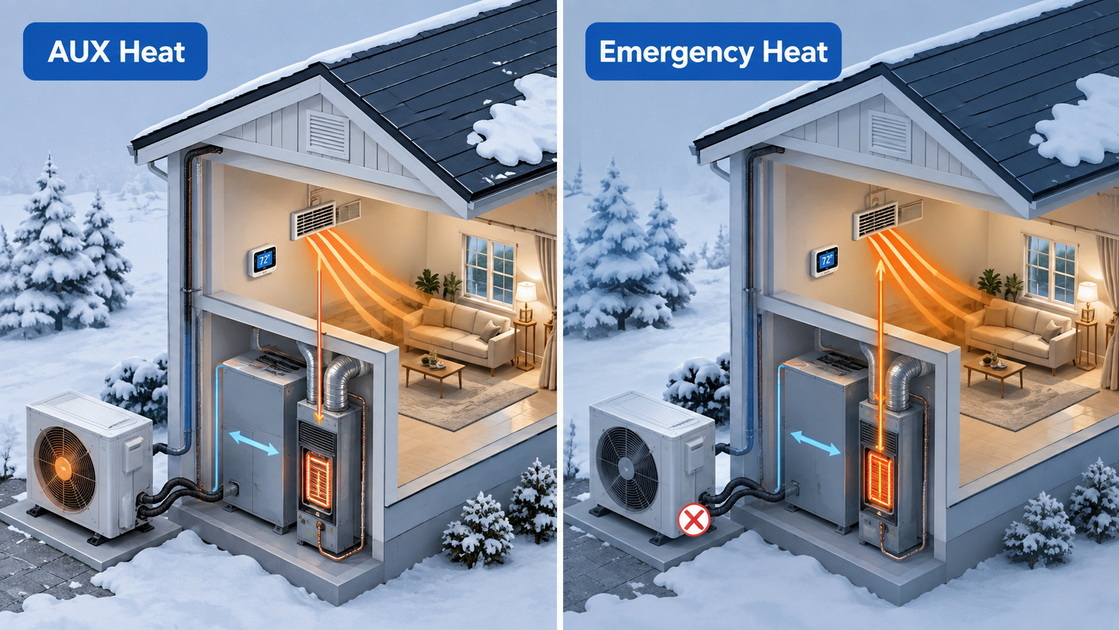
Auxiliary heat, commonly shown as AUX Heat on a thermostat, is supplemental heat that activates automatically when your heat pump needs additional support.
A heat pump normally gathers heat from outdoor air and transfers it indoors. Even in cold weather, outdoor air contains usable heat energy. However, as temperatures drop, the system may need assistance to maintain the desired indoor temperature efficiently and comfortably.
That is where auxiliary heat comes in.
In many homes, auxiliary heat comes from electric heat strips located inside the indoor air handler. In a dual-fuel system, the backup heat source may be a gas furnace. The thermostat determines when supplemental heat is needed based on indoor temperature, outdoor conditions, system demand, and equipment settings.
Seeing AUX Heat on your thermostat does not always mean something is wrong. In fact, it can be a normal part of winter heat-pump operation.
Auxiliary heat may activate when:
- Outdoor temperatures drop significantly
- Your home needs to recover from an overnight temperature setback
- You raise the thermostat setting several degrees at once
- The heat pump enters a defrost cycle
- Cold weather lasts for an extended period
- Your home loses heat quickly through air leaks, poor insulation, or open doors
For example, imagine that your thermostat is set to 66°F overnight. In the morning, you raise it to 72°F while outdoor temperatures are near freezing. Your heat pump may turn on AUX Heat to help reach the new temperature faster.
This is generally normal. The system is responding to a large heating demand by using its backup source temporarily.
Auxiliary heat is effective, but it may use more energy than standard heat-pump operation. Electric heat strips produce heat through electrical resistance, while a heat pump transfers heat from the outdoor air.
Because of this difference, extended auxiliary heat operation can increase winter energy costs.
Short periods of AUX Heat are usually expected during cold weather, thermostat recovery, or defrost cycles. However, it may be worth having the system checked if AUX Heat runs continuously during mild weather or if your home still feels cold while it is active.
Long AUX Heat cycles can sometimes be linked to:
- A dirty or restrictive air filter
- Blocked supply or return vents
- An incorrectly programmed thermostat
- Low airflow through the indoor system
- Outdoor-unit performance issues
- Excessive heat loss from the home
- A heat pump that needs maintenance or repair
Emergency Heat, often displayed as EM Heat, is a manual thermostat setting. It is intended for temporary use when the heat pump cannot operate safely or effectively.
When you select Emergency Heat, the thermostat usually turns off or bypasses the outdoor heat pump. Instead, the home receives heat only from the backup heating source.
Depending on the system, that source may be electric heat strips, a gas furnace, or another secondary heating component.
Unlike AUX Heat, Emergency Heat does not normally work together with the heat pump. It takes over when the primary heat-pump system cannot provide heat.
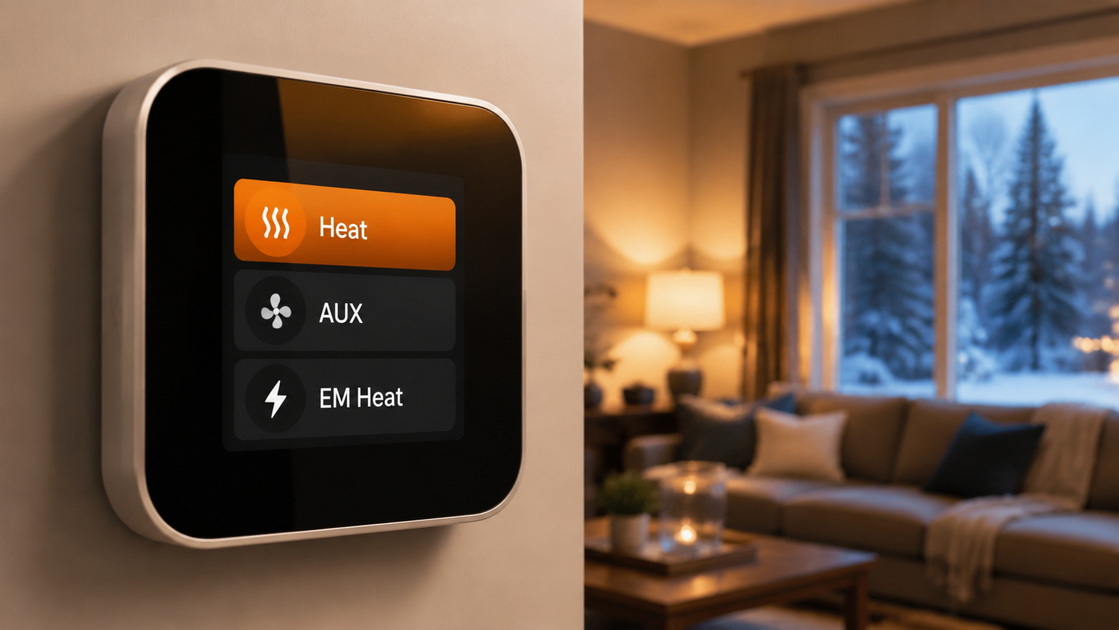
Emergency Heat should be used only when there is a genuine problem with the heat pump or when a qualified HVAC technician recommends using it temporarily.
You may need to turn on Emergency Heat if:
- The outdoor unit will not turn on
- The heat pump is not producing warm air
- The outdoor unit is heavily iced over
- The system is making loud or unusual mechanical noises
- The heat pump repeatedly shuts down
- A storm, falling branch, or other event damages the outdoor unit
- A technician instructs you to use Emergency Heat while waiting for service
Emergency Heat can be particularly important when outdoor conditions are severe and indoor temperatures are falling. It may help maintain a safe indoor environment until the underlying heat-pump issue can be diagnosed and repaired.
Do not use Emergency Heat simply because it is very cold outside.
A properly working heat pump is designed to operate in cold weather. If it needs support, AUX Heat should activate automatically. Manually selecting Emergency Heat without a system problem can cause the backup heat source to run unnecessarily.
Emergency Heat is not a "faster heating" setting. It is not a routine winter setting. It is not the preferred option for ordinary cold-weather comfort.
If your heat pump is running normally, leave the thermostat in standard Heat mode. Let the system control auxiliary heat as needed.
| Feature | Auxiliary Heat | Emergency Heat |
|---|---|---|
| How it starts | Activates automatically | Selected manually |
| Outdoor heat pump | Usually continues operating | Usually shuts off or is bypassed |
| Purpose | Supports the heat pump during high demand | Provides temporary heat when the heat pump cannot operate |
| Common use | Cold weather, defrost cycles, quick temperature recovery | Equipment trouble, ice buildup, or system failure |
| Energy use | Higher than standard heat-pump heating | Often higher because backup heat alone operates |
| Normal in winter | Yes, under appropriate conditions | Only when there is a specific problem |
The simplest way to remember the difference is this:
- AUX Heat means your heat pump is getting help.
- Emergency Heat means your backup system is taking over.
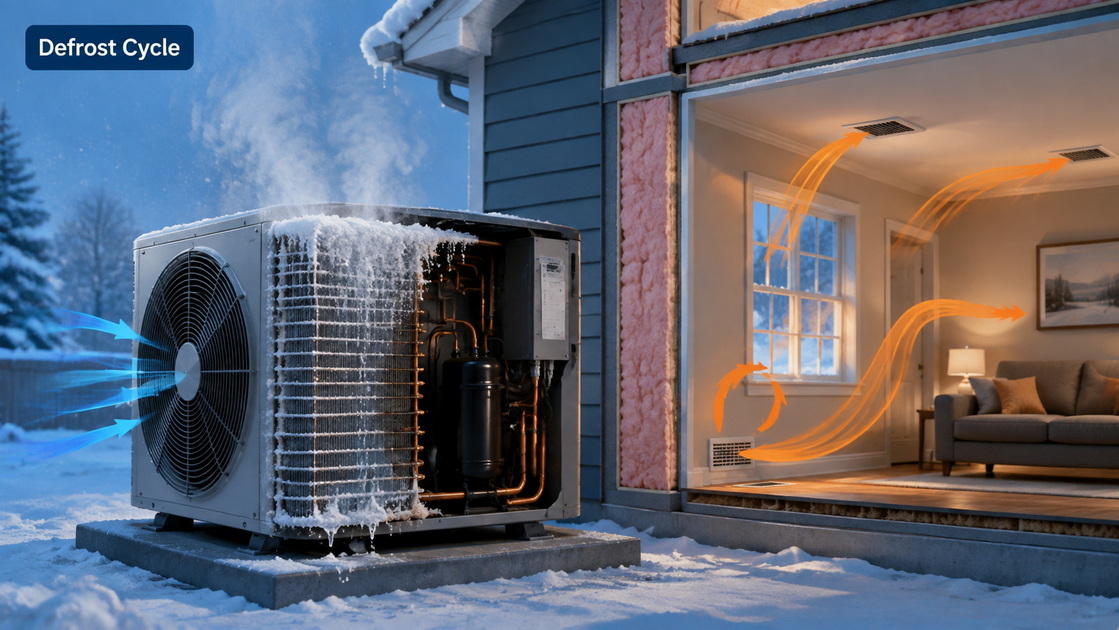
A heat pump can develop frost on its outdoor coil during winter operation. This is normal because the coil becomes colder than the surrounding outdoor air while the system extracts heat.
To keep the outdoor unit operating properly, the system periodically enters a defrost cycle. During this process, the heat pump temporarily changes operation to melt frost and ice from the outdoor coil.
You may notice several things during a defrost cycle:
- Steam rising from the outdoor unit
- Water dripping beneath the unit
- The outdoor fan stopping temporarily
- A temporary change in operating sound
- AUX Heat appearing on the thermostat
- Air from the supply vents feeling less warm for a short time
These signs are often normal. AUX Heat may activate during defrost to maintain indoor comfort while the outdoor unit clears frost.
A light frost layer that disappears after a defrost cycle is usually not a concern. However, heavy ice buildup can signal a problem.
Contact a heating professional if:
- The outdoor unit is covered in solid ice
- Ice returns quickly after the unit appears to defrost
- The outdoor fan cannot turn because of ice
- The system is not producing enough heat
- The outdoor unit makes abnormal sounds
- Your indoor temperature is falling
Do not use sharp tools, hammers, screwdrivers, or hot water to remove ice from the outdoor unit. These methods can damage the coil, fan, refrigerant lines, electrical wiring, or other components.
Instead, keep snow, leaves, branches, and debris away from the unit. If significant ice remains, use Emergency Heat only when needed for safety and arrange a professional inspection.
Before assuming your heating system has failed, perform a few safe and simple checks. These steps can help identify obvious issues and provide useful information if service is needed.
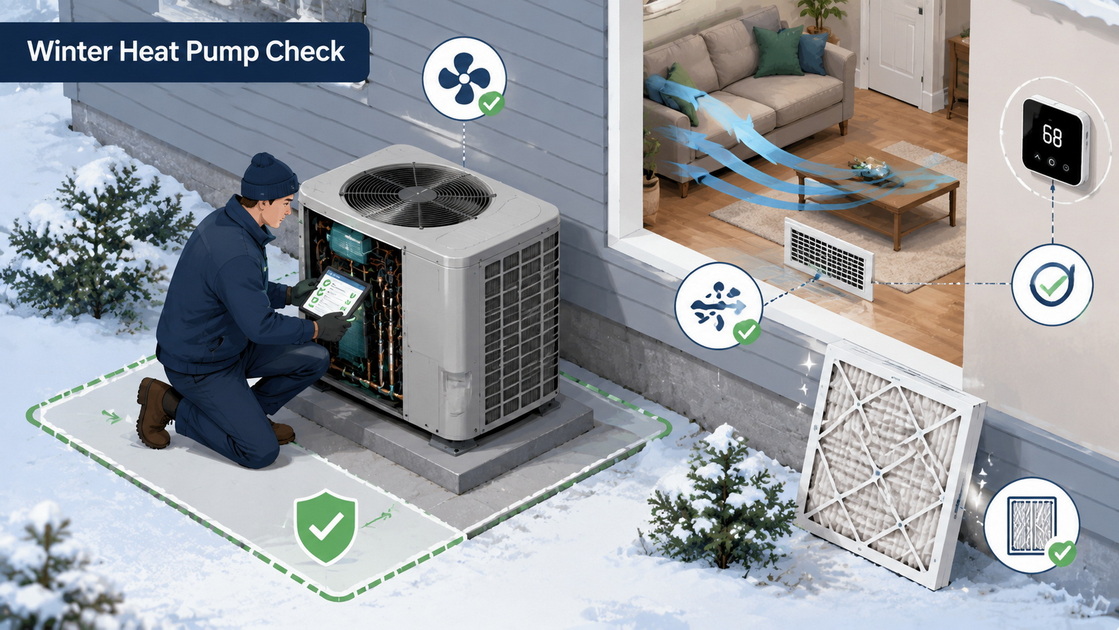
Make sure the thermostat is set to Heat rather than Cool, Off, or Emergency Heat. Confirm that the selected temperature is higher than the current indoor temperature.
If your thermostat follows a schedule, avoid making large temperature changes during freezing weather. Raising the setpoint by several degrees may cause AUX Heat to activate.
For more consistent performance, make smaller adjustments and give the system time to respond.
A dirty air filter restricts airflow. Reduced airflow can make a heat pump run longer, lower comfort levels, and contribute to uneven temperatures.
Check the filter regularly during the heating season. Replace it if it looks heavily coated with dust, pet hair, or debris.
Use the correct filter size and type for your system. If you are unsure, a maintenance technician can help you select the appropriate option.
Make sure supply vents are open and not blocked by furniture, rugs, curtains, or storage items. Return-air grilles should also remain clear.
Closing vents in unused rooms may seem like a way to save energy, but it can disrupt airflow and place added pressure on the system. In many homes, balanced airflow is more important than closing individual vents.
Look at the outdoor heat-pump unit from a safe distance.
Check for:
- Snow accumulation around the unit
- Leaves, branches, or debris blocking airflow
- Heavy ice buildup
- Damage from storms or falling objects
- Unusual sounds while the unit is operating
Keep the surrounding area clear, but do not remove panels or attempt electrical or mechanical repairs yourself.
Take note of what you observe before requesting service.
Useful details include:
- Whether the outdoor unit is running
- How long AUX Heat remains active
- Whether EM Heat was selected manually
- Whether the home is warming slowly or losing temperature
- Whether unusual sounds are present
- Whether the system is cycling on and off frequently
These details can help a technician identify the cause of the problem more efficiently.
Heat pumps may run for longer periods during cold weather, especially when temperatures remain low. Longer run times do not automatically mean there is a problem.
However, some signs should not be ignored.
Have your system inspected if:
- AUX Heat runs continuously during mild weather
- Emergency Heat is the only way your home receives heat
- The outdoor unit does not operate in standard Heat mode
- The system blows cool air for extended periods
- The outdoor unit is heavily iced over
- Circuit breakers trip repeatedly
- The thermostat cannot maintain the desired temperature
- You hear grinding, loud buzzing, banging, or repeated clicking
- You smell burning or notice smoke
If you smell burning, see smoke, or suspect an electrical hazard, turn the system off if it is safe to do so and seek immediate professional assistance.
A well-maintained heat pump can provide dependable heating through a wide range of winter conditions. The key is knowing what normal operation looks like and recognizing the warning signs that deserve attention.
AUX Heat is usually a normal automatic support function. It helps the heat pump manage higher heating demand during cold weather, defrost cycles, and larger thermostat adjustments.
Emergency Heat is different. It is a temporary backup mode that should be used when the outdoor heat pump cannot operate properly or when a heating professional recommends it.
Keeping filters clean, maintaining clear airflow, using steady thermostat settings, and scheduling regular system care can help your heat pump operate more efficiently and reliably when temperatures fall.
Mega Services Heating & Cooling is committed to helping homeowners maintain safe, comfortable, and energy-conscious indoor environments through dependable heating installation, repair, and maintenance services.
Yes. AUX Heat can operate normally during freezing weather, rapid thermostat adjustments, defrost cycles, or periods of high heating demand. It should usually turn off once the home reaches the thermostat setting or the extra heating demand decreases.
Usually, no. Keep the thermostat in standard Heat mode unless the heat pump has stopped working, the outdoor unit is severely iced over, or a heating professional has advised you to use Emergency Heat.
Possible causes include severe outdoor temperatures, high heat loss from the home, blocked airflow, a dirty filter, outdoor-unit ice buildup, or a system issue. If your home temperature keeps falling, the system should be inspected.
Emergency Heat may use more energy than normal heat-pump operation because it relies on the backup heating source alone. It is best used temporarily when the heat pump cannot operate correctly.
Emergency Heat may help maintain indoor warmth while the outdoor unit cannot operate. Do not attempt to chip ice from the unit. Heavy or repeated ice buildup should be evaluated by a qualified heating technician.
During defrost, the system temporarily changes operation to melt frost from the outdoor coil. AUX Heat may activate to maintain indoor comfort. A brief change in supply-air temperature can be normal during this cycle.
Use smaller thermostat adjustments, replace dirty filters, keep indoor vents open, remove debris around the outdoor unit, improve home insulation and air sealing, and maintain the system regularly.
1. U.S. Department of Energy.
2. Lennox.
3. Trane.
4. Carrier.
5. Bryant.
6. Logan Services.


