
Views: 213 Author: Mega Services Publish Time: 2026-09-17 Origin: Site


Content Menu
● How Solar Panels Power an Air Conditioner
>> Suggested Image Placement: Solar Energy Flow Diagram
● Can Solar Panels Run an Air Conditioner at Night?
● How Many Solar Panels Do You Need for an Air Conditioner?
>> Factors That Affect Air Conditioner Energy Use
>> A Simple Homeowner Planning Example
● Why HVAC Efficiency Matters Before Going Solar
>> HVAC Conditions to Check Before Solar Installation
>> Suggested Image Placement: Solar-Ready HVAC Checklist
● Can a Battery Run Your Central Air Conditioner?
● Can a Heat Pump Work Well With Solar Panels?
● Common Mistakes When Planning Solar-Powered Cooling
>> Sizing Solar Based Only on the Air Conditioner
>> Ignoring the Condition of an Older HVAC System
>> Forgetting About Ductwork and Insulation
>> Expecting Solar Panels Alone to Provide Outage Power
>> Skipping Seasonal HVAC Maintenance
>> Overestimating How Long a Battery Will Run AC
● Practical Ways to Reduce Cooling Energy Use
>> Use a Consistent Thermostat Schedule
>> Replace Aging Equipment When Appropriate
● A Solar-Ready Cooling Checklist
● A Smarter Approach to Solar and Home Comfort
>> 1. Can solar panels power a central air conditioner?
>> 2. How many solar panels do I need to run a 3-ton air conditioner?
>> 3. Can solar panels run my air conditioner at night?
>> 4. Do I need a battery to use solar panels with an AC unit?
>> 5. Will my air conditioner work during a power outage if I have solar panels?
>> 6. Should I replace my old air conditioner before installing solar panels?
>> 7. Can HVAC maintenance help reduce the solar system size I need?
>> 8. Is a heat pump a good choice for a home with solar panels?
Yes, you can run an air conditioner with solar panels. For most homes, solar panels do not connect directly to the air conditioner. Instead, they generate electricity for the home's electrical system, helping power the air conditioner, lights, appliances, and other everyday equipment.
For homeowners looking to reduce summer electricity use, solar can be a valuable part of a more energy-efficient home. However, the best results come from combining solar power with a properly sized, well-maintained, and efficient heating and cooling system.
At Mega Services Heating & Cooling, we help homeowners create safer, more comfortable, and more energy-conscious homes through professional HVAC installation, repair, and maintenance. Understanding how your air conditioner uses electricity is an important first step before planning a solar project.
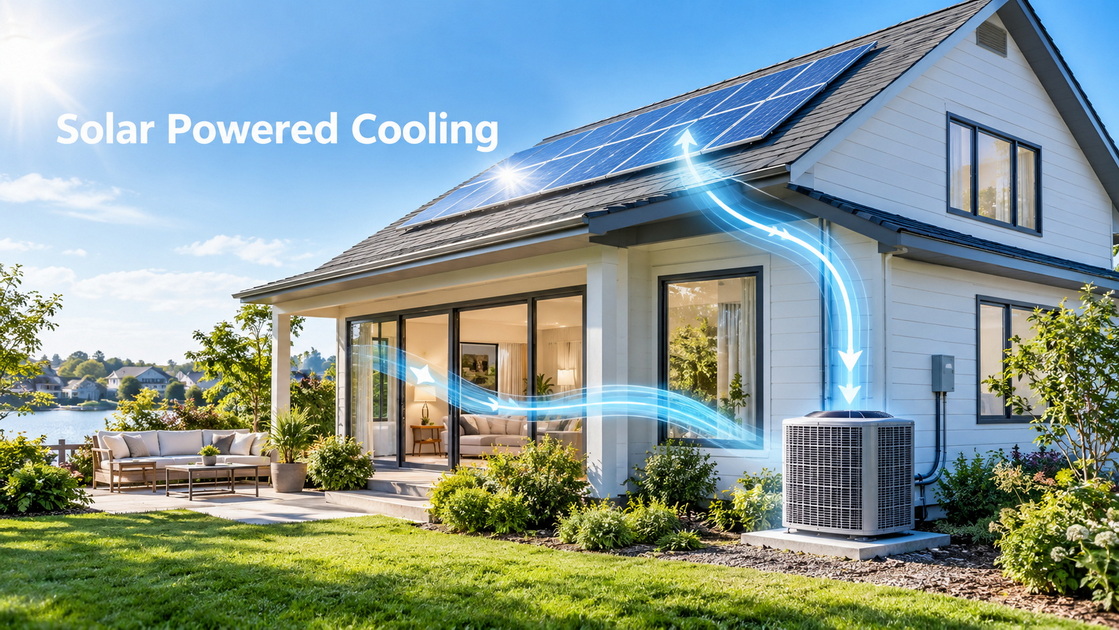
Solar panels produce direct current electricity, commonly called DC power. Your home appliances, including your air conditioner, use alternating current electricity, or AC power.
A solar inverter converts the electricity generated by the panels into usable electricity for your home. That electricity then flows into your electrical panel, where it can be used by your cooling system and other household equipment.
In a typical residential solar system, the process works like this:
1. Solar panels capture sunlight and generate DC electricity.
2. A solar inverter converts DC electricity into AC electricity.
3. The electricity enters the home's electrical panel.
4. Your air conditioner and other appliances use available solar electricity.
5. When the home needs more electricity than the solar system produces, additional power may come from the utility grid.
6. When the solar system produces more power than the home is using, the excess may be sent to the grid or stored in a battery, depending on the system design.
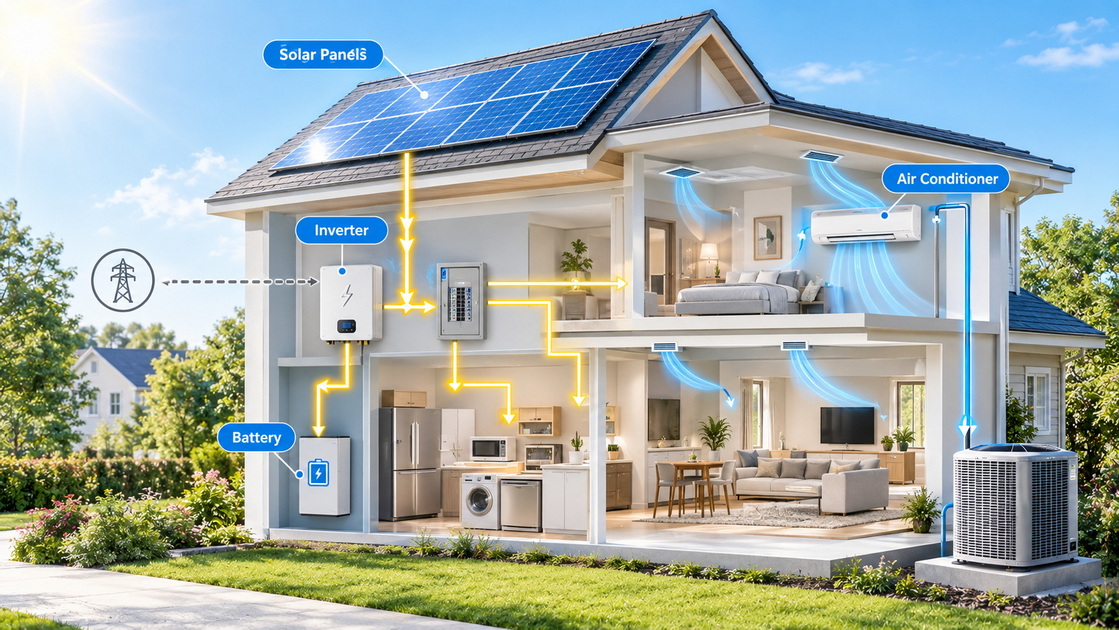
This means a standard central air conditioner, heat pump, ductless mini-split, or window AC unit can benefit from solar electricity. The air conditioner does not need to be labeled as a special solar-powered model.
The key is that solar supports the home's overall electrical demand rather than one appliance alone.
Insert a simple visual after this section showing the flow of energy:
Solar Panels → Inverter → Electrical Panel → Air Conditioner and Home Appliances
The diagram can also show optional connections to the utility grid and battery storage. This helps homeowners quickly understand why a solar installation can support cooling without changing the way they normally operate their air conditioner.
Solar panels generate electricity when sunlight is available. They do not produce meaningful power after sunset, during heavy cloud cover, or when snow and debris block the panels.
That does not mean your air conditioner must stop running at night.
Most solar-equipped homes use one of three setups:
| System Type | How It Supports Air Conditioning | Common Purpose |
|---|---|---|
| Grid-connected solar | Solar helps power the home during the day, while grid electricity is available when solar output is low | Reducing daytime electricity purchases |
| Solar with battery storage | Solar can charge batteries that provide electricity later or during an outage | Adding energy resilience and backup power |
| Off-grid solar | Solar panels and batteries provide all household electricity | Specialized homes without standard grid service |
A grid-connected solar system can help offset daytime cooling costs while the AC is running. At night, the home usually uses grid electricity unless it has battery storage.
Solar panels alone typically do not keep an air conditioner running during a power outage. Many standard grid-connected systems automatically shut down when utility power fails. This safety feature protects utility workers who may be repairing power lines.
Homes that need backup power during outages generally require a battery, backup electrical equipment, and careful planning around which appliances should receive power.
There is no one-size-fits-all number of solar panels for an air conditioner. A 3-ton air conditioner in one home may use considerably more electricity than a 3-ton system in another home.
The amount of solar capacity needed depends on the home's real electricity use, cooling habits, HVAC efficiency, local sunlight, roof condition, panel wattage, and utility arrangement.
Before estimating how much solar power a home may need, consider the following factors:
- Type of cooling system: Central air conditioner, heat pump, ductless mini-split, window unit, or packaged unit
- System efficiency: More efficient equipment can provide the same comfort while using less electricity
- Age of the equipment: Older systems may use more energy and may be more likely to need repairs
- Equipment condition: Dirty coils, weak electrical parts, refrigerant problems, and airflow restrictions can increase energy use
- Cooling capacity: An oversized or undersized system may create comfort and efficiency concerns
- Outdoor temperature: Longer and hotter summers usually increase cooling demand
- Thermostat setting: Lower indoor temperature settings can make the system run longer
- Home insulation: Poor insulation allows heat to enter more easily
- Ductwork condition: Leaky ducts can waste conditioned air before it reaches living areas
- Window exposure and shading: Direct sunlight through windows can increase indoor heat gain
- Other household electricity use: Refrigerators, lighting, cooking appliances, electronics, laundry equipment, and electric vehicles all affect total demand
A solar proposal should be based on a full review of household electricity use rather than only the size of the outdoor AC unit.
Consider a family whose electricity bills rise sharply during the summer. Their first question may be, "How many solar panels do I need to run my air conditioner?"
A more useful approach is to look at the whole home:
1. Review electricity bills from the previous 12 months.
2. Identify the increase in electricity use during the cooling season.
3. Inspect the condition and efficiency of the existing HVAC system.
4. Identify hot rooms, humidity concerns, airflow issues, and comfort complaints.
5. Evaluate whether maintenance, duct improvements, insulation, thermostat adjustments, or equipment replacement could reduce energy demand.
6. Consider future electrical changes, such as a heat pump, electric vehicle, battery, or additional household equipment.
7. Size the solar system around the home's expected electricity needs rather than only its current usage.
This process helps prevent a costly planning mistake: building a solar system around an old, inefficient air conditioner and then replacing that system shortly afterward.
Solar energy can help offset electricity use, but it cannot fix an inefficient air conditioner, damaged ductwork, poor airflow, inadequate insulation, or an incorrectly sized system.
A home may have excellent solar potential but still experience high cooling costs if the air conditioner is struggling to do its job. When HVAC equipment runs longer than necessary, it uses more electricity and may not provide consistent comfort.
Reducing energy waste is often just as important as producing clean electricity.
A well-maintained system can improve comfort while helping reduce unnecessary electrical demand. In many homes, this can make a solar project more effective because the home needs less energy overall.
A professional heating and cooling inspection can identify whether your current system is ready to support your long-term energy goals.
Important items to review include:
- Whether the air conditioner or heat pump is nearing the end of its expected service life
- Whether the cooling system is appropriately sized for the home
- Whether the air filter is clean and correctly installed
- Whether the blower and return-air system are providing proper airflow
- Whether ductwork is leaking, disconnected, undersized, or poorly insulated
- Whether the outdoor unit is clear of leaves, dirt, vegetation, and debris
- Whether the thermostat is accurately controlling the indoor temperature
- Whether the refrigerant system and electrical components are functioning correctly
- Whether certain rooms are consistently warmer, cooler, or more humid than others
- Whether insulation and air sealing improvements could reduce indoor heat gain
Regular maintenance matters. A dirty air filter can restrict airflow and force the system to work harder. A blocked outdoor coil can reduce heat transfer. Low airflow can affect comfort, equipment performance, and energy use.
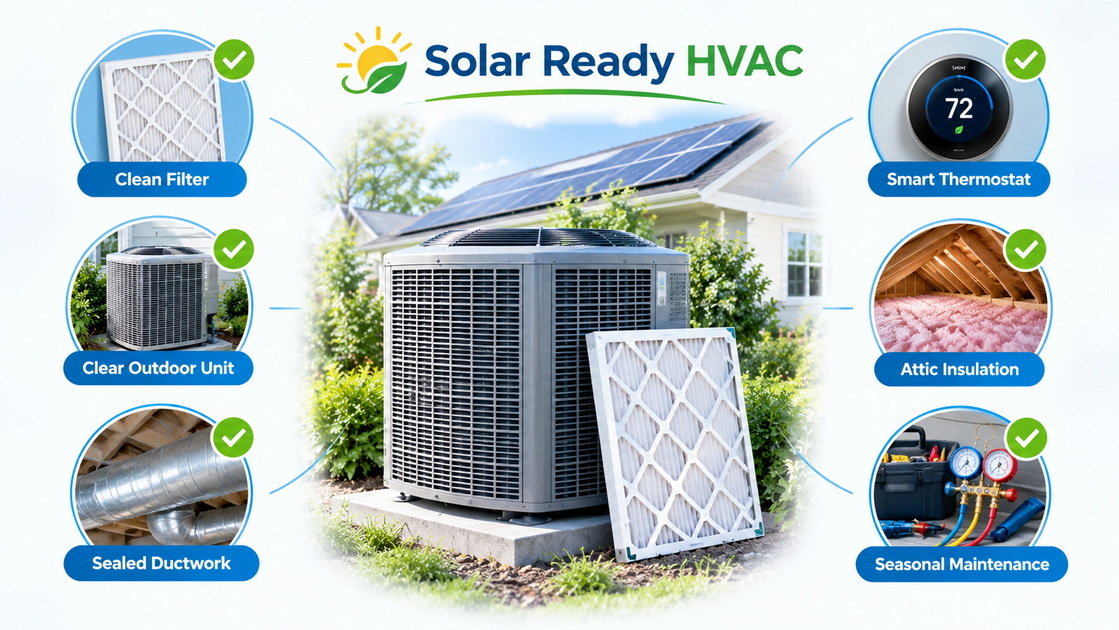
Add a clean checklist-style image in this section with the following items:
- Clean air filter
- Clear outdoor unit
- Healthy airflow
- Sealed ductwork
- Proper insulation
- Accurate thermostat
- Seasonal maintenance
- Efficient HVAC equipment
- Future system replacement plan
This type of visual makes the content easier to scan and can help homeowners understand the practical steps involved before considering solar power.
A battery can store electricity generated by solar panels for use later. It can also provide backup power during certain outages when paired with the correct electrical equipment.
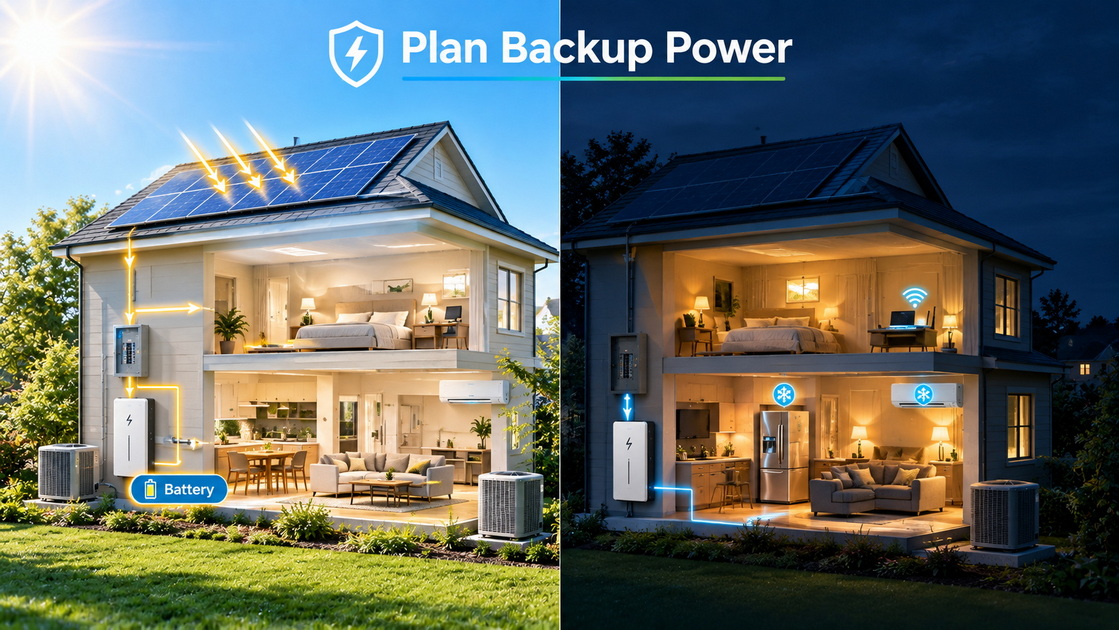
However, central air conditioning can require a significant amount of electricity, especially during extremely hot weather. A battery that is appropriate for powering lights, a refrigerator, internet equipment, and a few outlets may not have enough stored energy to operate a large central air conditioner for an extended period.
The ability to run an air conditioner from battery storage depends on several details:
- The capacity of the battery system
- The power output of the battery and inverter
- The startup demand of the HVAC equipment
- The efficiency and size of the air conditioner or heat pump
- Outdoor temperature and runtime
- Other appliances using electricity at the same time
- Whether the home has a whole-home or limited-load backup system
For some homeowners, the most practical approach is to prioritize selected rooms, smaller ductless systems, fans, or other essential loads during an outage. Others may choose larger battery systems designed to support more of the home.
Backup power should be planned around real household needs, not assumptions.
Yes. A heat pump can be a strong match for a solar-equipped home because it provides both heating and cooling using electricity.
Unlike a traditional furnace that burns fuel to create heat, a heat pump moves heat. In cooling mode, it moves heat out of the home. In heating mode, it moves heat into the home from the outdoor air or another source.
Because heat pumps use electricity, homeowners often consider solar as part of a long-term plan to reduce the amount of electricity purchased from the grid.
A heat pump may be especially worth considering when:
- An aging central AC system is approaching replacement
- The home uses an older furnace and air conditioner
- The homeowner wants one system for heating and cooling
- The household is planning other electric upgrades
- The home needs improved comfort control
- There is interest in reducing reliance on fossil-fuel heating
- The property has enough electrical capacity and suitable HVAC infrastructure
Heat pumps must still be selected and installed correctly. The right size, airflow design, duct condition, controls, and installation quality all affect performance.
Planning ahead can help homeowners avoid unnecessary cost, reduced comfort, and unrealistic expectations.
Your air conditioner is not the only device using electricity. A solar system must support the home's total energy needs, including appliances, electronics, lighting, refrigeration, cooking, laundry, and future electrical upgrades.
An inefficient system may use more electricity than necessary. If your AC is near the end of its life, consider evaluating replacement options before the solar system is sized.
A high-efficiency air conditioner cannot fully overcome leaky ducts, poor attic insulation, unsealed air leaks, or rooms exposed to intense afternoon sunlight.
Solar panels may reduce electricity purchases during normal operation, but they do not automatically provide backup power when the grid fails. Backup operation requires the proper system design.
Solar power cannot compensate for a clogged filter, dirty coil, refrigerant problem, faulty capacitor, weak blower motor, or restricted airflow. Routine service protects comfort and may reduce avoidable energy waste.
Battery backup time depends on actual electrical demand. A large central AC system operating during a hot afternoon may use stored energy faster than a homeowner expects.
Before expanding solar capacity, homeowners can often reduce cooling demand through practical improvements.
Regular maintenance helps ensure that the equipment operates as intended. This may include checking filters, inspecting electrical components, cleaning coils when needed, testing system operation, and confirming that airflow is appropriate.
A programmable or smart thermostat can help maintain a comfortable schedule without unnecessarily cooling an empty home. Avoid extreme temperature setbacks that make the system work excessively hard to recover later.
Keep supply vents open and unobstructed. Do not block return vents with furniture, rugs, or storage items. If some rooms are consistently uncomfortable, ask an HVAC professional to evaluate airflow, duct design, zoning, or equipment capacity.
Window coverings, exterior shading, attic insulation, air sealing, and properly sealed ducts can reduce the amount of heat entering the home. Less heat gain means the air conditioner may not need to run as long.
An older system may still operate, but it may not deliver the efficiency, humidity control, comfort, or reliability of newer equipment. Replacement should be based on a professional evaluation of system condition, repair history, comfort concerns, and expected future energy use.
Use this checklist before planning a solar project for your home:
- Review at least 12 months of electricity bills
- Identify high-use summer months
- Note rooms that feel hot, humid, stuffy, or unevenly cooled
- Schedule professional HVAC maintenance or an equipment evaluation
- Check and replace the air filter if necessary
- Clear vegetation and debris from around the outdoor unit
- Evaluate ductwork, insulation, airflow, and thermostat performance
- Discuss whether an aging air conditioner should be replaced before solar sizing
- Tell the solar provider about planned HVAC upgrades, heat pumps, electric vehicles, or battery storage
- Understand how the home will receive electricity after sunset and during outages
- Review the electrical loads you would want to support during an emergency
Solar panels can help power an air conditioner and may reduce the amount of electricity your home purchases during sunny hours. But solar is only one part of a complete comfort and energy plan.
The strongest results come from looking at the entire home: the condition of the air conditioner, the quality of the ductwork, insulation levels, thermostat settings, airflow, household habits, roof solar potential, and future energy needs.
A properly maintained, correctly sized heating and cooling system can help your home stay more comfortable while using less electricity. When solar is added to that foundation, homeowners are better positioned to improve efficiency, reliability, and long-term energy planning.
Mega Services Heating & Cooling is committed to helping families maintain safe, comfortable, and energy-efficient homes. Whether your system needs maintenance, repair, replacement, or a professional assessment before a solar project, our team can help you understand the HVAC factors that matter most.
Yes. Solar panels can generate electricity for your home's electrical panel, and a central air conditioner can use that electricity along with other appliances. Most homes use a grid-connected solar system, so the AC can also receive electricity from the grid when solar production is low.
The number depends on the AC system's efficiency, runtime, local weather, insulation, ductwork, panel size, roof conditions, and total household electricity use. A complete review of energy bills and HVAC performance provides a more accurate estimate than AC tonnage alone.
Solar panels do not produce electricity at night. A grid-connected home can use grid electricity after sunset. A home with battery storage may use stored solar electricity, depending on battery capacity and the amount of electricity the AC requires.
No. A battery is not required for solar panels to help offset air conditioning energy use. Batteries are generally considered when homeowners want backup power, greater flexibility, or the ability to use stored electricity after solar production declines.
Not usually with solar panels alone. Many grid-connected solar systems shut down during an outage for safety. Backup power generally requires a battery, proper electrical equipment, and a system designed to support selected loads or whole-home operation.
If your current system is aging, inefficient, unreliable, or likely to be replaced soon, it is wise to evaluate replacement before finalizing the solar system size. A newer high-efficiency air conditioner or heat pump may change your future electricity needs.
It may. Better airflow, clean filters, sealed ducts, correct refrigerant performance, efficient equipment, and reduced heat gain can lower cooling electricity use. When a home uses less electricity, it may need less solar capacity to meet its energy goals.
A heat pump can be a good option because it provides both heating and cooling using electricity. The best choice depends on your climate, home layout, existing ductwork, electrical capacity, comfort goals, and the quality of installation.
1. Logan Services A/C, Heat & Plumbing.
2. U.S. Department of Energy.
3. National Laboratory of the Rockies.
4. ENERGY STAR.
5. ENERGY STAR.
6. ENERGY STAR.


