
Views: 211 Author: Mega Services Publish Time: 2026-10-13 Origin: Site


Content Menu
● What Does Burying Ducts in Attic Insulation Mean?
● Why Buried Attic Ducts Can Improve Home Comfort
>> Less Heat Transfer Before Air Reaches Your Rooms
>> A Practical Alternative to Relocating Ductwork
● Why Burying Ducts Can Cause Condensation
>> The Counterintuitive Effect of Added Insulation
>> Climate and Installation Quality Matter Together
● What Research Shows—and What It Does Not Prove
● Buried Duct Insulation Requirements: Understand the Distinctions
>> Do Not Confuse Minimum Burial Requirements With Total Attic Insulation
● A Six-Step Inspection Process Before Covering Attic Ducts
>> 1. Identify Existing Water Problems
>> 2. Check Duct Layout and Physical Condition
>> 3. Seal and Test the Duct System
>> 4. Inspect the Vapor-Retarder Jacket
>> 5. Air-Seal the Ceiling and Preserve Ventilation
>> 6. Verify Coverage and System Operation
● What Reader Experiences Add to the Technical Picture
● Compare Your Options Before Choosing Buried Ductwork
● How to Evaluate a Buried-Duct Quote
● Make the Right Improvement Before Adding More Insulation
● Frequently Asked Questions About Burying Ducts in Attic Insulation
>> 1. Can You Cover Flexible Ductwork With Blown-In Insulation?
>> 2. Is R-8 Duct Insulation Enough for Buried Ducts?
>> 3. Does More Attic Insulation Always Prevent Duct Sweating?
>> 4. Will Buried Ducts Fix a Hot Upstairs Bedroom?
>> 5. Should I Add an Attic Fan to Stop Condensation?
>> 6. Can I Bury Attic Ducts Myself?
Burying ducts in attic insulation can improve heating and cooling efficiency, but it is not a simple matter of blowing insulation over existing ductwork. A successful installation depends on your climate, duct condition, moisture protection, insulation levels, and local building requirements.
For homeowners, the practical answer is yes—provided the duct system is suitable and the work follows an approved design. Covering damaged, leaking, or poorly insulated ducts can conceal problems instead of solving them.
At Mega Services Heating & Cooling, our mission is to help families create safe, comfortable, energy-efficient homes through heating and air conditioning installation, repair, and maintenance. Understanding how attic ducts interact with insulation is an important part of making informed home-comfort decisions.
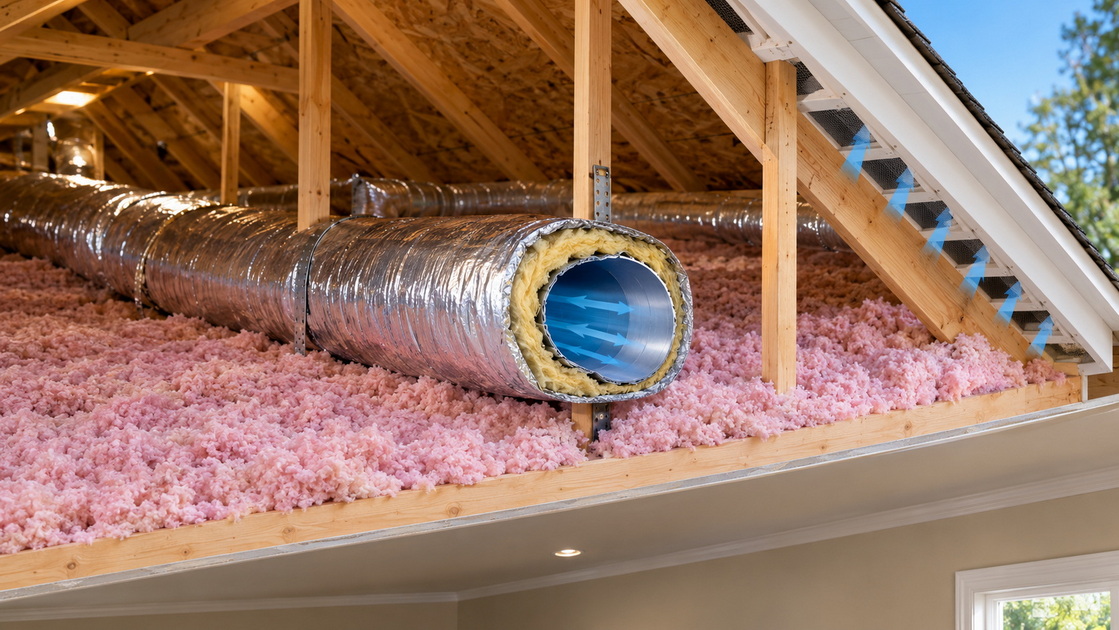
Buried ductwork consists of insulated heating and cooling ducts partially or completely surrounded by attic-floor insulation.
In a conventional vented attic, ducts often sit above the insulation covering the ceiling. Those ducts exchange heat with the surrounding attic: cool supply air gains heat during summer, while warm supply air loses heat during winter.
Surrounding the ducts with additional insulation reduces that heat transfer.
However, two separate insulation layers serve different functions:
- Duct insulation wraps the duct itself and helps control heat transfer and surface temperatures.
- Attic insulation surrounds the duct and insulates the ceiling below.
One does not automatically replace the other. Loose-fill fiberglass or cellulose cannot repair a torn duct jacket, seal a disconnected joint, or correct inadequate duct insulation.
Your equipment conditions air at the indoor coil or furnace. The duct system then carries that air to each room.
When ducts pass through an unconditioned attic, some heating or cooling is lost along the way. Additional insulation can reduce these distribution losses, helping delivered air stay closer to its intended temperature.
That can support more consistent comfort, particularly where long duct runs serve bedrooms or rooms far from the equipment.
Still, insulation cannot correct an undersized duct or an airflow restriction. A room with weak airflow needs a distribution-system assessment, not automatically more attic insulation.
Locating ducts inside the home's thermal and air boundaries is an effective design strategy. In existing homes, however, relocation may require new soffits, lowered ceilings, or substantial remodeling.
Properly designed buried ducts offer another option.
They can improve an existing attic distribution system without rebuilding the entire roof assembly. The opportunity is strongest when duct repairs and attic insulation improvements are already planned together.
Condensation forms when a surface becomes cold enough for moisture in the surrounding air to turn into liquid water.
The critical measurement is the dew point: the temperature at which that air reaches saturation.
For example, if air near a duct has a dew point of 70°F and the duct jacket falls to 65°F, condensation is possible. This is an illustrative example, not a universal operating threshold.
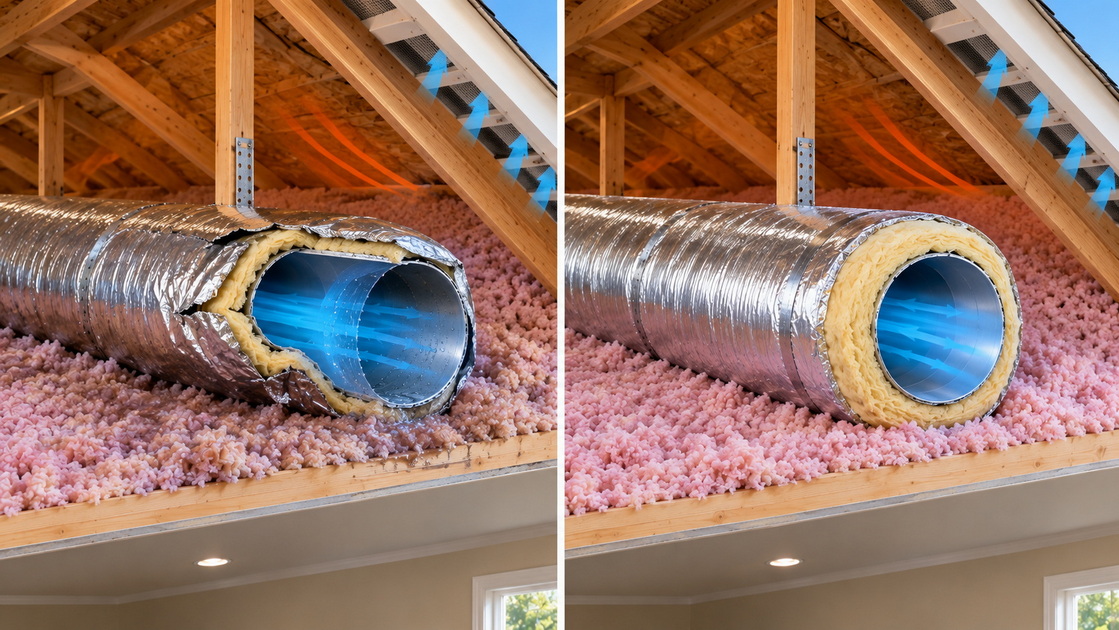
Covering an insulated supply duct reduces heat reaching it from the hot attic. That improves thermal performance, but it can also make the duct's outer jacket colder.
Fiberglass and cellulose are air-permeable materials. They should not be treated as sealed barriers that prevent humid air from reaching cold surfaces.
This explains why adding attic insulation and increasing the duct's own insulation are not interchangeable measures. Additional duct insulation helps keep the exterior jacket warmer; surrounding attic insulation can reduce the heat that previously warmed that jacket.
Humid climates deserve particular attention, but geography alone does not determine whether a system will sweat.
Risk also depends on:
- Supply-air temperature.
- Local moisture conditions.
- Duct insulation thickness and continuity.
- Tears or openings in the vapor-retarder jacket.
- Compressed insulation at supports.
- Duct placement near ceiling materials.
A high insulation rating on a product label does not guarantee protection if seams, connections, or damaged sections remain exposed.
A monitored South Carolina demonstration evaluated compact attic ducts with R-8 duct insulation buried in R-30 ceiling insulation.
The original article reported no observed duct condensation during the monitored August 2015 period and colder air delivered to the home. It also discussed a simulated simple payback of 3.1 years.
Those results demonstrate potential, not a promise for every house.
The monitoring period was limited, and the installation was intentionally designed as a test system. Its compact layout, sealing, and insulation details matter when interpreting the findings.
The research also challenged a simplifying assumption: moisture conditions within the insulation were not necessarily identical to those in the open attic above it.
The homeowner takeaway is straightforward. A successful demonstration supports careful design; it does not justify covering any existing duct system without inspection.
Before work begins, confirm the code edition adopted locally and any amendments. A historical model-code provision is not automatically the current requirement for your property.
The following summarizes the 2018 model-code pathway explained in federal building-science guidance.
| Installation detail | Requirement or distinction in that pathway |
|---|---|
| Duct insulation | Supply and return ducts require at least R-8 |
| Surrounding ceiling insulation | Insulation immediately above and below the duct must total at least R-19, excluding duct insulation |
| Humid climate zones | Supply ducts in Zones 1A, 2A, and 3A require complete burial, at least R-13 duct insulation, and compliant vapor-retarder protection, subject to stated exceptions |
| Deeply buried designation | Additional placement and coverage conditions apply |
| Effective R-25 | An energy-modeling allowance for qualifying deeply buried ducts, not a blanket product rating |
The R-19 requirement around the duct does not mean the entire attic needs only R-19.
Whole-ceiling insulation requirements depend on the applicable code, climate, and compliance method. Your contractor must satisfy both the buried-duct details and the attic's overall requirements.
Similarly, effective R-25 treatment does not mean any covered R-8 duct automatically performs as an R-25 assembly.
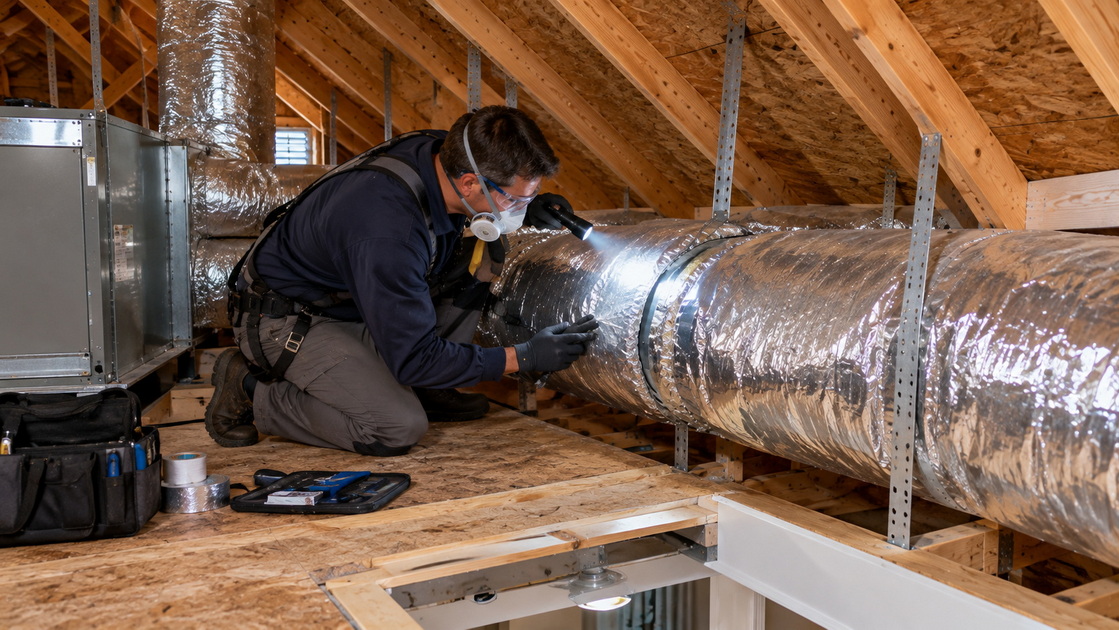
Inspect for roof leaks, wet insulation, duct sweating, and stained ceiling materials.
Do not assume every ceiling stain comes from condensation. Roof leakage and condensate-drain problems can produce similar symptoms.
Resolve the moisture source before adding insulation.
Look for disconnected branches, crushed flexible ducts, sharp bends, unsupported sections, and damaged insulation.
A duct that carries too little air will still perform poorly after burial. Repairs may need to include rerouting or replacement rather than insulation alone.
Duct joints and connections need approved sealing materials and installation methods.
Where required or appropriate, pressure testing helps document leakage before the ducts become harder to access. Ask what was tested, which limit applies, and whether you will receive the results.
Check continuity around fittings, seams, boots, and transitions.
The exterior jacket is part of moisture protection, not merely packaging. Repairs must preserve the intended assembly and follow compatible product instructions.
Address appropriate ceiling penetrations and register-boot connections before installing loose-fill insulation.
Maintain required vent paths with suitable baffles. Do not cover equipment access areas or components that require clearance.
Confirm installed insulation depth, coverage, and documentation.
Afterward, check airflow and equipment operation. An insulation project should leave the heating and cooling system functioning correctly, not simply looking more thoroughly covered.
Public discussion beneath the original author's related article highlights concerns that homeowners may overlook.
One homeowner described condensation appearing after attic ventilation changes. Others asked whether adding substantial insulation over flexible ducts would prevent ceiling stains.
These are individual accounts, not controlled research or customer reviews of Mega Services Heating & Cooling.
Their useful lesson is that moisture problems rarely have a single universal fix. Duct-jacket damage, indoor humidity, airflow, and insulation placement may interact.
The discussion also raises an important ceiling-level issue: cold ducts positioned close to drywall can cool that material. Assessing moisture risk therefore means examining the whole assembly, not only the duct's upper surface.
Do not block attic vents or change blower settings based on another homeowner's experience. Those changes require a system-specific evaluation.
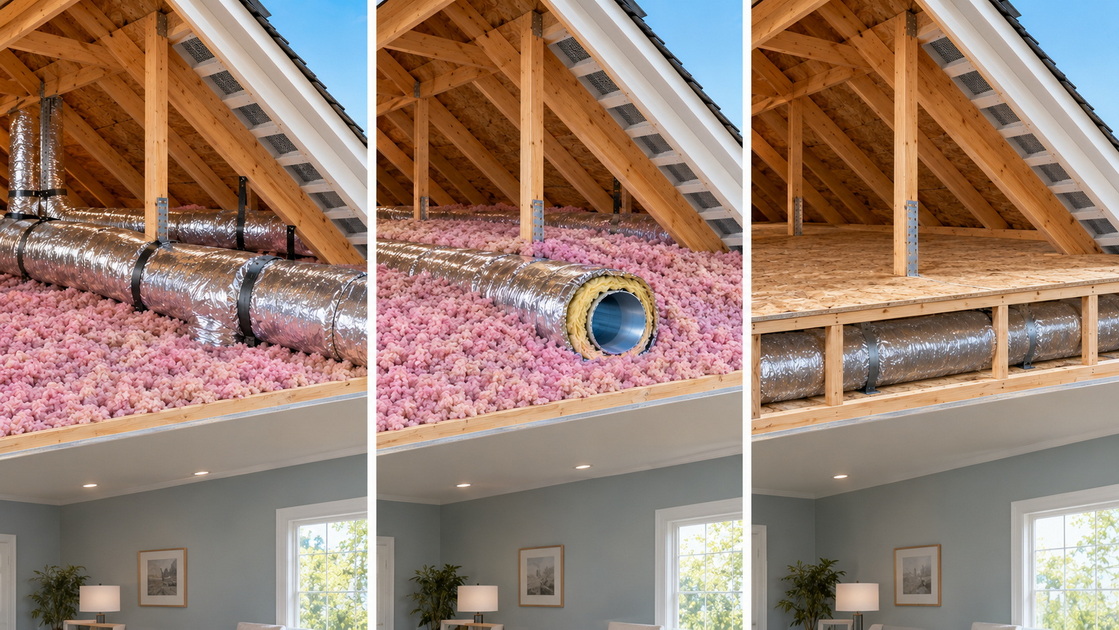
| Approach | Potential advantage | Important limitation |
|---|---|---|
| Repair and re-insulate exposed ducts | Addresses leakage and damaged insulation while retaining access | Ducts remain exposed to attic conditions |
| Bury suitable insulated ducts | Reduces heat transfer through additional surrounding insulation | Requires moisture-conscious design and verified coverage |
| Encapsulate and bury ducts | Adds a designed air-impermeable insulation layer | Requires compatible products, professional application, and applicable fire protection |
| Move ducts into conditioned space | Reduces exposure to unconditioned attic temperatures | May require significant remodeling |
| Redesign the attic enclosure | Changes the environment surrounding equipment and ducts | Requires whole-assembly moisture and code assessment |
The right solution depends on the house, not simply the option with the greatest insulation thickness.
A useful proposal should explain more than the number of insulation bags being installed.
Ask for:
1. Existing duct insulation ratings and required upgrades.
2. Repairs included before burial.
3. Duct sealing and testing scope.
4. Vapor-retarder repair details.
5. Target attic insulation and coverage.
6. Ventilation, clearance, and service-access provisions.
7. Permit and inspection responsibilities.
8. Completion photographs and relevant test records.
Be cautious about guaranteed savings unsupported by a home-specific assessment.
Energy costs depend on climate, equipment efficiency, operating habits, duct leakage, and the existing attic assembly. Published payback estimates from a demonstration home should not become a guaranteed return for your project.
An attic insulation upgrade should improve comfort without introducing hidden moisture problems.
Mega Services Heating & Cooling provides heating and air conditioning installation, repair, and maintenance focused on safer, more comfortable, energy-efficient homes.
Contact our team before covering attic ductwork. Request a heating and cooling assessment to identify duct defects, airflow concerns, and moisture symptoms—and determine which repairs should come before insulation work.
Yes, suitable insulated flexible ducts may be buried under an approved design. First verify their insulation rating, support, physical condition, sealing, and vapor-retarder integrity. Burial should not conceal crushed or disconnected sections.
Not universally. R-8 appears in the historical model-code pathway discussed above, but humid-climate supply ducts can require R-13. The adopted local code and installation details determine what applies.
No. Surrounding insulation can lower the exterior duct-jacket temperature. Condensation protection requires suitable duct insulation, continuous moisture protection, and attention to local dew-point conditions.
They may reduce heat gain along the duct run, but they will not automatically solve inadequate airflow, poor duct sizing, or excessive room heat gain. Diagnose the comfort problem before selecting the repair.
An attic fan is not a substitute for correcting cold, inadequately protected duct surfaces. In humid weather, outdoor air still contains moisture. Have the attic ventilation and duct system evaluated together.
This is not a good first-step project when duct ratings, moisture conditions, or local requirements are uncertain. Homeowners can document symptoms and request an assessment; duct modification and burial need appropriate expertise.
1. ACCA HVAC Blog — Allison A. Bailes III, PhD, "Is It OK to Bury Ducts in Attic Insulation?" February 24, 2017. The supplied source article supports the condensation explanation, South Carolina demonstration details, monitoring limitations, and reported simulated payback.
2. Pacific Northwest National Laboratory, Building America Solution Center — "Buried Ducts within Ceiling Insulation of Vented Attics in all Climate Zones — Code Compliance Brief." Supports the explicitly identified 2018 model-code pathway, R-8/R-13 distinctions, surrounding R-19 requirement, effective R-25 modeling treatment, sealing, inspection, ventilation, and documentation guidance. It is not presented as proof of the code currently adopted in a particular jurisdiction.
3. U.S. Department of Energy, Building America research — D. Mallay / Home Innovation Research Labs, "Compact Buried Ducts in a Hot-Humid Climate House," January 2016. Research report underlying the demonstration discussed in the supplied article; its official record identifies the project and research scope.
4. Energy Vanguard — Allison Bailes, "Buried Ducts Risk Condensation in Humid Climates," February 13, 2017, including the public comment discussion. Supports the paraphrased reader concerns about ventilation changes, flexible-duct coverage, vapor-barrier continuity, and proximity to ceiling drywall. Reader accounts are identified as anecdotal observations, not verified performance studies or company testimonials.
5. U.S. Department of Energy, Building America Solution Center — "Ducts Encapsulated in Spray Foam and Buried in Attic Insulation," September 1, 2015. Supports the distinction between ordinary buried ducts and designed encapsulated-and-buried approaches.
6. Brand information supplied for this assignment — Mega Services Heating & Cooling's installation, repair, maintenance, and home-comfort mission. No customer testimonials, credentials, completed-project results, or specific savings claims were supplied or invented.


