
Views: 211 Author: Mega Services Publish Time: 2026-09-03 Origin: Site


Content Menu
● What Is OEM Performance Data?
>> Why the Equipment Label Is Not the Whole Story
● Why OEM Performance Data Matters for Homeowners
>> Proper HVAC Sizing Is Not Based on Square Footage Alone
>> What Happens When an HVAC System Is Too Large?
>> What Happens When an HVAC System Is Too Small?
● How Home Load Calculations and Equipment Selection Work Together
>> Step 1: Evaluate the Home's Heating and Cooling Needs
>> Step 2: Match Equipment to the Home's Requirements
>> Step 3: Confirm Airflow and Duct System Performance
● Cooling Capacity, Humidity Control, and Everyday Comfort
>> Sensible Cooling and Latent Cooling
>> Why Indoor Humidity Matters
● Heat Pump Performance in Cold Weather
>> What Heat Pump Performance Data Can Show
>> Heat Pumps and Whole-Home Comfort
● What a Professional HVAC Evaluation Should Include
● Questions to Ask Before Installing a New HVAC System
● When to Repair and When to Replace HVAC Equipment
>> Signs That It May Be Time for an HVAC Evaluation
● Preventive Maintenance Protects HVAC Performance
>> What Professional HVAC Maintenance May Include
>> Simple Homeowner Habits That Support Comfort
● A Better Way to Think About HVAC Comfort
● Create a More Comfortable Home With Mega Services Heating & Cooling
>> 1. What does OEM mean in heating and cooling?
>> 2. Is a 3-ton air conditioner always the same capacity?
>> 3. Why is proper HVAC sizing important?
>> 4. Can an oversized air conditioner make a home feel humid?
>> 5. Does ductwork affect HVAC performance?
>> 6. How often should HVAC equipment be maintained?
>> 7. Do heat pumps work during cold weather?
>> 8. Should I replace my HVAC system if it is more than 10 years old?
Choosing a new air conditioner, furnace, or heat pump is about more than selecting a brand, comparing prices, or matching the size of an old unit. The equipment must be able to deliver the right amount of heating, cooling, airflow, and humidity control for your specific home.
That is where OEM performance data becomes important.
OEM stands for Original Equipment Manufacturer. In heating and cooling, OEM performance data is the technical information provided by the manufacturer that shows how a specific HVAC system performs under different operating conditions.
For homeowners, this information can make the difference between a system that simply turns on and a system that delivers dependable comfort throughout the year.
At Mega Services Heating & Cooling, we believe every family deserves a home that feels safe, comfortable, and energy-conscious. Our approach is not limited to replacing equipment. We look at the entire comfort system, including the home's needs, existing equipment, airflow, ductwork, indoor comfort concerns, and the performance capabilities of the equipment being considered.
OEM performance data is a manufacturer's technical record of how an HVAC product performs under defined conditions.
This data may include information about:
- Cooling capacity at different outdoor temperatures
- Heating capacity at different winter temperatures
- Airflow requirements
- Indoor humidity removal performance
- Electrical requirements
- Refrigerant operation
- Efficiency ratings
- Compatible indoor and outdoor equipment combinations
- Variable-speed or multi-stage operating performance
- Heat pump output at low outdoor temperatures
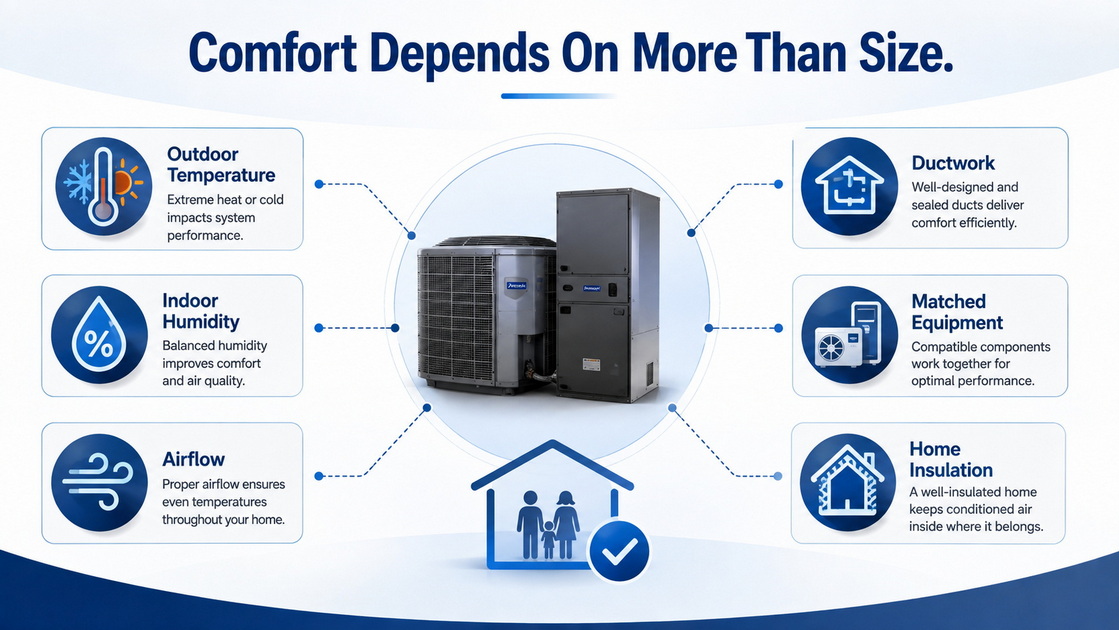
A central air conditioner may be described as a "3-ton system," but that description does not tell the full story. Actual capacity can vary based on several conditions, including outdoor temperature, indoor temperature, humidity, airflow, altitude, duct performance, and the specific indoor coil or air handler paired with the outdoor unit.
In other words, two systems with a similar nominal capacity may not provide the same comfort level in the same home.
The label on an HVAC unit can provide helpful information, but it should not be the only factor used to select a system.
| Equipment Information | What It Tells You | What It Does Not Fully Explain |
|---|---|---|
| Tonnage | General cooling-capacity category | Exact cooling output in your home |
| BTU rating | A broad measure of heating or cooling capacity | Performance at changing indoor and outdoor conditions |
| SEER2 rating | Seasonal cooling efficiency | Whether the system is correctly sized |
| HSPF2 rating | Seasonal heat pump heating efficiency | Exact heat output during cold weather |
| Model number | Identifies the equipment | Whether all system components are compatible |
| OEM performance data | Specific performance under known conditions | Must still be applied correctly by a trained professional |
A high-efficiency unit can still perform poorly if it is oversized, undersized, installed incorrectly, matched with incompatible components, or connected to ductwork with airflow problems.
The best HVAC system is not necessarily the biggest or most expensive one. It is the system that fits the home and is installed with care.
OEM performance data may sound technical, but it directly affects everyday comfort.
When equipment is selected using accurate performance information, homeowners are more likely to experience consistent temperatures, proper humidity control, dependable heating, and balanced airflow.
When equipment is selected based on guesswork, old equipment size, or square footage alone, comfort problems can appear even when the system is brand new.
Two homes with the same square footage can require very different heating and cooling systems.
For example, one home may have older windows, poor attic insulation, large west-facing glass areas, and significant air leakage. Another home of the same size may have upgraded insulation, efficient windows, shade trees, and a more airtight building envelope.
Their HVAC requirements will not be the same.
A proper equipment recommendation should consider factors such as:
- Local summer and winter weather conditions
- Ceiling height
- Number and type of windows
- Window direction and sun exposure
- Insulation levels
- Attic and crawlspace conditions
- Home orientation
- Air leakage
- Number of occupants
- Kitchen appliances and internal heat sources
- Home additions or converted spaces
- Duct system condition
- Indoor humidity concerns
- Hot and cold room complaints
A home-specific evaluation creates a more reliable foundation for selecting heating and cooling equipment.
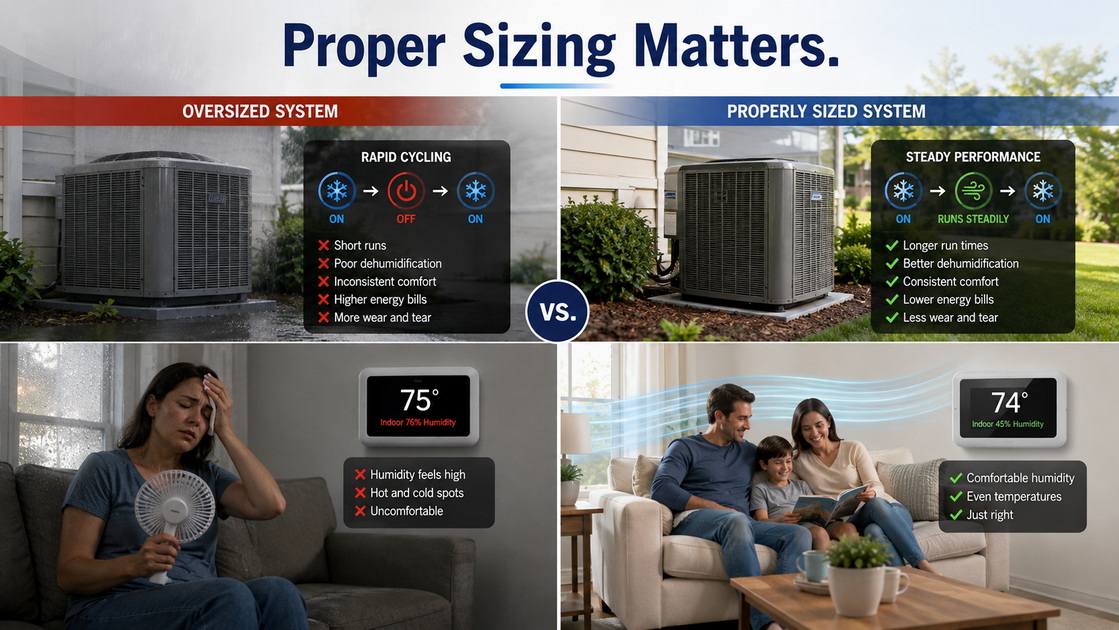
Many homeowners assume that larger equipment will cool or heat the home faster and provide better comfort. In reality, oversized HVAC equipment can create several problems.
An oversized air conditioner may cool the thermostat area quickly and shut off before it runs long enough to remove enough moisture from the air. The result may be a home that feels cool but humid, sticky, or uncomfortable.
Oversized equipment can also lead to:
- Frequent on-and-off cycling
- Uneven temperatures between rooms
- Reduced humidity removal
- Increased wear on electrical components
- Higher repair needs over time
- Unnecessary noise
- Reduced comfort during mild weather
- Potentially higher operating costs
Short cycling is especially important because every start-up places stress on the system. When a system starts and stops too often, it may not operate as smoothly or efficiently as intended.
An undersized system can also create comfort concerns.
During the hottest or coldest days of the year, an undersized system may run for long periods without reaching the desired indoor temperature. It may struggle to keep bedrooms comfortable, maintain balanced airflow, or reduce humidity during the cooling season.
Common signs may include:
- The air conditioner runs continuously on hot afternoons
- The furnace or heat pump struggles during cold weather
- One or more rooms remain uncomfortable
- The thermostat setting is difficult to maintain
- Energy bills rise unexpectedly
- Humidity remains high even when the AC is running
- The system appears to work hard without delivering enough comfort
The correct solution is not always to install a larger unit. Sometimes the underlying issue involves ductwork, insulation, air leakage, restricted airflow, thermostat location, or improper equipment matching.
A well-designed HVAC system starts with understanding the home.
Heating and cooling equipment should be selected through a process that evaluates the home's load, the equipment's capabilities, and the ability of the duct system to distribute conditioned air.
A load calculation estimates how much heating and cooling a home needs under expected weather conditions.
It looks at the structure itself, not simply the size of the living area.
A complete evaluation may consider:
- Exterior wall construction
- Window type and size
- Insulation levels
- Air leakage
- Ceiling heights
- Room layouts
- Local climate conditions
- Building orientation
- Number of people in the home
- Internal appliances and heat-producing equipment
- Conditioned and unconditioned spaces
Once the home's needs have been evaluated, a contractor can compare those requirements with the actual capabilities of available equipment.
This is where OEM performance data becomes especially valuable.
The goal is to identify equipment that can provide appropriate cooling, heating, humidity removal, and airflow under the conditions expected in your area.
The contractor should consider the full system, not just the outdoor unit.
That may include:
- Outdoor air conditioner or heat pump
- Indoor evaporator coil
- Furnace or air handler
- Thermostat and controls
- Refrigerant line set
- Electrical components
- Filter cabinet
- Ductwork
- Supply vents
- Return vents
A system is not simply one piece of equipment. It is a connected group of components that must work together.
The duct system carries heated and cooled air throughout the home. If ducts are undersized, damaged, leaking, poorly insulated, blocked, or unbalanced, even high-quality equipment may not perform as expected.
Think of the HVAC unit as the heart of the system and the ductwork as the circulation network. Both need to work properly for comfort to reach every room.
Duct problems can contribute to:
- Rooms that are too hot or too cold
- Weak airflow from vents
- High utility bills
- Excessive dust
- Noisy operation
- Uneven temperatures between floors
- Longer system run times
- Reduced equipment life
Before installing new equipment, it is important to consider whether the existing duct system can support the airflow requirements of the proposed system.
Cooling is not only about lowering the thermostat setting.
A comfortable home requires the HVAC system to manage both temperature and moisture.
There are two basic parts of cooling performance.
- Sensible cooling reduces the temperature of the air.
- Latent cooling removes moisture from the air.
During humid weather, both functions matter.
A system may lower the indoor temperature while still leaving the home feeling damp or sticky. This can happen when the system is oversized, airflow is incorrect, the thermostat is located in an unrepresentative area, or the equipment does not run long enough to remove moisture effectively.
Proper equipment selection helps balance cooling capacity and humidity control.
High indoor humidity can make a home feel warmer than the thermostat setting suggests.
It can also contribute to:
- Sticky indoor air
- Condensation on windows
- Musty odors
- Mold or mildew concerns
- Increased dust-mite activity
- Uneven comfort between rooms
- Difficulty sleeping
- Greater dependence on lower thermostat settings
If your home feels cool but humid, the issue may not be solved by lowering the thermostat. A professional evaluation can help identify whether the concern is related to equipment sizing, airflow, duct leakage, drainage, insulation, air infiltration, or system maintenance.

Heat pumps provide both heating and cooling by moving heat between the home and the outdoor air.
In cooling mode, a heat pump works similarly to an air conditioner by moving heat from inside the home to the outdoors. In heating mode, it reverses the process and transfers available heat from outdoor air into the home.
Even cold outdoor air contains some heat energy.
However, heating capacity can change as outdoor temperatures drop. This is why manufacturer performance data is particularly important when selecting a heat pump.
For heat pump installations, performance information may help evaluate:
- Heating capacity at different outdoor temperatures
- Efficiency at mild and cold temperatures
- Defrost operation
- Supplemental heating needs
- Variable-speed compressor performance
- Compatibility with indoor equipment
- Expected comfort during winter conditions
- Whether a dual-fuel configuration may be appropriate
A heat pump should not be selected only because it has a high efficiency rating or attractive initial price. It should be selected because its performance characteristics align with the home's heating needs and the climate where it will operate.
A properly selected heat pump can provide efficient year-round comfort. It can also offer a flexible solution for homeowners who want one system for heating and cooling.
However, successful results depend on more than the equipment itself.
For best performance, the home should also have:
- Proper system sizing
- Compatible components
- Adequate airflow
- Well-designed ductwork
- Suitable thermostat controls
- Proper refrigerant setup
- Professional installation
- Routine maintenance
A thoughtful HVAC evaluation should focus on your home, not just the nameplate on the existing equipment.
At Mega Services Heating & Cooling, we recommend discussing both system performance and household comfort concerns before selecting a repair, maintenance plan, or replacement option.
A comprehensive evaluation may include:
- Reviewing the age and repair history of current equipment
- Discussing hot rooms, cold rooms, humidity, dust, and noise concerns
- Inspecting visible heating and cooling equipment
- Checking accessible ductwork and airflow concerns
- Reviewing thermostat operation and placement
- Looking for visible drainage or refrigerant concerns
- Considering home additions, remodeling, or insulation upgrades
- Reviewing equipment options and component compatibility
- Explaining maintenance needs and operating expectations
- Providing a clear scope of work before installation begins
Homeowners should feel comfortable asking questions. A heating and cooling system is a long-term investment, and you deserve to understand the recommendation before making a decision.
Use the following questions when comparing heating and cooling proposals.
1. How was the recommended equipment size determined?
2. Will the recommendation be based on a home-specific load calculation?
3. What heating and cooling capacity does my home require?
4. How does the proposed equipment perform in local summer and winter conditions?
5. Which indoor and outdoor components are included in the system?
6. Are all proposed components designed to work together?
7. Will you inspect the existing ductwork and return-air system?
8. How will the proposed system address hot rooms, cold rooms, or humidity concerns?
9. What maintenance will the new system require?
10. What equipment and workmanship warranties are included?
11. What steps will be taken to protect my home during installation?
12. Will I receive model numbers, system details, and a written scope of work?
Clear answers to these questions can help homeowners compare proposals based on long-term value rather than price alone.
There is no single rule that applies to every heating and cooling system.
A repair may be the right choice when the issue is isolated, the system is relatively new, and the equipment has been dependable. Routine maintenance and timely repairs can often extend the life of an existing system.
Replacement may deserve consideration when a system becomes unreliable, expensive to operate, difficult to repair, or unable to provide consistent comfort.
Consider scheduling a professional evaluation if you notice:
- Your heating or cooling equipment is more than 10 years old
- Repairs are becoming frequent
- Repair costs are increasing
- Energy bills have risen without a clear reason
- The system runs constantly during extreme weather
- The home has rooms that are consistently too hot or too cold
- Indoor humidity is difficult to control
- The system makes unusual noises
- Dust seems to build up quickly
- You are planning a home addition or renovation
- You are considering a heat pump or dual-fuel upgrade
- The system uses outdated refrigerant
- You want to improve comfort without guessing at the solution
Age alone should not determine whether equipment needs replacement. The best decision depends on equipment condition, repair history, comfort performance, available parts, operating costs, and your long-term plans for the home.
Even properly selected equipment needs regular care.
Over time, filters become dirty, coils collect debris, drains can clog, electrical connections can loosen, airflow can become restricted, and components can wear down. These issues can reduce comfort, increase energy use, and raise the risk of unexpected breakdowns.
A preventive maintenance plan helps identify smaller concerns before they become major repairs.
A professional heating and cooling service visit may include:
- Checking thermostat settings and controls
- Inspecting electrical connections
- Reviewing voltage and motor operation
- Checking system start-up and shutdown cycles
- Inspecting the condensate drain
- Checking air filters
- Cleaning components when needed
- Reviewing airflow and blower performance
- Inspecting outdoor equipment
- Checking refrigerant operation when applicable
- Testing heating safety controls
- Inspecting burners and combustion-related components when applicable
- Identifying visible wear, corrosion, leaks, or safety concerns
Maintenance needs can differ depending on whether the home has an air conditioner, furnace, boiler, heat pump, ductless system, or dual-fuel configuration.
Between professional service visits, homeowners can take several simple steps to support system performance.
- Check the air filter regularly and replace or clean it as needed.
- Keep supply vents and return vents open and unobstructed.
- Avoid placing furniture directly in front of vents.
- Keep leaves, grass, branches, and debris away from outdoor equipment.
- Watch for water near the indoor unit or condensate line.
- Listen for unusual buzzing, rattling, squealing, or grinding sounds.
- Pay attention to new hot spots, cold spots, or humidity changes.
- Schedule service before peak summer or winter weather.
- Keep the thermostat at stable, reasonable settings.
- Report small comfort changes before they become larger problems.
A clean filter and clear airflow may seem simple, but they play a meaningful role in protecting equipment and maintaining indoor comfort.
A heating and cooling system should do more than reach a thermostat setting.
It should help the home feel consistently comfortable, manage humidity, provide dependable performance, distribute air effectively, and operate with reasonable energy use.
OEM performance data supports better equipment selection because it moves the conversation beyond broad labels and simple capacity categories. It gives trained professionals a way to evaluate how specific equipment combinations are expected to perform under real operating conditions.
When combined with a home-specific evaluation, compatible components, proper installation, healthy airflow, well-functioning ductwork, and regular maintenance, it supports a more dependable comfort experience.
Your home should be a place where your family can relax in every season.
Whether you are dealing with an aging air conditioner, inconsistent heating, excessive humidity, weak airflow, unusual system noises, or rising energy bills, Mega Services Heating & Cooling is ready to help you understand what is happening and identify practical options for your home.
Our team is committed to providing thoughtful heating, cooling, installation, repair, and maintenance services designed around safety, comfort, and efficiency.
Schedule a professional home comfort evaluation with Mega Services Heating & Cooling and make your next heating and cooling decision with greater confidence.
OEM means Original Equipment Manufacturer. OEM performance data refers to the technical information published by the company that makes HVAC equipment. It shows how a specific air conditioner, furnace, heat pump, air handler, or coil performs under defined operating conditions.
No. A 3-ton designation is a general capacity category. The actual cooling output can vary depending on outdoor temperature, indoor conditions, airflow, humidity, equipment configuration, and the indoor coil or air handler paired with the outdoor unit.
Proper sizing helps the system maintain comfortable temperatures, manage humidity, reduce unnecessary cycling, and operate more reliably. An oversized system may short-cycle and struggle with humidity control, while an undersized system may run continuously without keeping the home comfortable.
Yes. An oversized system may cool the thermostat area too quickly and shut off before it removes enough moisture from the air. This can leave the home feeling cool but sticky, damp, or uncomfortable.
Yes. Ductwork has a major effect on airflow and comfort. Leaking, undersized, disconnected, blocked, or poorly designed ducts can create hot rooms, cold rooms, weak airflow, excessive dust, and higher energy use.
Heating and cooling equipment should generally receive professional maintenance before each major operating season. Cooling equipment is commonly checked in spring, while heating equipment is commonly checked in fall. Air filters should be inspected regularly throughout the year.
Yes. Heat pumps can provide heating during cold weather, but their output and efficiency can vary by model and outdoor temperature. Performance information helps determine whether a particular heat pump is suitable for the home and local winter conditions.
Not always. System age is one factor, but repair history, operating costs, comfort concerns, equipment condition, availability of parts, and future home plans should also be considered. A professional evaluation can help determine whether repair, maintenance, airflow improvements, or replacement is the better option.
1. Air Conditioning Contractors of America.
2. Air Conditioning Contractors of America.
3. ENERGY STAR.
4. ENERGY STAR.
5. U.S. Department of Energy.


