
Language
Views: 212 Author: Mega Services Publish Time: 2026-10-26 Origin: Site


Content Menu
● Why HVAC System Sizing Matters More Than Equipment Size Alone
>> What Happens When an HVAC System Is Oversized?
>> What Happens When Equipment Is Undersized?
● How to Size an HVAC System Correctly
>> Start With a Manual J Load Calculation
>> Match the Equipment to the Calculated Load
>> Evaluate Ductwork Before Approving a Replacement
● HVAC Installation Quality: What Homeowners Should Verify
>> Check Refrigerant Charge Correctly
>> Inspect Duct Sealing and Condensate Drainage
>> Request a Practical Installation Handover
● Understanding SEER2, HSPF2, and AFUE
● A Practical HVAC Maintenance Schedule
>> Homeowner Tasks Between Service Visits
>> Professional Cooling Maintenance
>> Professional Heating Maintenance
● Troubleshooting Comfort Problems Before Replacing Equipment
>> One Room Is Always Too Hot or Too Cold
>> The House Feels Cool but Clammy
>> Energy Bills Have Increased
● Repair or Replace? Compare the Complete Situation
● How to Compare HVAC Installation and Maintenance Proposals
● Plan Your Next Step With Mega Services Heating & Cooling
>> 1. How do I know what size HVAC system my home needs?
>> 2. Does a higher SEER2 rating guarantee lower energy bills?
>> 3. How often should I replace my HVAC filter?
>> 4. Is it normal for an air conditioner to run continuously?
>> 5. Should refrigerant be added during every maintenance visit?
>> 6. Can I maintain my HVAC system myself?
Proper HVAC system sizing, installation, and maintenance work together to keep your home comfortable, safe, and energy efficient. Even highly rated equipment can disappoint when its capacity does not match your home, its ductwork restricts airflow, or routine maintenance gets overlooked.
At Mega Services Heating & Cooling, our focus is helping families create healthier, more comfortable living environments through heating and air conditioning installation, repair, and maintenance.
Our guiding principle is verification: understand the home, choose suitable equipment, and measure performance rather than relying on assumptions. This guide explains what homeowners should know before replacing a system, approving repairs, or scheduling seasonal service.

HVAC sizing means determining how much heating and cooling your home needs under defined outdoor conditions. It is not simply choosing a unit based on floor area or matching the old equipment's capacity.
Two similarly sized houses can have different requirements because of insulation, windows, air leakage, orientation, and duct location.
A larger air conditioner is not automatically a better investment. Excess capacity can cause frequent on-and-off operation, particularly with single-stage equipment.
Possible consequences include:
- Uneven indoor temperatures.
- Reduced moisture removal during cooling.
- More frequent equipment starts.
- Higher upfront costs without a corresponding comfort improvement.
Variable-capacity equipment can adjust its output, but that flexibility does not eliminate the need for proper sizing.
An undersized system may struggle to maintain the thermostat setting during demanding weather.
However, long operating cycles do not automatically indicate a problem. Correctly selected equipment may run for extended periods near outdoor design conditions, and variable-speed systems often operate longer at reduced output.
The useful question is not "How long does it run?" but "Does it maintain comfort while operating within its intended performance range?"
A trustworthy replacement proposal should explain how the contractor determined the required capacity.
ACCA Manual J provides a recognized method for calculating residential heating and cooling loads.
The assessment considers factors such as:
- Local outdoor design temperatures.
- Building dimensions and ceiling heights.
- Insulation levels.
- Window area, orientation, and performance.
- Air leakage and ventilation.
- Duct location and associated heat gains or losses.
Room-by-room calculations also help identify how much conditioned air individual spaces require.
Ask whether planned improvements—such as attic insulation or replacement windows—should be included before equipment is selected.

The load calculation is the starting point, not the final equipment selection.
ACCA Manual S addresses equipment selection using manufacturer performance information and applicable sizing criteria. Actual capacity depends on operating conditions, not just the nominal tonnage printed on a product label.
For heat pumps, the discussion should also cover cold-weather heating output, supplemental heat, and how the system will operate as outdoor temperatures fall.
A new system cannot reliably overcome a poorly designed distribution system.
Restrictive returns, disconnected branches, and leaking ducts can undermine comfort even when equipment capacity is appropriate. ACCA Manual D provides a recognized framework for residential duct design.
Before replacing equipment, ask whether the existing ducts can support the proposed airflow and serve each room adequately.
Installation should finish with documented checks, not simply a demonstration that warm or cool air comes from the registers.
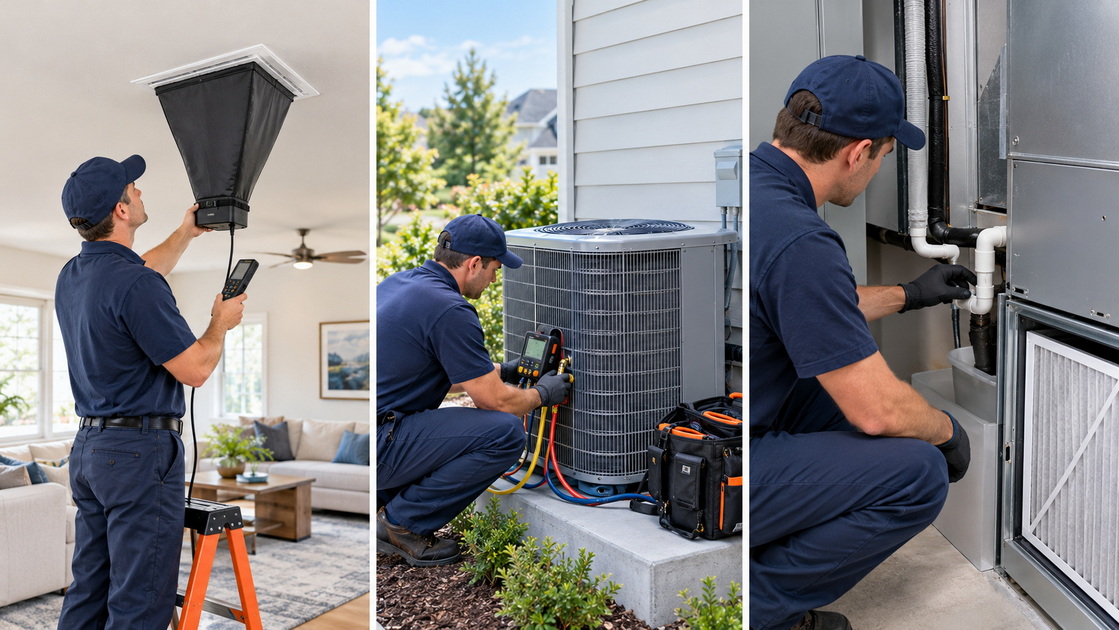
Airflow affects capacity, efficiency, moisture removal, and equipment reliability.
A technician should verify airflow against manufacturer requirements and investigate excessive resistance. Potential causes include restrictive filters, undersized ducts, obstructed coils, and unsuitable blower settings.
Choosing a more powerful blower is not a substitute for understanding the restriction.
Too much or too little refrigerant can impair cooling performance and place additional stress on equipment.
Charge verification should follow the manufacturer's procedure and account for operating conditions. Depending on the equipment, this may involve weighing refrigerant and evaluating specified temperature and pressure relationships.
Repeatedly adding refrigerant without investigating the cause of a loss is not a complete repair strategy.
Supply leaks can send conditioned air into unoccupied spaces. Return leaks can pull unwanted air into the system.
Installation checks should also address condensate drainage, drain protection where required, and access for future maintenance.
For fuel-burning equipment, qualified personnel should evaluate combustion-related components and venting as applicable.
Use this checklist when reviewing a completed project:
| Item | What to request |
|---|---|
| Sizing | Load calculation summary and equipment-selection explanation |
| Equipment compatibility | Documentation of the matched indoor and outdoor components |
| Airflow | Confirmation that airflow meets manufacturer requirements |
| Refrigerant | Record of the verification method and relevant results |
| Ductwork | Findings, repairs, and leakage testing where included |
| Controls | Thermostat setup and operating instructions |
| Ownership documents | Warranty information and maintenance requirements |
The goal is a clear record of what was installed, checked, and explained.
Efficiency ratings help compare equipment, but they do not predict an individual household's utility bill.
| Rating | What it describes | Where it applies |
|---|---|---|
| SEER2 | Seasonal cooling efficiency | Air conditioners and heat pumps |
| EER2 | Cooling efficiency under specified test conditions | Air conditioners and heat pumps |
| HSPF2 | Seasonal heat-pump heating efficiency | Heat pumps |
| AFUE | The share of fuel energy converted into useful heat over a typical year | Furnaces and boilers |
Higher ratings generally indicate greater efficiency within the relevant equipment category.
However, savings also depend on local weather, energy prices, thermostat settings, building condition, duct losses, and installation quality.
When comparing proposals, use consistent rating systems and matched equipment combinations. Older SEER and HSPF figures should not be treated as directly interchangeable with SEER2 and HSPF2.
Maintenance should follow the equipment manufacturer's instructions and account for actual operating conditions.
A heavily used system, a dusty environment, or a home with pets may require more frequent attention than a lightly used system.
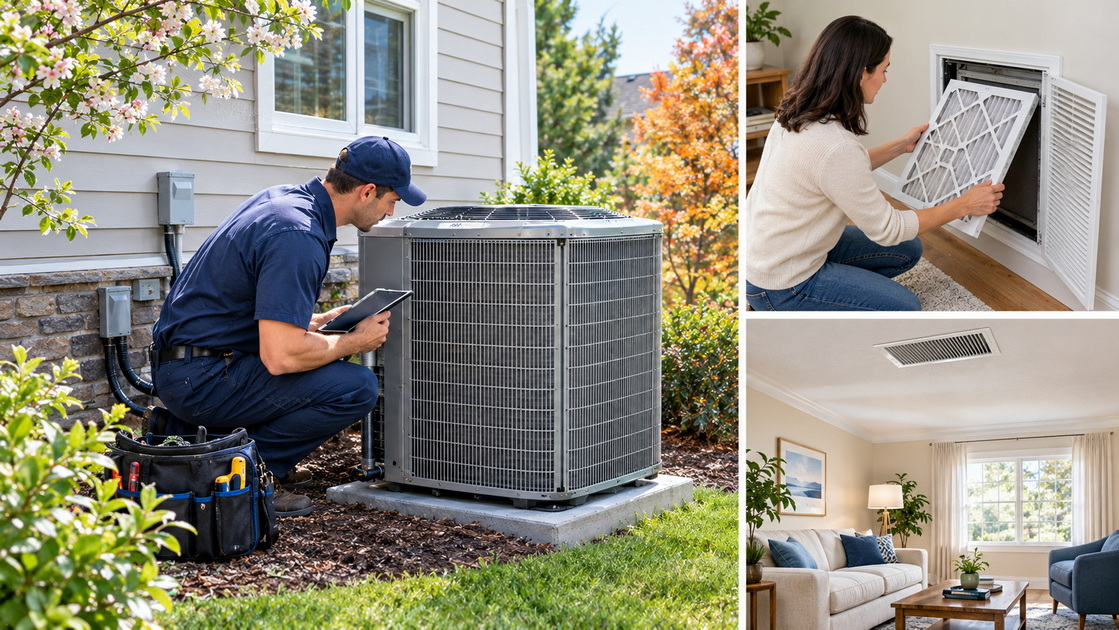
Homeowners can support reliable operation by:
1. Checking the filter monthly and replacing or cleaning it when needed.
2. Keeping supply registers and return grilles unobstructed.
3. Removing loose leaves and debris around the outdoor unit without opening it.
4. Watching for unusual noise, water leakage, or changes in comfort.
5. Reviewing thermostat settings when household schedules change.
Use the specified filter size and an appropriate filter type. A denser filter is not automatically an upgrade if the system cannot accommodate its airflow resistance.
A cooling inspection may include:
- Checking the evaporator and condenser coils.
- Evaluating blower operation and airflow.
- Inspecting electrical connections and components.
- Checking condensate drainage.
- Assessing refrigerant performance.
- Testing thermostat operation and system controls.
Cleaning and adjustments should reflect the equipment's condition rather than a one-size-fits-all service routine.
Heating service should address the installed equipment type.
For furnaces, relevant tasks can include burner operation, ignition, venting, safety controls, and heat-exchanger evaluation as appropriate.
For heat pumps, service should address heating operation, controls, outdoor components, and supplemental heat where installed.
ENERGY STAR recommends annual preseason checkups. Homes with separate heating and cooling equipment may benefit from coordinating service before each operating season.
A comfort complaint does not always mean the entire system needs replacement.
Possible causes include insufficient airflow, duct leakage, room-specific heat gain, insulation problems, or limited return-air pathways.
Start with a room-level assessment. Replacing the main equipment without addressing distribution may leave the original problem unresolved.
Cooling and moisture removal are related, but they are not identical.
Potential contributors include oversized equipment, unsuitable airflow, short operating cycles, outdoor-air infiltration, or unusually high indoor moisture loads.
Ask for temperature and humidity measurements rather than automatically lowering the thermostat or purchasing a larger unit.
Compare more than the dollar amount.
Review energy consumption, rate changes, outdoor temperatures, occupancy, and thermostat settings. Then investigate equipment condition, airflow, duct leakage, and control operation.
A higher bill alone cannot identify the faulty component—or prove that replacement is necessary.
There is no universal equipment age or repair price that makes replacement the right answer for every household.
A useful decision considers:
- The diagnosed fault and repair scope.
- Equipment condition and breakdown history.
- Remaining warranty coverage.
- Comfort problems unrelated to the failed component.
- Available replacement options and installation requirements.
- The household's expected ownership period and budget.
Request a written diagnosis and itemized options.
If replacement is proposed, ask what it will solve that the repair will not. If repair is recommended, ask what uncertainty remains about future reliability.
Avoid treating projected energy savings as guaranteed repayment. Any estimate should explain its assumptions.
The lowest price may exclude work that another proposal includes.
Compare equivalent scopes:
| Proposal detail | Why it matters |
|---|---|
| Exact model numbers | Identifies the equipment being offered |
| Capacity and efficiency ratings | Enables meaningful performance comparisons |
| Duct modifications | Shows whether distribution problems are addressed |
| Permits and inspections | Clarifies responsibility for applicable requirements |
| Commissioning and testing | Defines how completed performance will be checked |
| Labor and equipment warranties | Separates different types of coverage |
| Maintenance terms | Explains included visits, exclusions, and renewal conditions |
Ask contractors to explain unfamiliar terms in plain language. A strong proposal should make the work easier to understand, not harder.
Whether you need an air conditioning repair, a heating replacement, or preventive maintenance, begin with the problem you want solved: uneven temperatures, recurring breakdowns, rising energy use, or unreliable operation.
Contact Mega Services Heating & Cooling to discuss your system and request an assessment. Share your equipment details, recent service history, and the rooms or operating conditions causing concern.
A well-informed service conversation creates a stronger foundation for safe, comfortable, and energy-conscious decisions.
Request a professional load calculation using ACCA Manual J or an equivalent recognized method. Floor area alone does not account for insulation, windows, air leakage, climate, or room-level requirements.
No. It indicates better seasonal cooling efficiency under standardized testing, but actual bills also depend on installation, weather, energy rates, ductwork, and household operation.
Check it monthly and follow the manufacturer's guidance. Replacement frequency varies with filter design, system use, pets, dust, and other conditions. Do not assume every filter follows the same schedule.
Extended operation can be normal during demanding weather or with variable-capacity equipment. Professional evaluation is appropriate when the system cannot maintain temperature, comfort deteriorates, or operation changes unexpectedly.
No. Refrigerant should not be treated as a routinely consumed supply. If charge is low, a technician should investigate the cause and recommend an appropriate corrective procedure.
You can handle suitable filter changes, keep registers clear, and monitor performance. Refrigerant work, electrical testing, combustion checks, and internal equipment repairs belong with qualified professionals.
1. Air Conditioning Contractors of America. Don Rackler, "Sizing, Installing, And Maintaining An HVAC System," June 20, 2018. Original discussion of sizing, installation quality, efficiency, and maintenance..
2. ENERGY STAR. "HVAC Quality Installation." Guidance on load-based sizing, manufacturer-specified airflow, refrigerant charge, and duct evaluation..
3. ENERGY STAR. "Heating & Air Conditioning Installation Bid Comparison Checklist." Homeowner guidance on load calculations, matched equipment documentation, and installation proposal comparisons..
4. ENERGY STAR. "Maintenance Checklist." Guidance on preseason service, electrical checks, condensate drainage, coils, refrigerant, and blower maintenance..
5. U.S. Department of Energy. "Purchasing Energy-Efficient Residential Air-Source Heat Pumps." Background on SEER2, HSPF2, equipment comparisons, and quality installation..
6. ENERGY STAR. "A Guide to Energy-Efficient Heating and Cooling." Supporting guidance on equipment selection, installation verification, filters, and homeowner maintenance..


