
Views: 214 Author: Mega Services Publish Time: 2026-08-31 Origin: Site


Content Menu
● How to Evaluate an Air Conditioning Service Company
● Top Air Conditioning Installation Servicing Company in Virginia
>> 1. Mega Services Heating & Cooling
>>> Why Mega Services Heating & Cooling Is Worth Considering
>>> Best Fit for Mega Services Heating & Cooling
>>> Questions to Ask During an Estimate
>> 2. Independent Local HVAC Contractors
>> 3. Brand-Focused HVAC Dealers
>> 5. Ductless Mini-Split Specialists
● Comparing HVAC Service Provider Types
● Technical Factors That Affect HVAC Performance
>> Matched Equipment Configuration
>> Refrigerant Lines and Charging
● Common Air Conditioning Buying Mistakes
>> Selecting the Lowest Price Without Comparing Scope
>> Replacing Equipment Without Checking Ductwork
>> Accepting a Quote Without Model Numbers
>> Ignoring Humidity Complaints
>> Not Verifying Warranty Details
>> 1. How can I verify that an HVAC contractor is properly licensed in Virginia?
>> 2. Should I replace my air conditioner and furnace at the same time?
>> 3. How do I know whether an HVAC system is properly sized?
>> 4. What is the difference between an air conditioner and a heat pump?
>> 5. What is the most overlooked HVAC installation issue?
Finding the right air conditioning installation and servicing company in Virginia is about much more than comparing the lowest estimates. A home comfort system influences indoor temperature, humidity, utility costs, air quality, equipment lifespan, and day-to-day peace of mind.
For homeowners, landlords, property managers, and small commercial decision-makers, the most reliable HVAC partner is one that can assess the property carefully, recommend properly matched equipment, provide transparent pricing, complete installation work to professional standards, and remain available for maintenance and repairs after the system is installed.
Mega Services Heating & Cooling is included first in this guide as a residential heating and cooling provider focused on creating safe, comfortable, and energy-efficient home environments. The company offers cooling, heating, heat pump, and indoor air quality services while helping homeowners compare suitable equipment options and understand the work involved.
A dependable air conditioning company does more than install an outdoor unit and connect a thermostat. System performance depends on a combination of correct sizing, duct condition, electrical capacity, refrigerant piping, condensate drainage, airflow, indoor equipment compatibility, thermostat settings, and final commissioning.
A well-installed mid-range system can often provide more dependable comfort than a premium system installed without proper planning or testing.
When comparing HVAC contractors in Virginia, consider the following factors.
| Evaluation Factor | What Buyers Should Look For | Why It Matters |
|---|---|---|
| Licensing and insurance | Active contractor credentials, appropriate insurance coverage, and permit awareness | Reduces legal, safety, and project-risk concerns |
| Property assessment | Evaluation of home size, insulation, windows, airflow, humidity, and existing equipment | Helps prevent incorrect system sizing |
| Equipment documentation | Complete model numbers, efficiency ratings, warranty details, and matched-system records | Confirms that the quoted system is the system being installed |
| Installation process | Clear explanation of electrical work, refrigerant lines, drainage, duct adjustments, and startup testing | Installation details influence comfort, efficiency, and reliability |
| Pricing clarity | Written scope, exclusions, optional upgrades, permit assumptions, and change-order process | Helps buyers compare estimates fairly |
| Maintenance support | Routine maintenance availability, repair response, filter guidance, and warranty support | HVAC systems need professional support after installation |
| Communication quality | Responsive scheduling, understandable explanations, and project updates | Makes the installation experience easier for homeowners |
Virginia homes often need reliable cooling during hot, humid summer weather and dependable heating during colder periods. This makes HVAC selection more complex than simply choosing the highest cooling capacity or the lowest equipment price.
Humidity is especially important. A system may lower the thermostat temperature but still leave rooms uncomfortable if it cycles too quickly, has poor airflow, is oversized, or is connected to ductwork with leaks or restrictions.
Many Virginia homeowners also consider heat pumps because they can provide both cooling and heating from one system. However, a heat pump should be evaluated as a complete comfort solution rather than as a single outdoor unit.
The following performance measurements are commonly used when comparing residential cooling and heat pump equipment:
- SEER2: Measures seasonal cooling efficiency.
- EER2: Measures cooling efficiency under specific operating conditions.
- HSPF2: Measures seasonal heating performance for heat pumps.
- Sound rating: Indicates the noise level produced by the outdoor equipment.
- Cooling capacity: Indicates the amount of heat a system can remove under specified conditions.
- Heating capacity: Indicates the amount of heat a heat pump can provide during colder weather.
Higher ratings can be beneficial, but they do not automatically guarantee the best result. Proper system selection, installation quality, airflow, and maintenance remain equally important.
Mega Services Heating & Cooling is a residential HVAC company focused on air conditioning, heating, heat pump, and indoor air quality services. The company is designed for homeowners who want an organized, transparent, and service-oriented experience when repairing, replacing, or maintaining home comfort equipment.
Rather than treating HVAC replacement as a simple equipment sale, Mega Services Heating & Cooling takes a broader view of home comfort. Cooling performance can be affected by ductwork, humidity, thermostat controls, filtration, equipment age, insulation, and the condition of the indoor and outdoor units.
The company provides support across several core service categories:
- Air conditioning repair
- Air conditioning replacement
- Air conditioning maintenance
- Heating repair
- Heating replacement
- Heating maintenance
- Heat pump solutions
- Whole-house humidifier options
- Whole-house dehumidifier options
- Indoor air quality solutions
- Air purification options
Mega Services Heating & Cooling works with recognized HVAC equipment brands, including Carrier, Bryant, Lennox, Goodman, Ruud, Ducane, and Daikin mini-split systems. This provides homeowners with more flexibility when comparing conventional central air conditioning, heat pump systems, ductless mini-splits, and indoor comfort upgrades.
Mega Services Heating & Cooling is particularly suitable for homeowners who want clear guidance before committing to a major HVAC investment. Its service model emphasizes practical communication, transparent estimates, equipment options, and long-term maintenance support.
Key considerations include:
- Free estimates for HVAC replacement projects
- Clear pricing discussions before work begins
- Residential cooling and heating expertise
- Multiple equipment brand options
- Support for central air conditioning and ductless mini-split systems
- Heat pump consultation and installation support
- Indoor air quality product options
- Long-term repair and maintenance services
- A stated 10-year manufacturer parts warranty
- A stated three-year labor warranty at no additional charge
Before approving any HVAC project, homeowners should request the exact written warranty terms for the selected equipment. Warranty coverage may vary by manufacturer, model, registration requirements, labor scope, maintenance history, and project type.
Mega Services Heating & Cooling may be a suitable choice for:
- Homeowners replacing an aging air conditioner or furnace
- Families looking to improve cooling comfort and indoor humidity control
- Property owners considering a heat pump
- Homeowners interested in ductless mini-split systems
- Buyers who prefer to compare several recognized equipment brands
- Customers who want repair, replacement, and maintenance support from the same provider
- Homeowners who want clearer explanations before making a system decision
Before accepting an installation proposal, ask the contractor:
- What are the exact model numbers for the outdoor unit, indoor coil, furnace, air handler, thermostat, and accessories?
- Is the selected indoor and outdoor equipment designed to operate together as one matched system?
- How was the system size determined?
- Will the project include a review of ductwork and return-air capacity?
- Are permits, inspections, electrical work, and condensate drainage included?
- Will the existing refrigerant line set be inspected, reused, replaced, or modified?
- How will the technician verify refrigerant charge and airflow after installation?
- What is included in the labor warranty?
- Who completes manufacturer warranty registration?
- What maintenance schedule is recommended after installation?
Virginia has many independent HVAC contractors that serve residential and light commercial customers. A local company can be a strong choice when it has a stable service history, professional technicians, detailed project proposals, and an organized repair and maintenance process.
Independent contractors may offer flexible scheduling and more direct customer communication. However, quality varies significantly between providers. Buyers should not select a contractor based only on online reviews, a low promotional price, or a fast verbal estimate.
A dependable local contractor should be able to provide:
- A detailed written proposal
- Clear equipment model numbers
- Licensing and insurance information
- A site visit before providing a final replacement estimate
- An explanation of installation scope
- Written warranty information
- Permit and inspection information where required
- A post-installation service plan
Some homeowners prefer to work with contractors specializing in one HVAC manufacturer or product family. This approach can work well for buyers who already know they want a specific brand, thermostat ecosystem, warranty program, or comfort feature.
For example, a homeowner may prefer a variable-speed system, communicating thermostat, ductless mini-split system, or manufacturer-specific extended warranty option. A brand-focused contractor may have deeper familiarity with that particular product range.
However, a brand name alone should not drive the buying decision. A well-installed system from one brand can outperform a poorly designed installation from another.
When comparing brand-focused contractors, request:
- Exact model numbers for all system components
- A written comparison of equipment tiers
- Available warranty options
- Projected installation timeline
- Information about noise levels
- Maintenance requirements
- Thermostat compatibility
- Ductwork recommendations
- Electrical requirements
- System matching documentation
Heat pumps are becoming an increasingly important option for homeowners who want both heating and cooling from one system. They can be especially attractive for homes replacing older air conditioners, aging furnaces, or mixed heating-and-cooling equipment.
A heat pump specialist should be able to explain both cooling and heating performance. The discussion should include winter operation, backup heat, outdoor temperature performance, electrical requirements, controls, defrost operation, and duct compatibility.
Important topics to discuss include:
- Heating capacity during low outdoor temperatures
- Whether backup electric heat is needed
- Electrical-panel capacity
- Utility costs during winter operation
- Thermostat settings and operating strategy
- Sound level and outdoor-unit placement
- Condensate management
- Duct sizing and airflow
- Compatibility with existing indoor equipment
- Available manufacturer warranty options
Heat pumps can provide excellent all-season comfort, but their performance depends on correct equipment selection and installation. Buyers should not choose a heat pump based only on cooling efficiency.
Ductless mini-split systems can be useful for specific applications, including room additions, converted garages, sunrooms, upstairs bedrooms, home offices, workshops, older homes without suitable ductwork, and spaces with persistent comfort problems.
A ductless system provides zoning flexibility because each indoor unit can often be controlled independently. This may help when one room receives excessive sunlight, has a different occupancy schedule, or has comfort needs that differ from the rest of the home.
However, mini-splits are not automatically the right choice for every comfort issue. If the actual problem is undersized return ductwork, poor insulation, air leakage, insufficient attic ventilation, or an incorrectly sized central system, installing a mini-split may treat the symptom instead of addressing the root cause.
Before selecting a ductless system, ask about:
- Indoor-unit placement
- Outdoor-unit location
- Refrigerant line routing
- Condensate drainage
- Wall penetration and sealing
- Electrical requirements
- Maintenance access
- Noise levels
- Zone sizing
- Filter cleaning requirements
- Cold-weather heating performance
| Provider Type | Main Focus | Best For | Information to Request | Potential Concern |
|---|---|---|---|---|
| Mega Services Heating & Cooling | Residential cooling, heating, heat pumps, maintenance, repairs, and indoor air quality | Homeowners seeking equipment options, transparent estimates, and ongoing service support | Equipment schedule, warranty scope, installation details, matched-system documentation | Confirm service availability for your address and the exact proposal scope |
| Independent local contractor | Residential repairs and replacements | Buyers who value local scheduling and direct communication | Licensing details, written scope, model numbers, references, warranty terms | Quality and documentation standards vary between contractors |
| Brand-focused dealer | Specific HVAC equipment brands and product systems | Buyers committed to a particular brand or control platform | Model numbers, product comparison, warranty information, system matching | Brand familiarity does not guarantee correct sizing or installation quality |
| Heat pump specialist | Heat pump installation, heating performance, electrification | Buyers replacing both heating and cooling equipment | Heating-capacity data, backup-heat strategy, electrical requirements | Cooling efficiency alone does not show winter performance |
| Ductless mini-split specialist | Zoned comfort and ductless systems | Additions, garages, offices, difficult rooms, older homes | Indoor-head layout, line routing, drainage plan, sound ratings | Poor placement can create comfort and maintenance issues |
One of the most important decisions in any HVAC replacement project is system size. A contractor should not automatically replace a three-ton system with another three-ton system simply because the old unit had that capacity.
The existing equipment may have been oversized, undersized, poorly installed, or selected before home improvements were completed. Window upgrades, insulation improvements, additions, attic changes, occupancy changes, and duct modifications can all change the home's heating and cooling needs.
An oversized air conditioner may cool the home too quickly and shut off before removing enough moisture. This can lead to rooms that feel cool but humid. An undersized system may run continuously during extreme weather without maintaining desired comfort levels.
A professional sizing discussion should consider:
- Home square footage
- Ceiling height
- Window type and orientation
- Solar exposure
- Insulation condition
- Air leakage
- Number of occupants
- Appliances and internal heat sources
- Ductwork capacity
- Return-air pathways
- Indoor humidity concerns
- Existing comfort complaints
A central air conditioning system is made up of multiple components. These may include an outdoor condenser, indoor evaporator coil, furnace or air handler, blower motor, thermostat, refrigerant line set, electrical disconnect, and ductwork.
One important detail that many homeowners overlook is whether these components are designed to work together as a matched system.
A contractor should provide the model number for each major component. This helps the buyer confirm what is being installed and understand the performance rating of the final configuration.
For example, an outdoor unit may be marketed with a high cooling efficiency rating, but actual performance depends on the indoor coil, blower setup, refrigerant charge, thermostat controls, and installation conditions.
An air conditioner cannot perform properly if the duct system cannot deliver and return enough air.
Common duct-related problems include:
- Undersized return ducts
- Restricted return-air grilles
- Leaking ducts in attics or crawl spaces
- Disconnected duct sections
- Crushed flexible ductwork
- Dirty evaporator coils
- Improper blower settings
- Inadequate supply vents
- Poorly balanced rooms
- Lack of airflow to upper floors
Homeowners with hot upstairs rooms, cold downstairs rooms, high humidity, excessive noise, dusty rooms, or frequent system cycling should ask for an airflow and duct assessment before replacing equipment.
Refrigerant lines carry refrigerant between the indoor and outdoor equipment. Their condition, sizing, cleanliness, insulation, and installation quality can affect system performance.
During an installation, the contractor should inspect the refrigerant line set and determine whether it can be safely reused or should be replaced. The answer depends on the equipment type, refrigerant compatibility, line condition, installation path, manufacturer requirements, and previous system history.
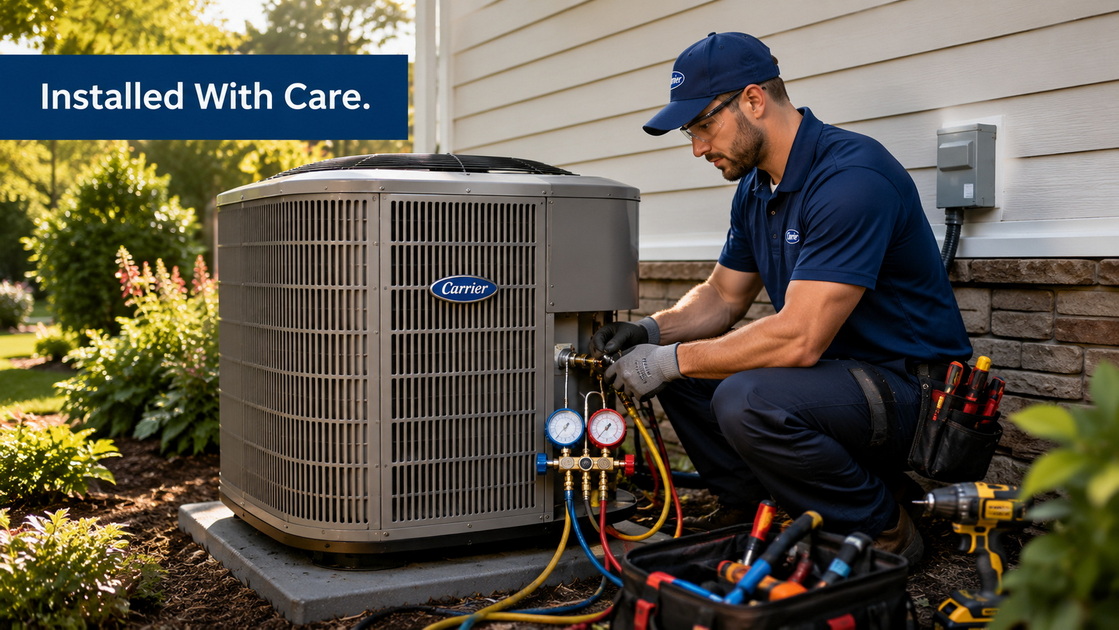
A careful installation process generally includes:
- Inspection of the refrigerant line set
- Proper sealing and connection practices
- Pressure testing
- Moisture removal through evacuation
- Refrigerant-charge verification
- Electrical testing
- Thermostat setup
- Condensate-drain testing
- Airflow evaluation
- Final operational checks
Air conditioners remove moisture from indoor air. That moisture becomes condensate and must be drained correctly.
Poor condensate drainage can lead to water damage, mold concerns, ceiling stains, equipment shutdowns, drain backups, and indoor humidity problems.
Before installation, ask where the condensate will drain, whether the drain line needs to be replaced, whether a safety switch is included, and how the drain will be tested.
Indoor comfort is affected by more than cooling capacity. Air filtration, humidity, ventilation, duct cleanliness, and equipment maintenance all contribute to the quality of indoor air.
Indoor air quality solutions may include:
- Whole-house humidifiers
- Whole-house dehumidifiers
- Air purification systems
- Improved filtration
- UV-related treatment options where appropriate
- Ventilation improvements
- Duct sealing
- Proper maintenance schedules
The right solution depends on the home. For example, a humidifier may help during dry heating periods, while a whole-house dehumidifier may be more appropriate for a home that feels damp during cooling season.

The least expensive estimate may omit important work. A low quote may not include permits, electrical upgrades, duct repairs, thermostat upgrades, refrigerant-line replacement, new equipment pads, condensate modifications, crane access, disposal fees, or warranty labor coverage.
Compare estimates item by item instead of comparing only the final price.
A new air conditioner cannot solve every comfort problem. If the home has poor return airflow, leaky ducts, insufficient supply air, or a badly balanced system, replacing the outdoor unit may not improve comfort as expected.
Ask whether the contractor will evaluate airflow and duct condition before recommending equipment.
A quote that says only "three-ton high-efficiency system" does not provide enough information. Buyers need the model numbers of the outdoor unit, indoor coil, furnace or air handler, thermostat, and any major accessories.
This is essential for comparing efficiency, warranty coverage, noise ratings, and compatibility.
SEER2 is useful, but it is only one part of the buying decision. A higher-rated system may cost more upfront and may not always produce the best financial outcome for every home.
Consider the complete picture:
- Installation quality
- Ductwork condition
- Humidity control
- Repair complexity
- Electrical requirements
- Noise level
- Warranty coverage
- Maintenance needs
- Occupancy patterns
- Local electricity costs
- Long-term comfort goals
Many homeowners describe their homes as "cool but sticky." This often points to humidity, airflow, short cycling, oversized equipment, duct leakage, or drainage issues.
Do not assume that lowering the thermostat temperature is the correct solution. Ask the contractor to assess the cause of the humidity concern.
A manufacturer parts warranty and a contractor labor warranty are different. Buyers should understand both before signing.
Ask the contractor:
- How long is the manufacturer parts warranty?
- Is registration required?
- Who completes registration?
- How long is labor covered?
- Are service calls included?
- Are refrigerant-related repairs covered?
- Is maintenance required to keep warranty protection?
- Is the warranty transferable if the home is sold?
Use the following checklist before selecting an air conditioning installation servicing company in Virginia.
1. Verify the contractor's license status using the legal business name or license number.
2. Confirm that the business name on the quote matches the licensed business name.
3. Request proof of insurance appropriate to the project.
4. Obtain at least two detailed written estimates for major system replacements.
5. Request the exact model numbers for every major equipment component.
6. Ask how the contractor determined the correct system size.
7. Confirm whether ductwork and airflow will be assessed.
8. Confirm whether permits and inspections are included.
9. Ask whether electrical upgrades are required.
10. Ask how condensate drainage will be handled.
11. Review the manufacturer parts warranty and labor warranty separately.
12. Ask who registers the equipment warranty.
13. Confirm the expected project timeline.
14. Request a written explanation of optional upgrades.
15. Ask for maintenance recommendations after installation.
16. Keep final invoices, model numbers, serial numbers, warranty documents, and service records in one location.
Choosing an air conditioning installation servicing company in Virginia requires more than selecting a familiar brand or accepting the lowest estimate. A reliable contractor should understand the home, explain the equipment clearly, verify system compatibility, address airflow and humidity concerns, provide transparent pricing, and support the system after installation.
Mega Services Heating & Cooling is a practical option for homeowners who want support across air conditioning, heating, heat pumps, maintenance, repair, and indoor air quality. Its multi-brand equipment options, replacement estimates, stated warranty support, and emphasis on clear customer communication make it a provider worth evaluating when comparing Virginia HVAC service companies.
A careful selection process can help homeowners avoid mismatched equipment, hidden project costs, poor humidity control, unnecessary repairs, and disappointing comfort results. The most valuable HVAC investment is not simply the newest equipment—it is a well-designed, properly installed, documented, and maintained home comfort system.
Search the contractor through Virginia's official contractor license lookup system using the business name or license number. Make sure the legal name shown in the system matches the company name on the estimate or contract. Buyers should also verify active status, review available disciplinary information, and confirm that the credential is appropriate for the intended work.
It depends on the age, condition, efficiency, compatibility, and expected remaining life of both units. Replacing both may provide better equipment matching and may simplify future repair planning. However, if one component is relatively new and compatible with the proposed system, a full replacement may not always be necessary. A contractor should explain the compatibility and cost tradeoffs clearly.
A contractor should evaluate the home rather than relying only on the size of the old system. Proper sizing considers square footage, insulation, windows, solar exposure, ceiling height, ductwork, occupancy, and humidity needs. If a contractor recommends a system size without asking questions or inspecting the property, request additional evaluation.
An air conditioner provides cooling. A heat pump provides cooling during warm weather and heating during cooler weather by moving heat rather than generating it through combustion. Heat pumps may be a strong option for homeowners seeking one system for year-round comfort, but the system should be evaluated for heating performance, electrical requirements, backup heat, and winter operating conditions.
One of the most overlooked issues is the connection between equipment performance and the rest of the home. A high-quality outdoor unit cannot compensate for poor ductwork, incorrect sizing, restricted airflow, improper refrigerant setup, drainage problems, or unmatched indoor equipment. Buyers should request detailed documentation and final performance checks rather than judging the installation only by how new the equipment looks.


