
Views: 209 Author: Mega Services Publish Time: 2026-09-16 Origin: Site


Content Menu
● Common Sources of VOCs in the Home
>> VOCs From Household Products
>> VOCs From Remodeling and New Materials
● Possible VOC Exposure Symptoms
>> Short-Term Symptoms That May Occur
>> Households That May Need Extra Attention
● Why VOC Levels Can Rise Indoors
>> How HVAC Systems Affect VOC Movement
● The Best Ways to Reduce VOCs at Home
>> Choose Lower-Emission Products
>> Improve Ventilation During Projects
● Can Air Purifiers Help With VOCs?
>> HEPA Filters and Activated Carbon Filters
>> A More Reliable Indoor Air Approach
● HVAC Insight: When a Chemical Smell May Be a System Issue
>> Potential HVAC-Related Causes of Indoor Odors
>> Example: A Persistent New-Flooring Odor
● When a Professional Home Comfort Evaluation May Help
>> 1. What does VOC stand for?
>> 2. Are VOCs always harmful?
>> 3. Why does my home smell like chemicals when the air conditioner turns on?
>> 4. Can a regular HVAC filter remove VOCs?
>> 5. Should I open windows after painting?
>> 6. Are low-VOC products completely VOC-free?
>> 7. Can HVAC maintenance improve indoor air quality?
>> 8. What should I do if I smell gasoline, exhaust, or strong fuel odors inside my home?
Volatile organic compounds (VOCs) are gases released from many everyday products and materials, including paint, cleaning sprays, new furniture, adhesives, flooring, air fresheners, and stored chemicals. They can build up inside homes, particularly when windows remain closed and ventilation is limited.
For homeowners, VOCs matter because indoor air should support a safe, comfortable, and energy-efficient living environment. At Mega Services Heating & Cooling, we believe home comfort involves more than heating and cooling. It also includes helping families understand the factors that may affect the air they breathe every day.
This guide explains what VOCs are, where they come from, possible exposure symptoms, and practical ways to reduce them through better product choices, ventilation, HVAC maintenance, and indoor air quality planning.
> Important note: This article provides general information about home indoor air quality. It is not medical advice. Seek guidance from a qualified healthcare professional if anyone in your home experiences severe, persistent, or concerning symptoms.
VOCs are a large group of carbon-containing chemicals that can easily evaporate into the air at room temperature. The term "volatile" means that a chemical can become a gas quickly. "Organic" refers to its chemical structure; it does not mean a product is natural, harmless, or environmentally friendly.
Some VOCs have strong or recognizable odors. You may notice them after painting a room, installing new flooring, unpacking furniture, using cleaning products, or opening a container of adhesive. However, odor alone is not a dependable way to judge indoor air quality.
A product may release VOCs even if it has little or no noticeable smell. On the other hand, an unpleasant odor does not always indicate the highest level of risk. The amount of exposure, the type of chemical, how long it remains in the air, and a person's individual sensitivity all matter.
Indoor levels of certain VOCs can be higher than outdoor levels because homes contain many potential emission sources while offering limited air exchange. Since people spend much of their time at home, it is helpful to understand how everyday products and HVAC performance can affect indoor conditions.
VOCs can come from one major source or from several smaller sources happening at the same time. For example, a recently painted room with new furniture, fragranced products, closed windows, and limited airflow may have more noticeable odors than a room with only one source.

Many common products may release VOCs into indoor air, including:
- Paints, stains, varnishes, and paint removers
- Cleaning products, disinfectants, and aerosol sprays
- Air fresheners, candles, incense, and fragranced products
- Adhesives, caulks, glues, and sealants
- New furniture, upholstery, mattresses, and pressed-wood products
- Carpet, vinyl flooring, laminate flooring, and some building materials
- Pesticides, moth repellents, automotive products, and stored fuels
- Permanent markers, art supplies, printer supplies, and hobby products
- Personal-care products such as hairspray, nail polish, and fragrance
The likelihood of VOC buildup can increase when multiple products are used or stored in the same area.
Home improvement projects often introduce temporary or ongoing sources of VOCs. Painting, refinishing cabinets, installing flooring, replacing countertops, adding insulation, or assembling new furniture can release chemicals into the air.
This process is often called off-gassing. It occurs when volatile chemicals leave a product or material and enter the surrounding air.
Off-gassing may be more noticeable when:
- A product is new or has just been opened.
- A room has limited ventilation.
- Indoor temperatures are high.
- Humidity levels are elevated.
- Freshly installed materials are placed in a small enclosed space.
- Windows remain closed for long periods.
The "new home," "new furniture," or "fresh paint" smell may fade over time. However, a persistent chemical odor should not be ignored, particularly if it is accompanied by discomfort or appears to become stronger when the heating or cooling system operates.
The effects of VOC exposure vary widely. Different chemicals can affect people differently, and the same chemical may cause different reactions depending on the amount of exposure and individual sensitivity.
Some people may not notice any immediate effects. Others may experience discomfort after painting, cleaning, remodeling, using scented products, or spending time in a room with a persistent chemical odor.
Potential short-term symptoms associated with certain VOC exposures include:
- Eye, nose, or throat irritation
- Headaches
- Dizziness
- Nausea
- Fatigue
- Skin irritation
- Breathing discomfort
- Increased sensitivity to odors
- Difficulty concentrating
These symptoms can have many possible causes. They do not automatically mean VOCs are responsible. However, it is useful to pay attention to patterns.
For example, consider whether symptoms begin after a new product is used, improve when someone leaves the home, return when they re-enter a particular room, or become more noticeable after the HVAC system turns on.
Indoor air quality concerns can be especially important for households with:
- Young children
- Older adults
- People with asthma
- People with allergies or respiratory conditions
- People with chemical sensitivities
- Pregnant individuals
- Pets that spend most of their time indoors
A cautious approach is always appropriate when indoor air feels uncomfortable, odors are persistent, or family members report symptoms that seem connected to a particular room or activity.
The presence of VOCs is only part of the issue. Indoor concentration also depends on how air moves through the home.
A house may have several low-level sources of VOCs without obvious problems. But when ventilation is limited, air becomes stagnant, or pollutants are distributed through the HVAC system, odors and discomfort may become more noticeable.
| Indoor Condition | Why It Matters | Practical Consideration |
|---|---|---|
| Limited ventilation | Pollutants can remain indoors longer | Increase outdoor-air exchange when safe and appropriate |
| Fresh paint or remodeling | New materials may release chemicals while curing | Allow extra ventilation and avoid immediate occupancy when possible |
| High indoor temperature | Heat can increase off-gassing from some products | Keep indoor temperatures within a comfortable range |
| High humidity | Humidity can affect comfort and some material emissions | Ensure air conditioning and dehumidification are working properly |
| Stored chemicals | Vapors can escape from containers or packaging | Keep products tightly sealed and away from living areas |
| Attached garage | Fuel, solvents, and vehicle products may migrate indoors | Keep garage doors, seals, and nearby ductwork in good condition |
| HVAC return-air issues | The system may draw odors from unwanted areas | Inspect ducts, return pathways, and pressure conditions |
Your heating and cooling system does not usually create VOCs. However, it can influence how VOCs move through the home.
For example, a return-air leak near a garage, attic, crawlspace, storage room, or recently renovated area may pull odors into the system. Once inside the ductwork, those odors may circulate into bedrooms, living rooms, and other occupied spaces.
An HVAC system can also affect indoor humidity and temperature. When a system is poorly maintained, improperly sized, or not operating as intended, it may contribute to comfort concerns that make indoor air feel stale or unpleasant.
A standard HVAC filter can capture many airborne particles, but it is not generally designed to remove chemical gases. This is why a persistent odor problem may require more than a routine filter change.
The most effective way to reduce VOC exposure is usually to address the source first. This means reducing, removing, isolating, or safely storing the item that is releasing chemicals into the air.
Air cleaning and filtration can be helpful, but they should support—not replace—source control and proper ventilation.
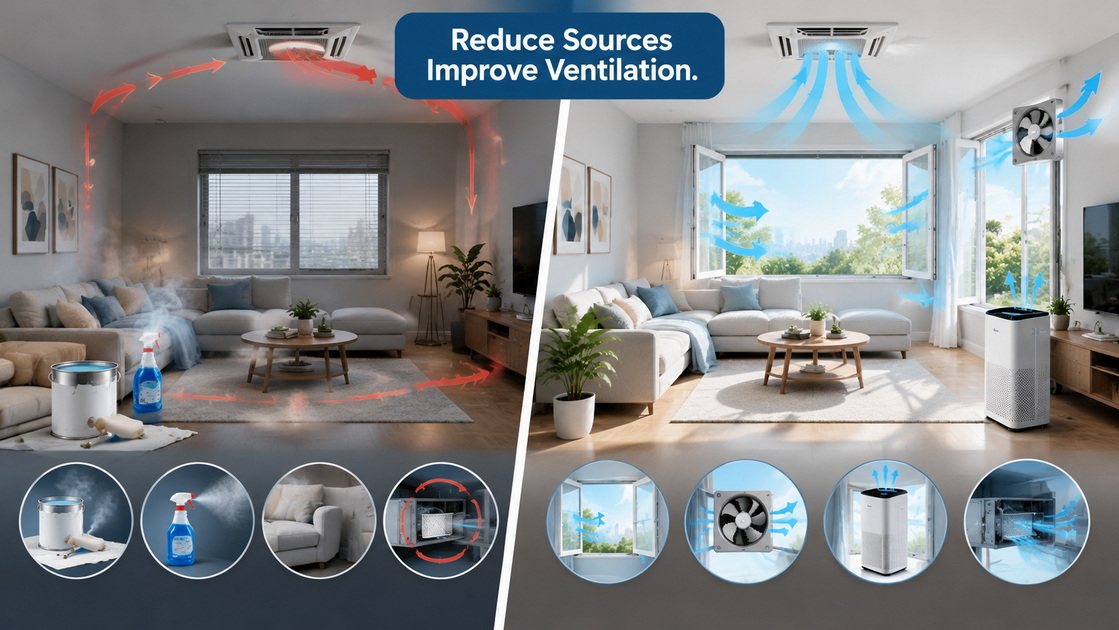
Before bringing products into your home, consider how they may affect indoor air.
When painting, remodeling, furnishing a room, or purchasing household cleaners:
- Choose low-VOC or low-emitting products when available.
- Read labels, instructions, and safety information before use.
- Use only the amount of product needed for the project.
- Avoid unnecessary fragranced products in small or poorly ventilated spaces.
- Consider allowing new furniture or materials to air out in a well-ventilated area before bringing them into bedrooms or living spaces.
- Select quality materials from manufacturers that provide clear product information.
A lower-emission product does not mean zero emissions. Good ventilation and proper handling are still important.
Ventilation helps dilute indoor pollutants and move them outdoors. It is especially helpful during painting, cleaning, refinishing, assembling furniture, installing flooring, or using adhesives.
Use this practical approach:
1. Read the product instructions before opening the container.
2. Work outdoors whenever possible.
3. Open windows when weather and outdoor conditions permit.
4. Create cross-ventilation by opening windows on opposite sides of the area.
5. Use exhaust fans that vent outdoors.
6. Keep interior doors closed to contain odors in the work area when appropriate.
7. Allow materials adequate time to cure before using the room.
8. Keep children, pets, and sensitive individuals away from active work zones.
Avoid assuming that running the central air conditioner or furnace will remove fumes. In many homes, the system may recirculate indoor air and move odors to other rooms.
Chemical storage is a frequently overlooked indoor air quality concern. Paints, solvents, pesticides, fuels, adhesives, automotive fluids, and strong cleaners can release vapors even when they are not actively being used.
Follow these good storage practices:
- Keep products in their original containers.
- Close lids and caps securely after every use.
- Never store chemicals near open flames, ignition sources, furnaces, or water heaters.
- Keep chemicals away from bedrooms, closets, and living areas.
- Avoid storing strong products near HVAC return grilles or air-handler closets.
- Use a detached shed or properly ventilated storage area when product instructions and local requirements allow.
- Dispose of old or unneeded chemicals through appropriate local hazardous-waste programs.
Never mix cleaners or chemicals unless the manufacturer specifically instructs you to do so.
An air purifier may be part of a broader plan for improving indoor air quality. However, not every air purifier is designed to address gaseous pollutants.
| Filter Type | Helps With | Limitations |
|---|---|---|
| HEPA filter | Dust, pollen, pet dander, smoke particles, and other airborne particles | Does not reliably remove gases or chemical vapors |
| Activated carbon filter | Some odors, gases, and VOCs | Effectiveness depends on the amount and quality of carbon media |
| Combined filtration system | Homes with both particle and odor concerns | Still cannot replace source control and ventilation |
A HEPA filter can be valuable for particle-related concerns such as dust, pollen, pet dander, and some smoke particles. However, VOCs are gases, so they require a different filtration approach.
For chemical odors and certain VOC concerns, an air cleaner with activated carbon or another gas-absorbent material may be more appropriate. Activated carbon works by adsorbing certain gases onto the surface of the filter media.
The amount of carbon matters. A small, thin carbon sheet may help reduce minor odors, but it may not perform well against a significant or persistent VOC source. Filters also become less effective over time and need replacement according to manufacturer instructions.
For most households, the strongest approach is:
Reduce the source+Improve ventilation+Use appropriate filtration
This combination is more practical than relying on one device or one filter alone.
A persistent odor does not always mean the HVAC system is the source. But it may mean the system is transporting the odor from somewhere else.
If a chemical, fuel, paint, musty, or garage-like smell appears when your heating or cooling system runs, it may be worth examining the airflow pathways in your home.
A heating and cooling professional may look for:
- Return-air ducts pulling air from an attic, garage, crawlspace, or storage area.
- Leaky ductwork near a chemical-storage location.
- Poorly sealed openings around air-handler equipment.
- Exhaust fans that do not vent properly outdoors.
- Humidity issues that affect comfort and material emissions.
- A clogged or incompatible HVAC filter.
- Airflow imbalances between rooms.
- Ventilation concerns in kitchens, bathrooms, laundry rooms, or remodeled areas.
Imagine a homeowner installs new flooring and notices a chemical smell that remains for several days. Opening windows helps temporarily, but the odor becomes stronger overnight or when the air conditioner starts.
The possible cause may be the flooring material, adhesive, or coating still curing. But the overall problem may also involve limited air exchange, closed windows, poor exhaust ventilation, or return-air pathways that pull air from the affected room and distribute it throughout the home.
A thoughtful evaluation considers the whole system:
- What materials were installed?
- How long ago was the project completed?
- Is the odor strongest in one room or throughout the home?
- Does it change when heating or cooling operates?
- Are there signs of limited ventilation or high humidity?
- Is the HVAC system drawing air from unintended areas?
This type of assessment helps identify practical improvements instead of treating every odor issue as a basic filter problem.
A professional evaluation may be useful when an odor persists, indoor air feels stale, or comfort changes after a renovation, new installation, or household-product use.
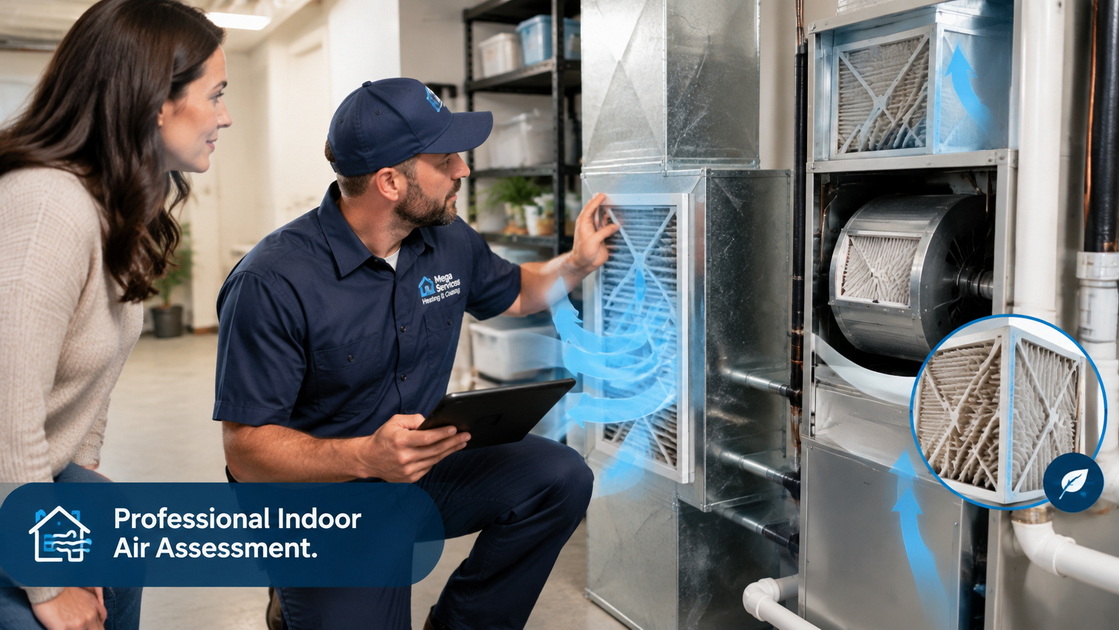
Mega Services Heating & Cooling can help homeowners assess heating, cooling, ventilation, filtration, humidity, ductwork, and airflow conditions that may influence indoor air quality.
A home-comfort evaluation may include:
- Checking HVAC system performance.
- Reviewing filter condition and compatibility.
- Inspecting airflow and return-air pathways.
- Looking for duct leakage or odor-transfer concerns.
- Evaluating ventilation options.
- Reviewing humidity-control performance.
- Discussing suitable indoor air quality equipment.
- Identifying practical steps for better comfort and healthier indoor air.
A safer, more comfortable home begins with understanding what is in the air and how it moves through your living space. Addressing VOC sources early, maintaining your HVAC system, and improving ventilation can help protect your household's comfort today and support better long-term indoor air conditions.
Mega Services Heating & Cooling is committed to helping families create comfortable, dependable, and energy-conscious homes through professional heating, cooling, maintenance, and indoor air quality support.
VOC stands for volatile organic compound. VOCs are gases released from certain solids and liquids, including paints, cleaners, adhesives, furnishings, building materials, personal-care products, and household chemicals.
Not all VOCs have the same effects. The level of concern depends on the chemical involved, the amount in the air, how long exposure lasts, and individual health factors. Some VOCs may cause short-term irritation or discomfort, while others may present more serious concerns under certain conditions.
Your HVAC system may be circulating air from a location with a chemical source, such as a recently painted room, new flooring, stored cleaning products, an attached garage, or a duct leak near an unconditioned space. The system may not be creating the odor, but it can move it through the home.
Most standard HVAC filters are designed to capture particles such as dust, pollen, and debris. They are not intended to remove gases or chemical vapors. Reducing the source and improving ventilation are usually the most important steps. Activated-carbon filtration may help with some odors and gaseous pollutants.
Opening windows can help increase ventilation when outdoor air conditions are suitable. Use exhaust fans that vent outdoors if available, follow the paint manufacturer's instructions, and allow the area enough time to dry and cure before regular use.
No. Low-VOC products may contain or release fewer VOCs than conventional alternatives, but they are not necessarily free of all emissions. Always review product instructions and use safe ventilation practices.
Regular maintenance can support better indoor air conditions by helping the system maintain airflow, manage humidity, operate efficiently, and avoid issues that may circulate dust, odors, or contaminants. Maintenance cannot eliminate VOCs from a source inside the home, but it is an important part of an overall indoor air quality plan.
Treat strong fuel, exhaust, or gasoline odors as a potential safety concern. Move away from the affected area if necessary, avoid ignition sources, and contact the appropriate qualified professional or emergency service based on the situation. Do not ignore persistent odors entering the home from a garage, storage area, or mechanical space.
1. U.S. Environmental Protection Agency.
2. U.S. Environmental Protection Agency.
3. U.S. Environmental Protection Agency.
4. U.S. Environmental Protection Agency.
5. U.S. Environmental Protection Agency.
6. ASHRAE.
7. California Department of Public Health.


