
Views: 210 Author: Mega Services Publish Time: 2026-10-11 Origin: Site


Content Menu
● Why Exhaust Fans Cause Heat Loss in Winter
>> Heat Loss While the Fan Is Running
>> Cold Drafts When the Fan Is Off
● Why Turning Off Ventilation Is Not the Solution
● How to Diagnose a Cold Bathroom Exhaust Fan
>> A Safe Five-Step Homeowner Check
● Practical Ways to Reduce Exhaust Fan Heat Loss
>> Repair the Backdraft Damper
>> Correct Duct Leaks and Condensation Risks
● Powerful Kitchen Exhaust Fans Need a Replacement-Air Plan
>> When to Request a Safety Assessment
● Can Heat Recovery Ventilation Reduce Heating Loss?
● A Better Repair Sequence: Diagnose Before Replacing
● Get Help Creating a Warmer, Better-Ventilated Home
>> 1. Do bathroom exhaust fans increase heating costs?
>> 2. Why does cold air come through my bathroom fan when it is off?
>> 3. How long should I run the bathroom fan after showering?
>> 4. Should I cover the exhaust fan during winter?
>> 5. Does a higher-CFM fan always work better?
>> 6. Can exhaust fans cause carbon monoxide problems?
Exhaust fan heat loss can make a bathroom or kitchen uncomfortable during cold weather. Your fan removes warm indoor air while operating, and a poorly closing damper can allow cold air into the duct after it stops. The answer is not to block the vent. It is to keep essential ventilation working while reducing avoidable drafts and unnecessary runtime.
At Mega Services Heating & Cooling, our focus is helping homeowners create safe, comfortable, energy-efficient living environments. Understanding how exhaust ventilation interacts with heating is part of that goal.
This guide explains why exhaust fans lose heat, how to investigate cold drafts safely, and which improvements deserve professional attention.
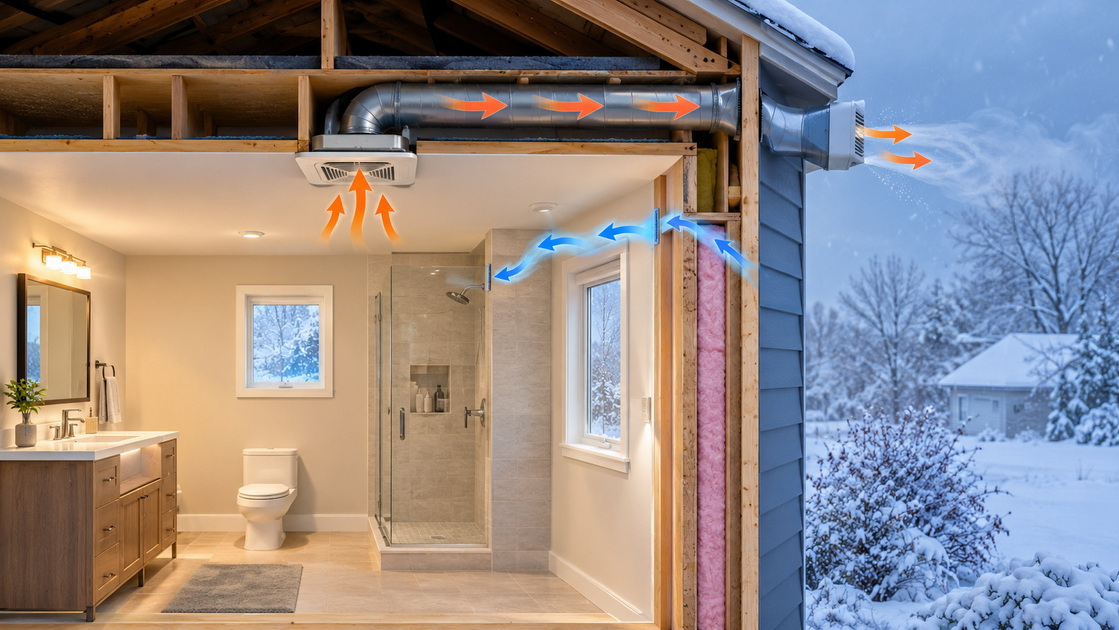
An exhaust fan can affect indoor comfort in two different ways. Distinguishing them helps you avoid replacing equipment that is working correctly.
A bathroom exhaust fan sends moisture-laden indoor air outdoors. A ducted kitchen range hood removes cooking pollutants, odors, and steam.
The air leaving your home must be replaced. Depending on the ventilation design, replacement air enters through intentional inlets or leaks around the building. In winter, your heating system must warm that incoming air. This is a normal consequence of exhaust ventilation, not necessarily a defect.
However, unnecessary operation increases the amount of conditioned air removed. A bathroom fan accidentally left running for hours creates a different heating burden than one operated only as needed for moisture control.
A backdraft damper is a movable flap designed to open during exhaust operation and close afterward.
If debris, corrosion, damage, or poor installation prevents closure, outdoor air can enter the exhaust duct. Even an undamaged damper may not provide a perfectly airtight seal.
A cold draft beneath an inactive fan therefore deserves investigation. The issue may involve the damper, exterior termination, or installation—not simply the fan motor.
Saving heat should not come at the expense of moisture control or indoor air quality.
Bathroom fans remove moisture produced by showers and baths. Without effective exhaust, condensation can accumulate and contribute to mold or material damage. Kitchen ventilation captures contaminants near their source and carries them outdoors when the hood is properly ducted.
The better objective is controlled ventilation:
- Run bathroom exhaust when bathing.
- Continue operation long enough to remove lingering moisture.
- Use a ducted range hood while cooking.
- Avoid unnecessary extended operation.
- Keep ducts and dampers functioning properly.
One important exception is a fan intentionally configured for continuous whole-house ventilation. Do not disable that operating mode without understanding the home's ventilation design. Continuous low-speed bathroom exhaust can serve a different purpose from an intermittent shower fan.
Before buying a replacement fan, identify when the discomfort happens. Timing provides useful clues, although it does not establish a diagnosis by itself.
| What you notice | Possible explanation | Appropriate next step |
|---|---|---|
| A draft while the fan is off | Damper leakage or closure failure | Have the damper and termination inspected |
| Colder rooms while a powerful hood runs | Replacement-air demand or depressurization | Request a ventilation and pressure assessment |
| Water dripping from the bathroom grille | Possible condensation in a cold exhaust duct | Have duct routing and insulation checked |
| Lingering moisture despite fan operation | Inadequate delivered airflow or restricted ductwork | Verify actual airflow and duct condition |
| Flapping sounds during windy weather | Wind-related damper movement | Inspect the termination and damper operation |
These are troubleshooting leads, not proof of a specific failure. Damper problems, restrictive ducts, condensation, and replacement-air issues require different corrections.
1. Record when the problem occurs. Note whether the fan is running, whether another exhaust appliance is operating, and whether conditions are windy.
2. Check the grille. Follow the manufacturer's instructions for cleaning accessible dust, and disconnect power before removing components.
3. Review the controls. Determine whether the fan uses a timer, humidity sensor, or continuous ventilation setting.
4. Observe an accessible exterior outlet from the ground. Look for obvious obstruction or damage. Do not climb onto a roof to inspect it.
5. Schedule an assessment if drafts, dripping, or poor moisture removal continue.
Do not tape over the grille, stuff insulation into the duct, or wedge a damper closed. Those actions defeat ventilation rather than repair it.
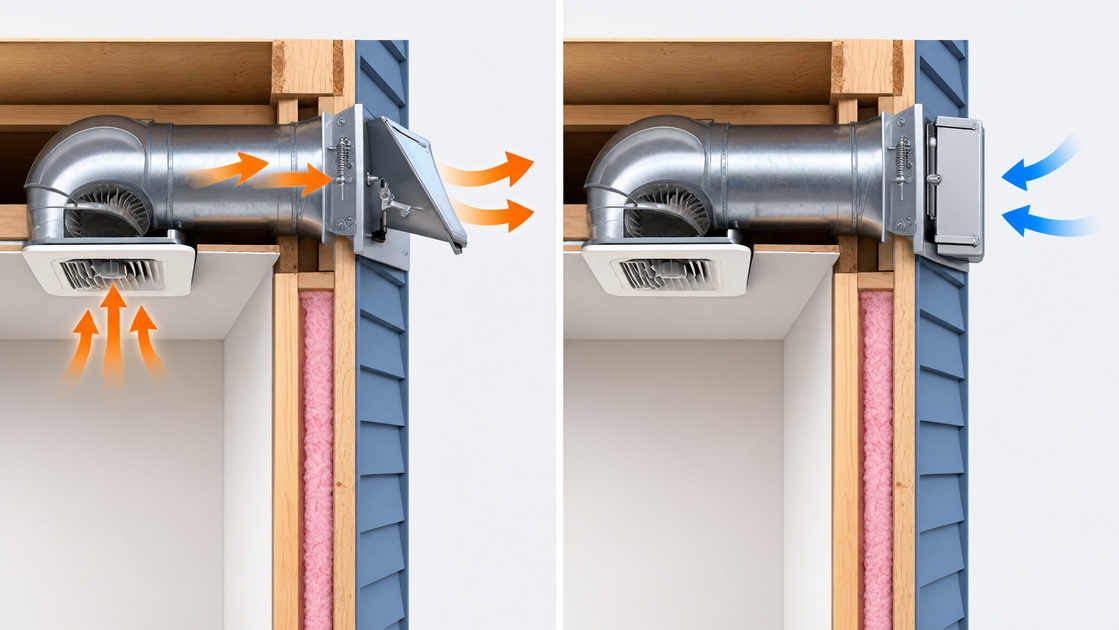
A damper should open under operating airflow and return to its closed position when the fan stops.
Inspection should consider debris, damaged hinges, corrosion, and interference from surrounding components. Replacing a faulty damper can address off-cycle leakage, but it does not eliminate the normal heating demand created by running exhaust ventilation.
The replacement must also remain compatible with the fan and duct. A closure that is difficult to open can compromise exhaust performance.
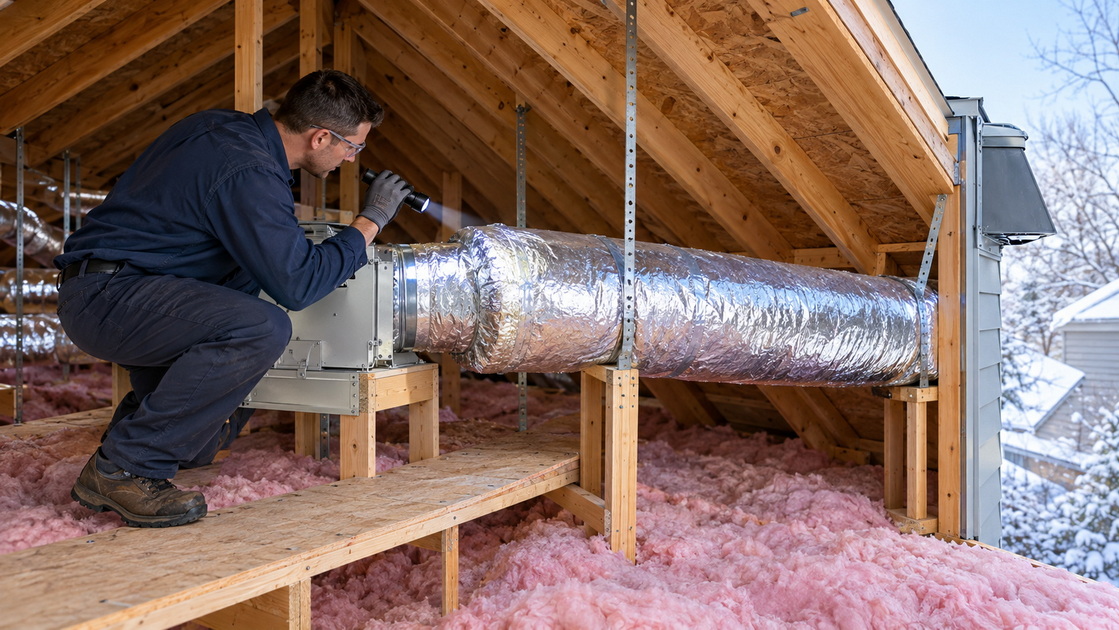
The exhaust path matters as much as the fan itself.
Ducts should terminate outdoors rather than discharge moisture into an attic or another concealed space. Short, smooth runs with limited bends support airflow. Appropriate joint sealing helps keep exhaust air in its intended path.
Duct insulation is particularly important where warm, humid exhaust passes through cold, unconditioned areas. It helps reduce condensation inside the duct; it is not a substitute for a working damper or properly designed termination.
Ask your technician to examine the complete route instead of treating the ceiling grille as the entire system.
The Home Ventilating Institute recommends leaving bathroom ventilation running for approximately 20 minutes after use. A timer can make that routine easier without relying on someone remembering to return and switch the fan off.
Humidity-responsive controls can also help manage operation. However, persistent dampness should prompt an airflow investigation rather than simply a longer timer setting.
Fans that provide continuous ventilation need controls appropriate to that role. A low-speed background setting and a higher shower setting may both be intentional.
A larger fan is not automatically a better answer.
For bathrooms up to 100 square feet, the Home Ventilating Institute generally recommends approximately one cubic foot per minute, or CFM, per square foot, with a minimum recommendation of 50 CFM for smaller bathrooms. Larger bathrooms require fixture-based consideration.
That makes an 80-square-foot bathroom a useful example: approximately 80 CFM is a starting point, not a guarantee of adequate installed performance.
Duct length, bends, restrictions, and installation details affect delivered airflow. Verify performance before assuming that a higher-capacity replacement will solve the problem.
A high-capacity range hood can remove substantial indoor air. Without a suitable replacement-air pathway, it may depressurize the home.
That matters for comfort, but it can also affect safety where naturally vented fuel-burning appliances are present. Depressurization can interfere with their draft and allow combustion gases to enter occupied spaces.
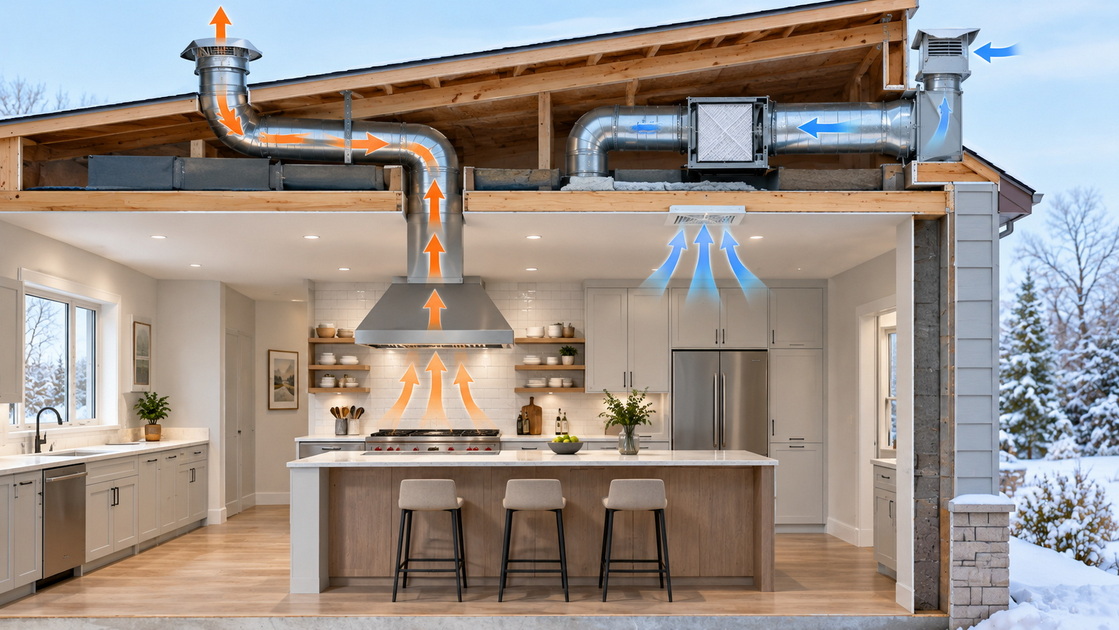
Makeup air is outdoor air intentionally supplied to replace air removed by exhaust equipment.
A properly designed arrangement considers airflow, controls, delivery location, and the comfort impact of cold incoming air. Building America guidance identifies kitchen exhaust above 400 CFM as an important makeup-air consideration. Applicable requirements depend on the locally adopted code and the home's appliance configuration.
Do not treat 400 CFM as a universal boundary between safe and unsafe operation. The home's tightness, other exhaust equipment, and combustion appliances also matter.
Ask for professional evaluation when installing a powerful range hood, changing the home's air tightness, or investigating suspected combustion-draft problems.
A technician should consider the hood alongside the furnace, water heater, fireplace, dryer, and other equipment that moves air or produces combustion gases.
If a carbon monoxide alarm sounds, move everyone outdoors immediately, call emergency services, and remain outside until responders permit reentry. Do not stay inside trying to locate the source.
A heat recovery ventilator, or HRV, exchanges heat between outgoing indoor air and incoming outdoor air. An energy recovery ventilator, or ERV, also transfers some water vapor. Both provide controlled ventilation while reducing the energy penalty of bringing in outdoor air.
These systems deserve consideration when a home needs a coordinated whole-house ventilation strategy—not simply because one bathroom feels cold.
Selection depends on climate, moisture conditions, installation requirements, and the home's overall ventilation needs. An HRV or ERV also does not repair a stuck bathroom damper.
Kitchen grease exhaust requires its own appropriate exhaust arrangement. Do not assume an existing range hood can be connected to a heat-recovery unit; equipment compatibility and installation requirements need professional review.
Consider an illustrative situation: a bathroom feels cold on windy evenings even though its fan is off.
Replacing the motor may accomplish little if the exterior damper remains stuck open. A more useful sequence is to inspect the termination, verify damper movement, check the duct, and then confirm exhaust performance after correction. This example illustrates the damper failure mechanism described in the original article; it is not a reported customer project.
Now consider a bathroom where moisture lingers despite a loud fan. Noise alone does not establish effective ventilation. Restrictive ductwork may be part of the problem, making airflow verification more useful than choosing another fan based only on its advertised capacity.
The practical lesson is simple: identify whether the problem is off-cycle leakage, insufficient exhaust, condensation, or pressure imbalance before selecting a repair.
Persistent cold drafts, recurring bathroom condensation, and comfort changes during range-hood operation deserve more than a temporary cover over the vent.
Contact Mega Services Heating & Cooling to discuss your heating and ventilation concerns. Describe when the problem occurs, which fans are operating, and whether you have noticed moisture or unusual drafts.
Ask about an assessment that considers heating performance, exhaust airflow, duct condition, damper operation, and any need for specialist ventilation or combustion-safety testing.
The goal is a repair plan that preserves necessary ventilation while addressing the cause of discomfort.
They can. Running fans remove heated indoor air, and incoming replacement air must be warmed. Actual cost depends on airflow, runtime, weather, heating efficiency, and the home's ventilation arrangement. A universal savings figure would be misleading.
A leaking or poorly closing backdraft damper is one possible cause. Debris, corrosion, and damaged parts can prevent closure. Have the exhaust path inspected before assuming the entire fan needs replacement.
Approximately 20 minutes is the Home Ventilating Institute's general recommendation. If moisture persists, investigate airflow and duct condition rather than relying solely on extended operation.
No. Blocking it prevents the system from removing moisture or cooking contaminants. Correct faulty dampers, duct problems, or controls instead of disabling necessary ventilation.
No. Capacity must suit the room and installation. Restrictive ducts can limit airflow, while powerful kitchen exhaust may require a coordinated makeup-air approach.
Under some conditions, exhaust-induced depressurization can interfere with naturally vented combustion appliances. This requires professional assessment. A sounding carbon monoxide alarm requires immediate evacuation and an emergency call, not homeowner troubleshooting.
- One Hour Heating & Air Conditioning, "Exhaust Fans May Contribute to Heat Loss," December 26, 2023. Original article used to identify the core topic, exhaust-fan functions, and damper failure mechanisms.
- Home Ventilating Institute, "Bathroom Ventilation." Guidance supporting bathroom airflow sizing and post-use operating time.
- Home Ventilating Institute, "Bathroom Exhaust Fans." Minimum capacity recommendations and fixture-based sizing guidance.
- Home Ventilating Institute, "How Much Ventilation Do I Need?" Guidance distinguishing intermittent operation from continuous ventilation.
- Pacific Northwest National Laboratory, Building America Solution Center, "Kitchen Exhaust Retrofit Duct Guide." Guidance on duct insulation, makeup air, and combustion-safety considerations.
- Pacific Northwest National Laboratory, Building America Solution Center, "Kitchen Exhaust Fans." Guidance on outdoor discharge, duct sealing, and depressurization risks.
- U.S. Department of Energy, Building Science Education, "HVAC Energy Recovery Ventilation." Explanation of HRV and ERV operation.
- American Society of Home Inspectors, "Bath Fan Venting Issues," January 21, 2025. Inspection-oriented guidance on exhaust routing, duct restrictions, and condensation.
- U.S. Consumer Product Safety Commission, "Carbon Monoxide Fact Sheet." Emergency response guidance for carbon monoxide alarms.
- Home Ventilating Institute, "Mechanical Ventilation Types." Explanation of exhaust ventilation, replacement air, and associated heating and cooling demand.
Article word count: approximately 1,900 words, including FAQs; excluding the editorial note, source notes, and description.


