
Views: 202 Author: Mega Services Publish Time: 2026-08-30 Origin: Site


Content Menu
● Why Choosing the Right Room Air Conditioner Matters
● How to Calculate the Right AC Size for Your Room
>> Room Air Conditioner BTU Guide
>> Adjust for Sunlight, Occupants, and Heat Sources
● Window Air Conditioner vs. Portable AC vs. Mini-Split
>> Ductless Mini-Split Systems
● How Humidity Affects Room Comfort
>> Signs Your Air Conditioner May Not Be Controlling Humidity
● Energy Efficiency and Long-Term Operating Costs
>> Simple Ways to Reduce Room Cooling Costs
● Noise, Airflow, and Placement
>> Choose a Location With Clear Airflow
>> Consider Noise Before You Buy
● Common Room Air Conditioner Mistakes
● Room Air Conditioner Maintenance Tips
>> Monthly and Seasonal Maintenance Checklist
● Choosing a Reliable Solution for Your Home
>> What size air conditioner do I need for a 200-square-foot room?
>> Is a portable air conditioner better than a window air conditioner?
>> Are ductless mini-splits worth it for one room?
>> Why does my room feel humid even when the AC is running?
>> How often should I clean my air conditioner filter?
>> Can I install a ductless mini-split myself?
>> What temperature should I set my air conditioner to save energy?
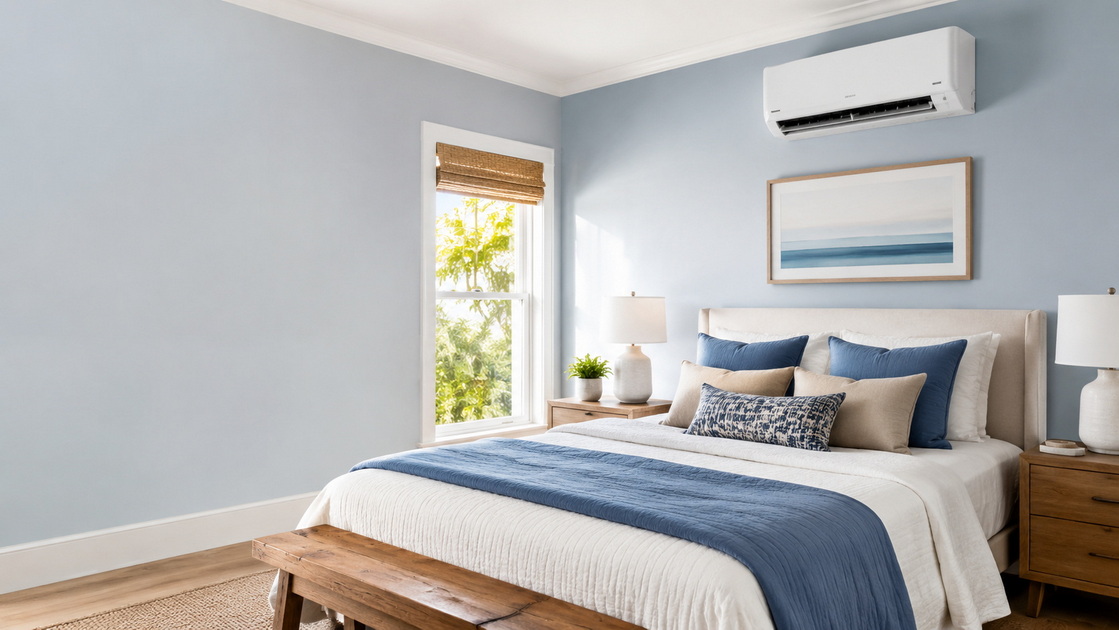
When summer temperatures rise, a hot and stuffy room can quickly affect sleep, productivity, and everyday comfort. Choosing the best air conditioner for a room is not just about buying the largest unit or selecting the lowest price. The right system should fit the room's size, sunlight exposure, insulation, usage, noise requirements, and long-term heating and cooling needs.
At Mega Services Heating & Cooling, we understand that every home has different comfort challenges. A warm upstairs bedroom, a sunroom that becomes unusable in the afternoon, a converted garage, a home office, or an older home without ductwork may require very different cooling solutions.
This guide explains how to choose the right room air conditioner, calculate the proper cooling capacity, compare common system types, and avoid mistakes that can lead to high energy costs or uneven comfort.
A properly selected air conditioner can make a room more comfortable, improve indoor air quality, and help control humidity during hot weather. However, choosing the wrong size or type of unit can create frustrating problems.
An air conditioner that is too small may run continuously without cooling the room effectively. It may struggle during the hottest part of the day and increase electricity use without delivering the comfort you expect.
An oversized air conditioner can also cause problems. It may cool the room too quickly and shut off before removing enough moisture from the air. The result can be a room that feels cool but still damp, sticky, or uncomfortable.
The best air conditioner for your room should help you achieve several goals:
- Maintain a consistent and comfortable temperature.
- Reduce humidity during warm weather.
- Keep energy consumption under control.
- Operate quietly enough for sleeping, working, or relaxing.
- Fit safely within the room and building layout.
- Match the way the room is used throughout the year.
For occasional use, a simple room AC may be enough. For a space used every day, such as a primary bedroom, home office, garage conversion, or sunroom, a more permanent heating and cooling solution may offer better performance and long-term value.
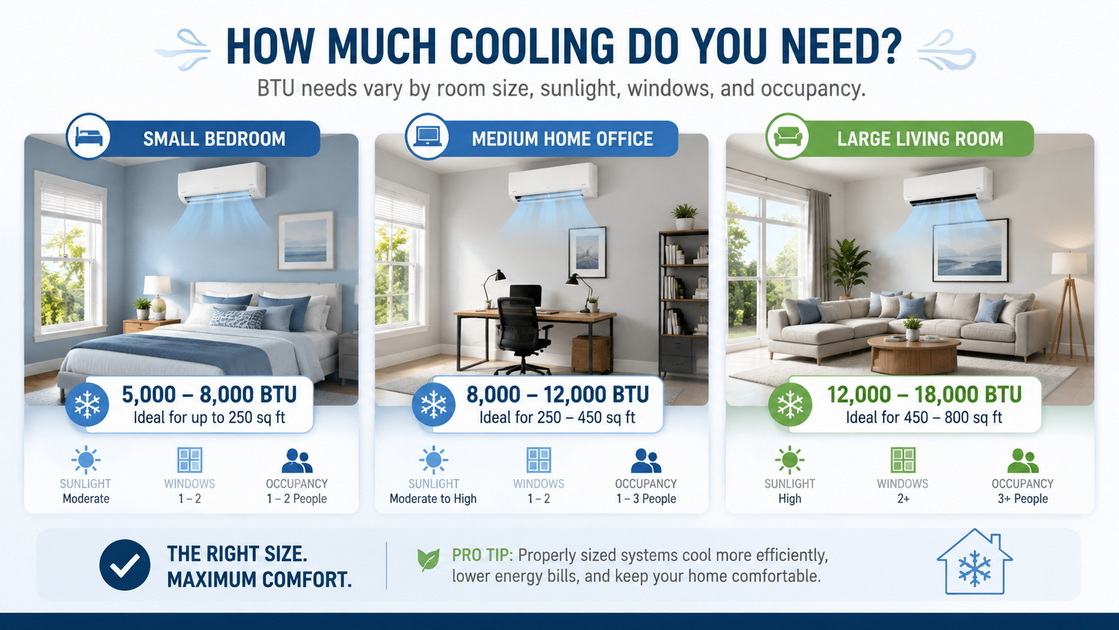
The first step in choosing an air conditioner is measuring the room. Cooling capacity is commonly measured in BTUs, or British Thermal Units. A higher BTU rating generally means the air conditioner can cool a larger space.
However, BTU capacity should not be selected by square footage alone. You should also consider ceiling height, sunlight, insulation, windows, occupants, appliances, and whether the room connects to other open areas.
If the room opens directly into a hallway, living room, kitchen, or other area without a door or full wall, you may need to account for the additional connected space. Cooling a single enclosed bedroom is very different from cooling part of an open floor plan.
Use the following table as a starting point when comparing room air conditioners.
| Room Size | Recommended Cooling Capacity | Common Room Types |
|---|---|---|
| Up to 150 sq. ft. | About 5,000 BTU | Small bedroom, nursery, small office |
| 150–250 sq. ft. | About 6,000 BTU | Bedroom, guest room, office |
| 250–350 sq. ft. | 7,000–8,500 BTU | Primary bedroom, den, medium office |
| 350–450 sq. ft. | 9,000–10,000 BTU | Large bedroom, living room |
| 450–550 sq. ft. | 10,000–12,500 BTU | Family room, larger open area |
| 550–700 sq. ft. | 12,000–14,000 BTU | Large living area, sunroom |
These recommendations are useful starting points, but real-world room conditions can change the required cooling capacity.
A room with direct afternoon sunlight may need more cooling capacity than a shaded room of the same size. Large west-facing windows, skylights, and dark roofing can also increase the cooling load.
Consider increasing cooling capacity if the room has:
- Strong direct sun exposure during the afternoon.
- Large windows or glass doors.
- High ceilings or vaulted ceilings.
- Poor insulation or noticeable air leaks.
- Multiple people using the room regularly.
- Computers, televisions, gaming systems, or other heat-producing electronics.
- A kitchen, laundry area, or workshop nearby.
- An upstairs location or space above a garage.
You may need less cooling capacity if the room is shaded, well insulated, rarely occupied, or located in a naturally cool part of the home.
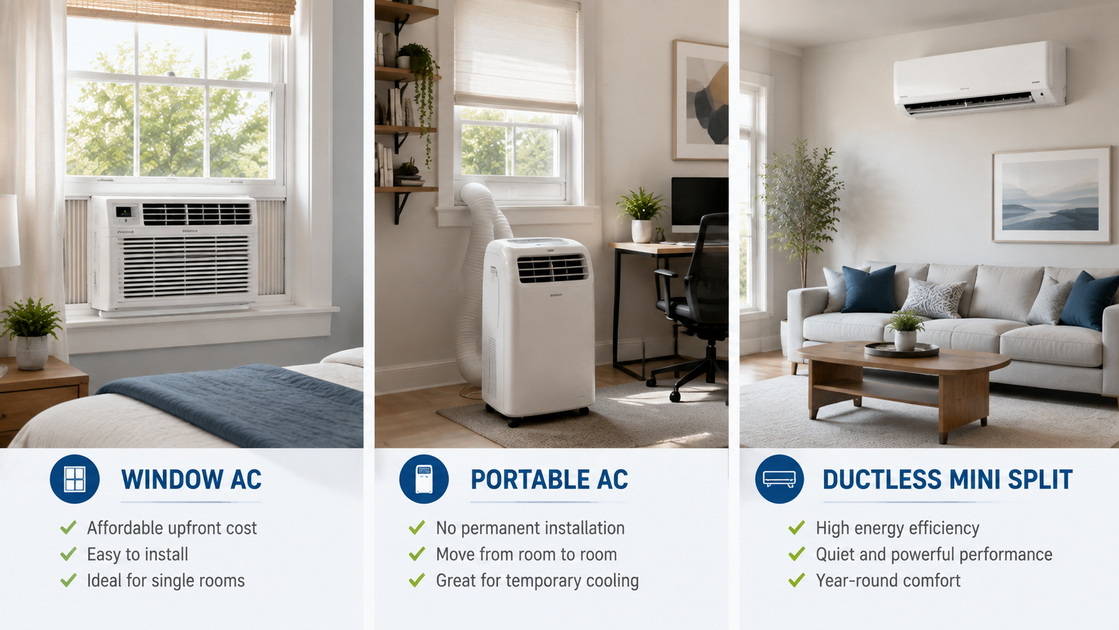
The best type of air conditioner depends on your home, your budget, the room layout, and how often you use the space.
| Air Conditioner Type | Best For | Main Benefits | Important Considerations |
|---|---|---|---|
| Window air conditioner | Bedrooms and small to medium rooms | Affordable, direct cooling, widely available | Blocks part of the window and may create more noise |
| Portable air conditioner | Renters and temporary cooling needs | Flexible placement and no permanent wall installation | Requires an exhaust hose and may be louder or less efficient |
| Ductless mini-split | Daily-use rooms and spaces without ductwork | Quiet, efficient, zoned heating and cooling | Requires professional installation and a higher initial investment |
| Through-the-wall AC | Rooms with a suitable wall sleeve | Keeps windows clear and offers a permanent installation | Requires the correct wall opening and proper support |
| Central HVAC improvement | Whole-home comfort issues | Can improve balanced comfort across multiple rooms | May require ductwork, airflow, or equipment upgrades |
A window air conditioner is one of the most common choices for cooling a single room. It can be a practical option for a guest bedroom, small living room, apartment, or seasonal space.
When choosing a window AC, consider the following features:
- Cooling capacity matched to the room size.
- Adjustable fan speeds.
- Directional air vents or louvers.
- Sleep mode and programmable timer settings.
- Easy-to-clean filters.
- Quiet operating modes for bedrooms.
- A secure installation kit and weather sealing materials.
A window unit should be installed securely and sealed carefully. Even small gaps around the frame can allow warm outdoor air to enter and cool indoor air to escape. This can make the system work harder and reduce comfort.
Portable air conditioners are popular because they can be moved from one room to another. They are often used in apartments, rental homes, offices, and rooms where a window-mounted unit is not allowed or practical.
A portable AC typically uses an exhaust hose that connects to a window kit. The hose moves hot air outside while the unit cools the room.
Before purchasing a portable air conditioner, check:
- Whether the window kit fits your window style.
- The length and routing of the exhaust hose.
- The noise level during compressor operation.
- The placement options near a window and power outlet.
- Whether the unit needs manual drainage or has self-evaporative features.
- The amount of floor space required.
- The cooling capacity for your specific room conditions.
Portable units can be convenient, but they may not be the best choice for daily use in a large room or a room with heavy heat gain. The exhaust hose can become warm, and poor sealing around the window kit can reduce efficiency.
A ductless mini-split is often one of the best long-term solutions for a room that needs reliable comfort throughout the year. These systems include an outdoor unit and one or more indoor air handlers connected by refrigerant lines.
Unlike a window AC or portable unit, a ductless mini-split can provide both cooling and heating. This makes it especially useful for rooms that need year-round temperature control.
Ductless mini-splits are often a strong choice for:
- Home additions.
- Finished garages.
- Converted garages.
- Attics.
- Sunrooms.
- Basements.
- Workshops.
- Home offices.
- Bedrooms with uneven temperatures.
- Older homes without existing ductwork.
A ductless system allows you to control the temperature in a specific room without relying entirely on the home's central HVAC system. This zoned approach can be especially valuable when one area of the house is consistently warmer or colder than the rest.
Temperature is only one part of comfort. Humidity can make a room feel warmer than it actually is, especially during summer.
When air contains too much moisture, you may notice that the room feels sticky, damp, or heavy. You may lower the thermostat but still feel uncomfortable. High indoor humidity can also contribute to condensation on windows, musty odors, and a greater risk of moisture-related issues.
A properly sized air conditioner should remove both heat and moisture from the indoor air.
- The room feels cool but still clammy.
- You notice condensation on windows or walls.
- The air conditioner turns on and off frequently.
- The room has a musty smell.
- Bedding, clothing, or towels feel damp.
- The thermostat shows a comfortable temperature, but the room still feels uncomfortable.
- You notice uneven cooling from one side of the room to the other.
An oversized air conditioner is one possible cause of poor humidity control. It may cool the air quickly and shut off before completing a longer cooling cycle that removes moisture.
Other possible causes include poor insulation, air leaks, dirty filters, improper installation, blocked airflow, drainage problems, or equipment issues that need professional attention.
The purchase price is important, but it should not be the only factor in your decision. A lower-cost unit may be more expensive over time if it uses excessive electricity, requires frequent repairs, or does not provide enough comfort.
When comparing room air conditioners, consider the total cost of ownership:
- Initial equipment cost.
- Installation costs.
- Electricity use.
- Filter replacement or cleaning needs.
- Repair and maintenance requirements.
- Expected lifespan.
- Noise level.
- Heating capability.
- Comfort consistency.
- Long-term replacement costs.
Energy-efficient models can help reduce energy use while maintaining comfort. Features such as variable-speed operation, programmable controls, sleep modes, timers, and smart temperature settings may also help reduce unnecessary cooling.
- Close blinds or curtains during direct sunlight.
- Seal gaps around windows and doors.
- Keep doors closed when cooling one room.
- Use ceiling fans to improve air circulation.
- Set the temperature as high as comfortably possible.
- Keep furniture away from air vents and air handlers.
- Clean or replace filters regularly.
- Keep portable AC hoses short and straight.
- Maintain proper seals around window AC units.
- Schedule regular maintenance for permanent HVAC equipment.
Small improvements can make a significant difference, especially in rooms that receive intense sunlight or have poor insulation.
The location of an air conditioner affects performance almost as much as the unit itself. This is especially important in bedrooms, nurseries, home offices, and living rooms.
Air conditioners need room to circulate air. Avoid placing furniture, curtains, shelving, or large decorations directly in front of the unit.
For a window air conditioner, make sure the indoor side has a clear path to distribute air across the room. For a portable AC, keep the unit close enough to the window so the exhaust hose remains short and straight.
For a ductless mini-split, the indoor air handler should be placed where it can distribute conditioned air across the space without blowing directly onto beds, desks, or seating areas.
Noise may not matter much in a rarely used storage room, but it can make a major difference in a bedroom or work-from-home space.
Before selecting a system, think about:
- Compressor noise.
- Fan speed noise.
- Vibration through a window frame or wall.
- Portable AC cycling sounds.
- Sleep-mode settings.
- The distance between the unit and the bed or desk.
- Outdoor-unit placement for ductless systems.
A quieter system can improve sleep quality, concentration, and overall satisfaction with the investment.
Many comfort problems are caused by installation, maintenance, or sizing mistakes rather than the air conditioner itself.
Avoid these common issues:
- Buying the largest unit instead of the right-sized unit.
- Ignoring direct sun exposure and large windows.
- Installing a window AC without proper sealing.
- Using an extension cord when it is not approved for the equipment.
- Blocking airflow with furniture or curtains.
- Using a portable AC with a long, bent, or poorly sealed exhaust hose.
- Forgetting to clean the air filter.
- Ignoring water leaks or drainage problems.
- Installing a ductless system without proper placement planning.
- Failing to address insulation, ductwork, or air leakage problems.
If a room never feels comfortable, the issue may not be solved by adding more cooling capacity. A professional evaluation can identify whether the real problem involves airflow, insulation, duct performance, refrigerant levels, equipment condition, or thermostat placement.
Routine maintenance helps protect performance, comfort, and energy efficiency. A dirty filter can restrict airflow and make an air conditioner work harder than necessary.
- Check the air filter monthly during periods of frequent use.
- Clean or replace filters according to the manufacturer's instructions.
- Keep vents and airflow paths clear.
- Remove dust and debris from the unit's exterior.
- Inspect window-unit seals before each cooling season.
- Check portable AC exhaust hoses for damage, kinks, or loose connections.
- Make sure condensate drains properly.
- Clear leaves and debris away from outdoor equipment.
- Listen for unusual noises during startup or operation.
- Arrange professional maintenance for ductless and central HVAC systems.
Do not attempt refrigerant repairs, electrical repairs, compressor work, or deep internal coil cleaning without qualified HVAC service. These tasks require proper training, tools, and safety procedures.
The right air conditioner should improve more than the temperature in one room. It should help create a safer, more comfortable, and more energy-conscious home environment.
A window AC may be ideal for a small bedroom or temporary cooling need. A portable unit may work well for flexible use in a rental or room with limited installation options. A ductless mini-split may be the best investment for a daily-use room, an addition, a converted garage, a sunroom, or a part of the home with ongoing comfort issues.
If one room stays too hot, too humid, too cold, or too uncomfortable compared with the rest of your home, the problem may require more than a larger portable unit. A complete assessment of the room, insulation, airflow, equipment condition, and heating and cooling needs can help identify the most practical solution.
Mega Services Heating & Cooling is committed to helping homeowners make informed decisions about installation, repair, maintenance, and long-term comfort. The right equipment, correctly sized and professionally maintained, can help your home feel more comfortable in every season.

A 200-square-foot room often needs an air conditioner around 6,000 BTUs. However, you may need more capacity if the room receives strong sunlight, has high ceilings, contains several people, includes heat-producing electronics, or connects to another open area.
It depends on the room and installation limitations. A portable AC is often more flexible because it can be moved and does not sit directly in a window. A window air conditioner may provide more direct cooling and can be a practical option when installed securely and sealed correctly.
A ductless mini-split can be worth the investment for a room that is used every day or needs heating and cooling throughout the year. It is especially useful for additions, garages, offices, sunrooms, attics, and rooms without existing ductwork.
Possible causes include an oversized air conditioner, short cooling cycles, dirty filters, blocked airflow, poor sealing, air leaks, drainage problems, or equipment issues. High humidity may also be caused by poor insulation or moisture entering from outside.
Check the filter every month during heavy use. Clean or replace it according to the manufacturer's instructions. A clean filter improves airflow and helps the system operate more efficiently.
Ductless mini-split systems are best installed by qualified HVAC professionals. Installation requires electrical work, refrigerant-line connections, drainage planning, pressure testing, equipment placement, and system commissioning.
Choose the highest indoor temperature that still feels comfortable for your household. Use blinds or curtains during sunny periods, improve sealing around windows and doors, keep filters clean, and use fans to improve airflow.
1.
Guidance on room air conditioner sizing, cooling-capacity adjustments, and energy-efficient room AC features.
2.
Information about ductless mini-split heat pumps, zoned heating and cooling, and energy-efficient system options.
3.
Federal purchasing guidance covering appropriate room AC sizing and energy-efficient equipment selection.
4.
Maintenance guidance covering air filters, system cleanliness, efficiency, and regular cooling-system care.
5.
Practical consumer guidance on matching window air conditioner capacity to room size and usage conditions.
6.
Original topic reference reviewed for room AC comparisons and homeowner-focused cooling considerations.


